
Cost of New Roof per Sq Ft: 2025 Top Secrets Revealed
Understanding Roofing Costs in 2025
The cost of new roof per sq ft typically ranges from $4.50 to $15.00 depending on material type, with most homeowners paying between $5.50 and $7.50 per square foot for standard asphalt shingle installation.
| Roofing Material | Cost Per Square Foot | Average Lifespan |
|---|---|---|
| Asphalt Shingles | $4.50 – $9.00 | 20-30 years |
| Metal Roofing | $9.00 – $17.00 | 40-70 years |
| Wood Shakes | $6.00 – $14.00 | 25-30 years |
| Clay/Concrete Tile | $12.00 – $21.00 | 50-100 years |
| Slate | $12.00 – $30.00 | 75-100+ years |
| Solar Shingles | $21.00 – $40.00 | 25-30 years |
When you’re facing a roof replacement, few numbers matter more than the cost per square foot. This seemingly simple figure actually encompasses numerous components that affect your total investment.
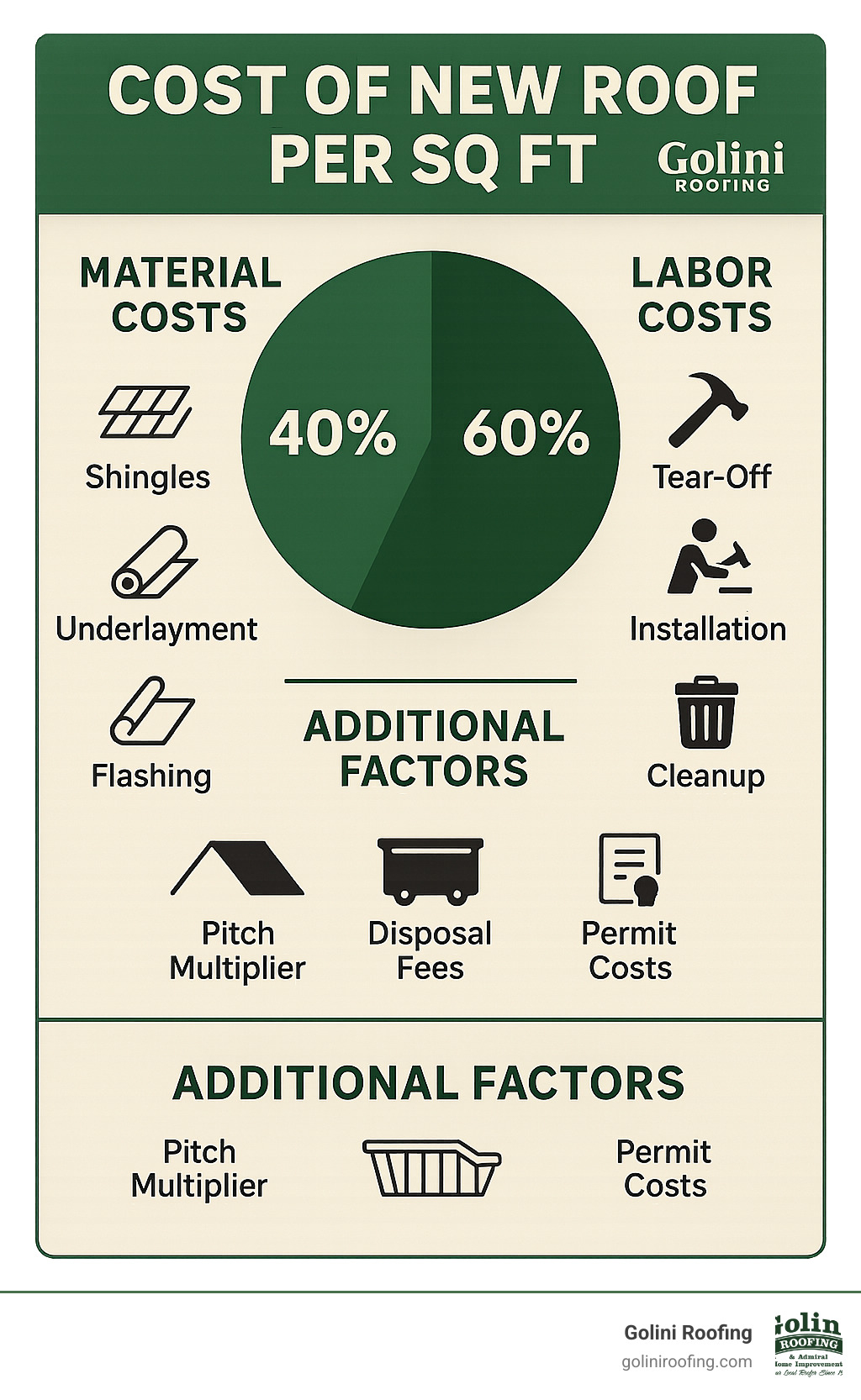
The cost of new roof per sq ft isn’t just about materials—it represents a complex calculation including labor (which typically accounts for 60% of the total cost), tear-off expenses, disposal fees, underlayment, flashing, ventilation, and permits. Understanding these components helps you budget accurately and avoid surprise expenses.
Most homeowners are shocked to find that their 1,700 square foot home doesn’t translate to 1,700 square feet of roofing. Roof pitch, overhangs, and complexity all increase the actual surface area—and cost—of your roof replacement.
I’m Jack Golini, owner of Golini Roofing with over 40 years of experience helping homeowners steer the cost of new roof per sq ft across Wakefield and surrounding Massachusetts communities. My team and I have installed thousands of roofs, giving us unique insight into the true costs behind quality roofing installation.
The “Cost of New Roof per Sq Ft” Formula Explained
When you chat with roofing contractors like us, you’ll quickly notice we speak in “squares” rather than square feet. One roofing square equals 100 square feet of roof area. This isn’t just contractor jargon—it’s an industry standard that helps us calculate materials more efficiently.
The basic formula seems straightforward:
Total Cost = Roof Square Footage × Cost per Square Foot
But in reality, your cost of new roof per sq ft involves several more factors. Here’s what’s actually happening behind the scenes:
Total Cost = (Home Footprint × Pitch Multiplier) × (Material Cost + Labor Cost + Additional Fees)
Your home’s footprint might be 2,000 square feet, but with a typical pitch multiplier of 1.12, your actual roof surface area jumps to 2,240 square feet. At $6.50 per square foot for quality asphalt shingles, you’re looking at around $14,560 for a complete replacement.
Most homeowners are surprised to learn that materials typically account for only about 40% of the total cost of new roof per sq ft, while labor makes up the remaining 60%. That’s because proper installation is just as crucial as the materials themselves—especially in our Massachusetts climate with its harsh winters and occasional Nor’easters.
| Roof Size (sq ft) | Low-End Cost ($4.50/sq ft) | Average Cost ($6.50/sq ft) | High-End Cost ($9.00/sq ft) |
|---|---|---|---|
| 1,000 | $4,500 | $6,500 | $9,000 |
| 1,500 | $6,750 | $9,750 | $13,500 |
| 2,000 | $9,000 | $13,000 | $18,000 |
| 2,500 | $11,250 | $16,250 | $22,500 |
| 3,000 | $13,500 | $19,500 | $27,000 |
Note: These are average costs based on internet data and not actual costs for Golini Roofing.
Another major factor affecting your cost of new roof per sq ft is whether you’re doing a complete tear-off or an overlay. While overlays (installing new shingles over existing ones) might save you $1-$3 per square foot initially, they often come with hidden costs. Many manufacturers won’t honor warranties on overlaid roofs, and the extra weight can shorten your roof’s lifespan. At Golini, we generally recommend tear-offs for long-term peace of mind.
What Does “Cost of New Roof per Sq Ft” Really Include?
When I quote a cost of new roof per sq ft to homeowners in Wakefield and surrounding areas, I’m including much more than just the shingles you see from your driveway.
Your materials (about 40% of cost) include quality shingles, of course, but also underlayment that protects your roof deck, ice and water shield (absolutely essential for Massachusetts winters), starter shingles along the edges, and ridge cap shingles that provide a finished look while protecting the peak.
Labor makes up the majority (about 60%) of your cost of new roof per sq ft. This covers the careful tear-off of existing materials, proper installation techniques, thorough site cleanup, and project management to ensure everything runs smoothly. At Golini Roofing, our hand-nailing technique takes a bit more time than pneumatic nail guns, but provides superior fastening that stands up to our local weather conditions.
Your quote should also include proper flashing around chimneys, valleys, and walls, ventilation components like ridge vents and soffit vents, drip edge to protect your fascia, and quality fasteners that won’t back out over time.
Don’t forget about disposal fees ($0.40-$0.90 per square foot), permit fees ($50-$400 depending on your town), potential deck repairs if we find water damage during tear-off (typically adding $1-$4 per square foot to affected areas), and warranty costs.
For more detailed information about calculating your specific roof replacement cost, you can learn more about calculating roof replacement cost.
“Cost of New Roof per Sq Ft” vs. Repair Pricing
Sometimes, a complete roof replacement isn’t necessary. When I visit homes in Wakefield or Reading for estimates, I often evaluate whether repairs might be more economical than replacement.
Roof repairs typically run $400-$2,000 total, while partial replacements might cost $1,000-$5,000 for a section. Compare that to $5,700-$16,000+ for a full replacement on an average home, and you can see why this decision matters.
Repairs make the most sense when your roof is relatively young (less than 10-15 years old), the damage is limited to a small area, your underlying structure is sound, and matching materials are still available. I’ve seen plenty of roofs in Burlington and Stoneham that just needed some targeted TLC rather than a complete overhaul.
However, the math changes when your roof is approaching the end of its lifespan, damage is widespread, you already have multiple layers installed, or you’re dealing with recurring leaks. In these cases, the long-term economics favor replacement.
Many of my customers find the “25% rule” helpful: if repairs would cost more than 25% of a new roof, replacement usually makes more financial sense in the long run. Plus, a new roof offers a better return on investment—typically around 60% of the cost is recouped in home value, which is nothing to sneeze at when Massachusetts property values are concerned.
Material-by-Material Price Breakdown (2025 Averages)
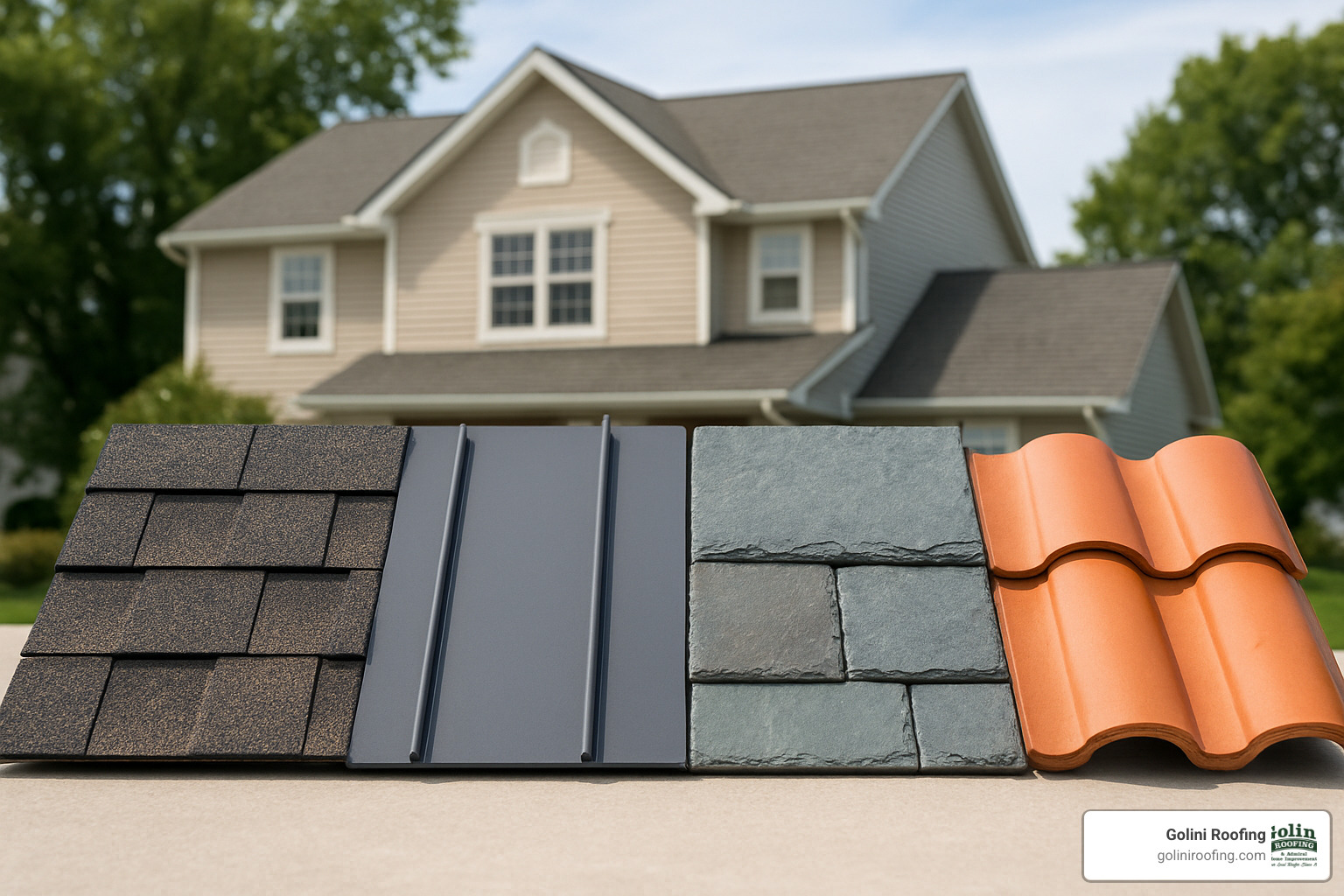
When you’re planning your roofing budget, understanding the cost of new roof per sq ft across different materials can help you make the best decision for your home and wallet. Let’s break down what you can expect to pay in 2025, along with the lifespan and return on investment for each option.
Asphalt & Architectural Shingles
Asphalt remains America’s favorite roofing material for good reason – it offers solid performance at an accessible price point. About 70% of American homes sport these familiar shingles.
Standard 3-tab asphalt shingles run about $4.50-$6.00 per sq ft installed, with materials alone costing just $0.80-$1.30 per sq ft. They’ll typically last 15-20 years, making them perfect for budget-conscious homeowners or those planning to sell in the near future.
Step up to architectural (dimensional) shingles at $5.00-$9.00 per sq ft installed, and you’ll get a more textured look plus an extended 20-30 year lifespan. The materials themselves cost $1.00-$1.50 per sq ft.
For those wanting something special, premium designer shingles cost $6.00-$11.00 per sq ft installed and last 25-35 years. These high-end products (materials: $1.50-$3.00 per sq ft) offer distinctive patterns that can mimic slate or wood.
While overlaying new shingles on existing ones can save $1-$3 per square foot, at Golini Roofing we typically recommend complete tear-offs. Starting fresh ensures we catch any hidden deck problems and maximizes your roof’s lifespan.
From a return on investment perspective, a new asphalt roof typically recoups about 56.9% of its cost in added home value – not bad for a practical necessity!
Metal Roofing Options
Metal roofing has surged in popularity as homeowners recognize its impressive longevity and energy efficiency. Though the upfront cost of new roof per sq ft is higher, the long-term value often makes it worthwhile.
Exposed fastener (ribbed) panels represent the entry-level option at $5.50-$8.50 per sq ft installed. These simple systems use visible screws to attach the panels, with materials costing $2.00-$3.50 per sq ft. They’ll typically perform well for 25-40 years.
Standing seam metal roofing steps up the quality and aesthetics considerably at $9.00-$17.00 per sq ft installed. The hidden fastener system creates clean vertical lines and superior weather protection for 40-70 years. Materials alone run $3.50-$7.00 per sq ft.
Metal shingles offer a middle ground at $7.00-$14.00 per sq ft installed, with materials costing $3.00-$6.00 per sq ft. With a 30-50 year lifespan, they provide the traditional look of shingles with metal’s durability.
The metal itself matters too: steel is most common and moderately priced, aluminum resists coastal corrosion at a slightly higher price, while copper provides best luxury at $15-$35 per sq ft but develops a beautiful green patina over time.
One often-overlooked benefit: metal roofs can slash cooling costs by 10-25% thanks to their reflective properties, making them increasingly popular even in Massachusetts.
The ROI for metal roofing averages about 48.1% of the installation cost, but the energy savings and minimal maintenance requirements add significant value over time.
Premium Tiles, Slate & Exotic Systems
For discriminating homeowners seeking distinctive looks and maximum longevity, premium materials deliver exceptional performance despite higher initial costs.
Concrete tiles bring Mediterranean charm at $12.00-$18.00 per sq ft installed (materials: $3.00-$5.00 per sq ft) and last 50+ years. Their substantial weight often requires structural assessment before installation.
Clay tiles step up the luxury factor at $15.00-$21.00 per sq ft installed. The materials themselves cost $4.00-$7.00 per sq ft, but their 75-100+ year lifespan makes them a once-in-a-lifetime investment for many homes.
Natural slate represents the pinnacle of roofing materials at $15.00-$30.00 per sq ft installed. These stone tiles (materials: $6.00-$15.00 per sq ft) can literally outlast your home with a 75-200 year lifespan. The distinctive look of slate adds tremendous curb appeal to historic or luxury homes.
Before choosing these premium options, we always recommend a structural assessment. Their significant weight often requires additional support, adding $1,000-$10,000 to your project. However, for homes that can accommodate them, these materials offer best durability and distinctive character.
Emerging Alternatives: Solar & Synthetics
Innovation continues to transform the roofing industry with exciting new options that blend aesthetics with advanced functionality.
Synthetic slate and shake materials deliver premium looks without structural concerns at $10.00-$18.00 per sq ft installed. Made from advanced polymers (materials: $4.00-$6.00 per sq ft), these products mimic natural materials but weigh much less and last 40-50 years.
Solar shingles represent the cutting edge at $21.00-$40.00 per sq ft installed. While materials cost $15.00-$25.00 per sq ft, the 30% federal tax credit significantly offsets this investment. Though they generate less power than traditional panels, the integrated appearance appeals to many homeowners seeking both energy production and aesthetics over their 25-30 year lifespan.
Green or living roofs bring nature to your home at $15.00-$30.00 per sq ft installed. These plant-covered systems (materials: $10.00-$20.00 per sq ft) provide excellent insulation and stormwater management while lasting 40+ years with proper care. They’re particularly valuable in urban settings where greenspace is limited.
Note: These are average costs based on internet data and not actual costs for Golini Roofing.
In our 40+ years of experience at Golini Roofing, we’ve installed every type of roofing material across Massachusetts. While prices vary based on your specific home and needs, our hand-nailing technique ensures whatever material you choose will be installed with meticulous care for maximum durability in our challenging New England climate.
Regional & Structural Cost Drivers You Can’t Ignore
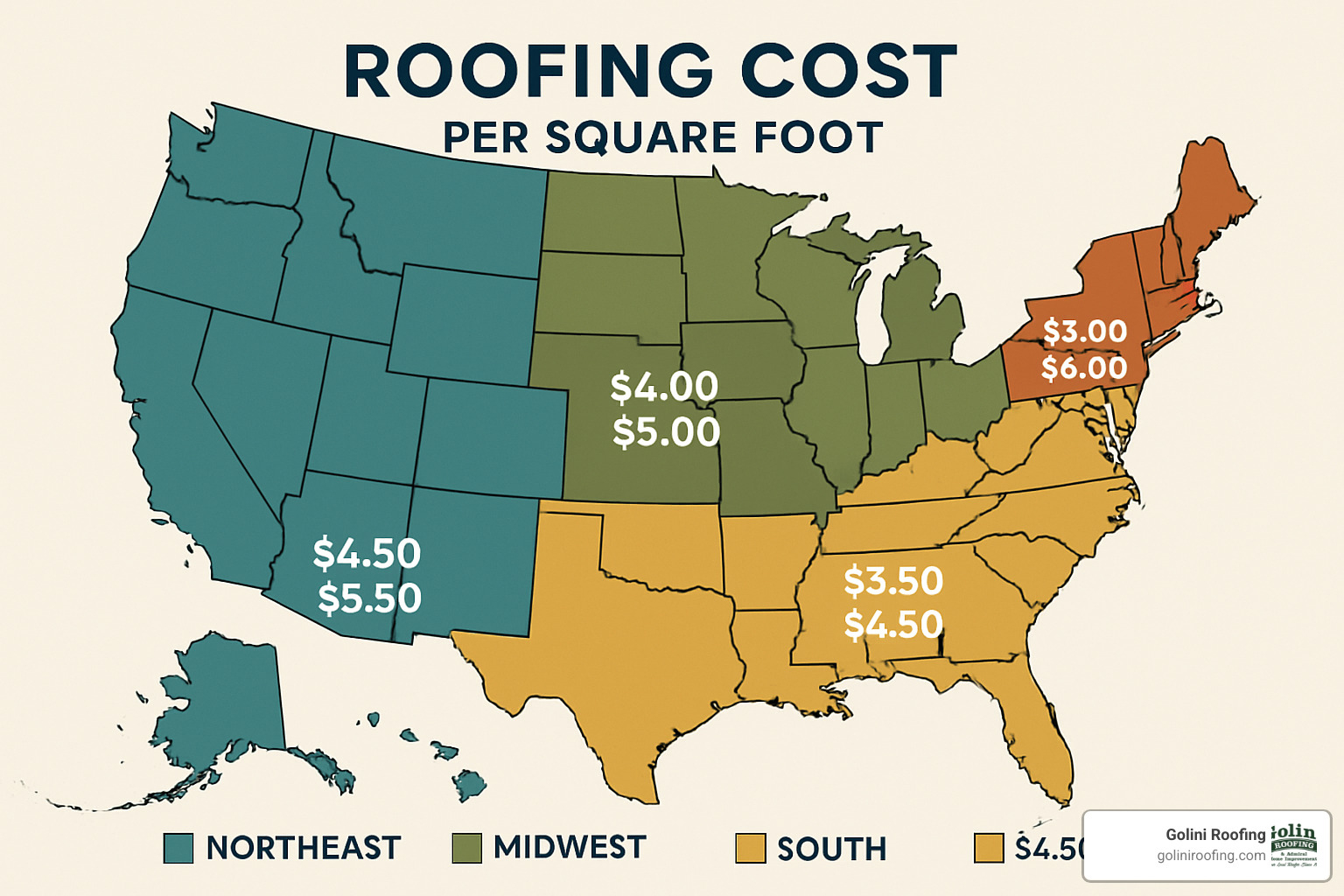
When it comes to roofing, your zip code matters almost as much as your shingle choice. The cost of new roof per sq ft isn’t just about materials—it’s deeply influenced by where you call home.
Here in the Northeast (including our Massachusetts service area), expect to pay between $6.50-$10.50 per square foot. Why so much? We’re dealing with strong union labor rates, strict building codes that require ice-and-water shield (a must for our harsh winters), higher transportation costs for materials, and some of the highest disposal fees in the nation. Plus, our shorter installation season means contractors need to make their living in fewer months.
Down in the Midwest, homeowners typically see more moderate pricing at $5.00-$8.00 per square foot. They benefit from reasonable labor costs and a more competitive contractor market, though they still need to account for severe weather considerations like hail and wind resistance.
Our friends in the South enjoy the lowest average costs at $4.50-$7.00 per square foot, thanks to lower labor rates and a year-round installation season. That said, coastal areas face unique challenges with hurricane-resistant requirements that can drive prices up.
Out West, costs climb back up to $5.50-$9.50 per square foot, with higher labor costs (especially near the coast), plus special considerations for wildfires, earthquakes, and increasingly strict energy efficiency requirements.
For us in Massachusetts, several unique factors influence what you’ll pay for your new roof:
“I’ve been installing roofs in Massachusetts for over 40 years,” says Jack Golini, “and our local building codes aren’t just bureaucracy—they’re protecting homes from our unique weather challenges.”
Those challenges include heavy snow load requirements, mandatory ice dam prevention measures, and coastal wind considerations for homes near the Atlantic. Our higher labor costs and stricter permitting processes also factor into your bottom line.
Beyond your GPS coordinates, your home’s structural features can significantly impact your roofing investment:
Roof height adds 15-30% to your cost when we’re dealing with multi-story homes. That’s not contractors being greedy—it’s the reality of additional safety equipment, slower work pace, and more complex material delivery.
Limited accessibility around your property can add 5-15% when our trucks and dumpsters can’t get close to your home. Those charming narrow streets in historic Massachusetts towns? They’re picturesque but problematic for roofing logistics.
Architectural features like valleys, dormers, skylights, and chimneys require special attention. Each cut and flashing area adds complexity and cost—but also character to your home.
For the most current research on how these factors affect cost versus value in home improvements, check out the latest research on cost vs value.
How Pitch, Complexity & Stories Add Dollars per Sq Ft
The steepness of your roof might be the most significant cost factor you’ve never considered. Your roof’s pitch dramatically impacts the cost of new roof per sq ft:
A gentle low pitch roof (0/12 to 3/12) serves as our baseline cost. As we move to a medium pitch (4/12 to 6/12), add 5-10% ($0.25-$0.90 per sq ft) to your budget. This increases substantially for steep pitch roofs (7/12 to 12/12), adding 15-25% ($0.75-$2.25 per sq ft). For those dramatic extreme pitch roofs exceeding 12/12, prepare for a 25-40% premium ($1.25-$3.60 per sq ft).
“Steep roofs aren’t just about looking grand,” Jack Golini explains. “They require specialized safety equipment, slow down our installation pace, and demand more skilled labor. Our hand-nailing technique becomes especially valuable on these steeper pitches where secure fastening is absolutely critical.”
Multi-story homes compound these challenges. When we’re working 20+ feet off the ground, we need additional scaffolding, more complex material transportation solutions, and extra safety precautions. These aren’t optional—they’re essential for both worker safety and quality installation.
At Golini Roofing, we’ve handled everything from shallow-pitched ranch styles in Wakefield to the steep Victorian roofs in Winchester. That experience means we can steer these complexities efficiently, even when they inevitably affect your bottom line.
Permit, Code & Warranty Requirements by Region
The paperwork behind your project adds dollars to your cost of new roof per sq ft in ways that aren’t immediately obvious.
Permit fees range from $50 in smaller towns to $400+ in larger municipalities. These aren’t just arbitrary taxes—they ensure your roof meets local safety standards through inspections, which may require multiple visits and extend your project timeline.
The International Residential Code (IRC 2021) establishes baseline requirements, but Massachusetts adds important local modifications. Our climate demands an ice barrier membrane on all eaves extending 24″ inside the exterior wall line—a crucial defense against our notorious ice dams. Coastal areas require improved fastening schedules to withstand nor’easters and Atlantic winds, while many municipalities mandate Class A fire ratings.
“These code requirements aren’t suggestions,” notes Jack Golini. “They’re essential protections for your home that we take very seriously.”
Warranty considerations also affect your investment. Standard manufacturer warranties typically cover materials for 25-50 years, while extended warranties might add $500-$2,000 to your project cost. At Golini Roofing, we stand behind our craftsmanship with a 10-year workmanship warranty—longer than many competitors.
Smart homeowners can offset some costs through insurance discounts. Class 4 impact-resistant shingles can reduce homeowners insurance premiums by 5-25%. Cool roofs may qualify for energy efficiency rebates, while fire-resistant materials can lower premiums in wildfire-prone areas.
Understanding these regional factors helps explain why online calculators often miss the mark when estimating your true roofing costs. Your home’s unique combination of location, structure, and local requirements creates a fingerprint that only an experienced local contractor can accurately assess.
Money Matters: Insurance, Financing & Smart Savings
Let’s face it – a new roof isn’t cheap. But before you start sweating about the cost of new roof per sq ft, take a deep breath. There are several smart strategies to manage this significant investment without emptying your savings account.
Turning Storm Damage Into Lower Out-of-Pocket Cost per Sq Ft
Mother Nature can be tough on Massachusetts roofs, but storm damage might actually be your ticket to a more affordable replacement.
When your roof takes a beating from wind, hail, or fallen tree limbs, your homeowner’s insurance could be your financial lifeline. Start by thoroughly documenting everything – snap clear photos of all visible damage, note the exact date of the storm, and keep receipts for any emergency repairs you’ve made. These details will be gold when filing your claim.
Contact your insurance company promptly – ideally within a year of the damage. Most Massachusetts policies cover sudden, accidental damage but won’t touch normal aging or neglect. That’s why timing matters. The longer you wait, the easier it is for insurers to argue the damage came from something else.
Here’s where experience really pays off: have a professional contractor (like us!) present during your adjuster visit. We’ve worked with countless insurance adjusters over our 35+ years and know exactly what they’re looking for. We can help ensure all legitimate damage gets properly documented and included in your claim.
Understanding your policy’s fine print makes a huge difference too. Most insurance companies use one of two methods to calculate payouts:
– Actual Cash Value (ACV): What your old roof was worth (original cost minus depreciation)
– Replacement Cost Value (RCV): What a new roof actually costs (much better for you!)
Be aware that insurance companies typically depreciate roof value aggressively as it ages. A 5-year-old roof might see 20% depreciation, while a 15-year-old roof could face a painful 50-70% reduction in covered value. Many Massachusetts insurers now require inspections at policy renewal time if your roof is over 15 years old – another reason not to delay necessary replacements.
Financing Your Roof Without Busting the Budget
If insurance isn’t covering your new roof (or you’re facing a hefty deductible), don’t worry – you’ve got options.
Home equity solutions often provide the lowest interest rates since your home serves as collateral. A fixed-rate home equity loan gives you a lump sum with predictable payments, while a HELOC offers flexible borrowing with variable rates. Cash-out refinancing replaces your existing mortgage with a larger one, using the difference for your roof. These options typically make the most financial sense for larger projects.
Personal loans offer a solid middle ground – no collateral required, but interest rates (typically 6-36% depending on your credit) higher than equity options. With fixed terms usually between 3-7 years, they provide structured payments that help with budgeting.
Many homeowners don’t realize that contractor financing can be surprisingly affordable. At Golini Roofing, we understand that a new roof is a significant investment, which is why many quality contractors offer payment plans, sometimes with promotional 0% interest periods. Just be careful with deferred interest offers – read the fine print carefully.
Credit cards work best for smaller projects or to cover just part of the cost, especially if you can take advantage of a 0% promotional period and pay it off before higher interest kicks in.
Don’t overlook government programs either. FHA Title I loans are specifically designed for home improvements, and various local weatherization assistance programs might help, especially if you’re upgrading to energy-efficient materials.
Beyond financing, consider these smart savings strategies:
Schedule your roof replacement during our slower seasons (late fall or winter in Massachusetts) and you might save 5-10%. The weather may be chillier, but so are the prices! Bundle your roofing project with other exterior work like gutters or siding for potential contractor discounts. And while it’s always wise to compare multiple quotes, be wary of estimates that seem too good to be true – they usually are.
Sometimes the smartest savings come from thinking long-term. Premium materials with longer lifespans often deliver better value despite higher upfront costs. A quality metal roof might cost twice as much as basic asphalt shingles initially, but could last three times as long while reducing energy costs.
For more detailed information about financing options and roof replacement costs, visit our page on roof replacement cost.
Measuring & Comparing Quotes Like a Pro
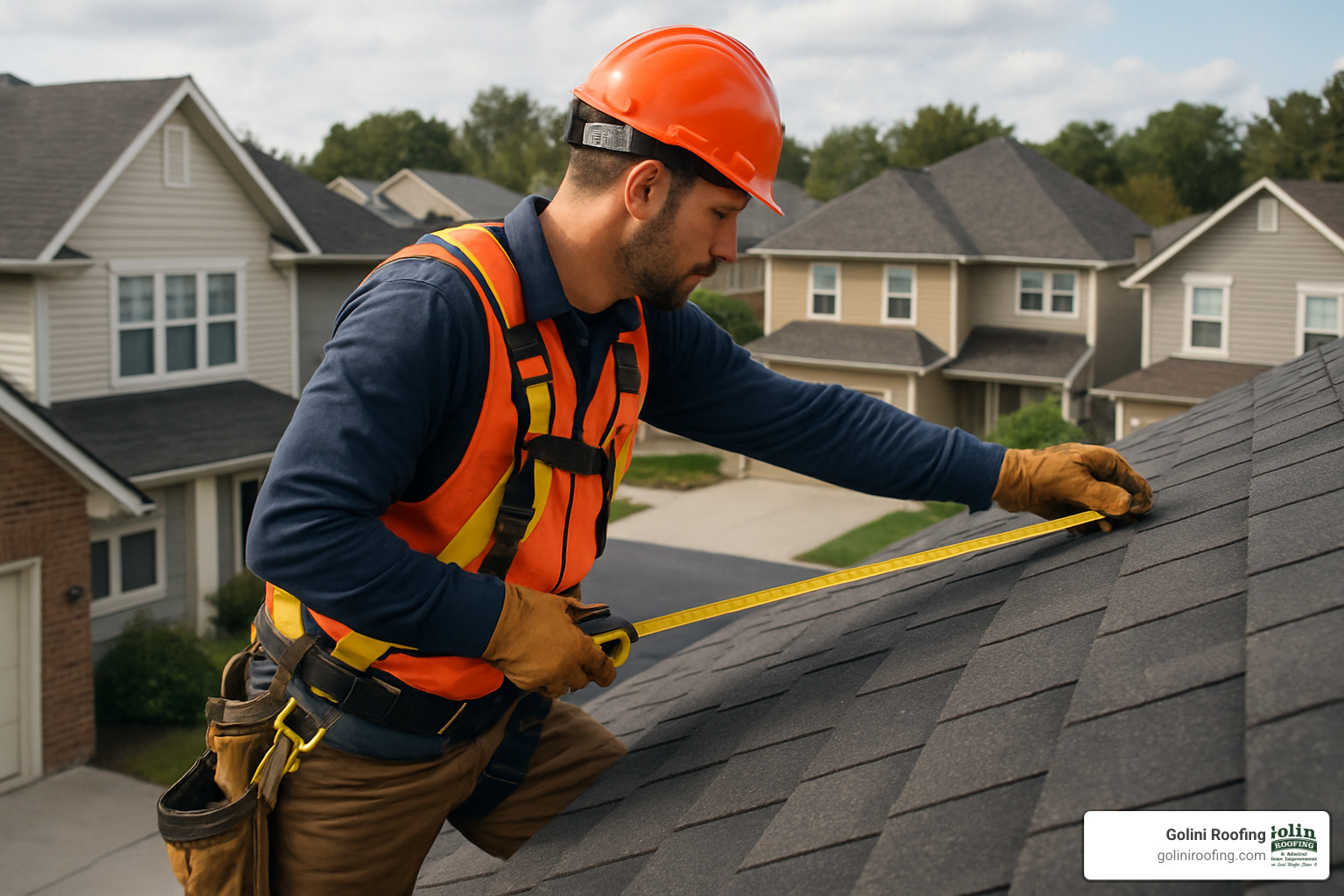
Understanding your roof’s actual size is the first step to getting accurate quotes. After 40 years in the business, I’ve seen countless homeowners surprised when they learn their 2,000 square foot home actually needs 2,400 square feet of roofing materials!
DIY Roof Measurement Step-by-Step
While we’ll always provide professional measurements at Golini Roofing, you can get a reasonable estimate of your roof size before calling contractors. Start by measuring your home’s footprint – the length and width of your house at ground level. Don’t forget to include attached garages and porches in your calculations.
Once you have your home’s footprint square footage (length × width), you’ll need to account for your roof’s pitch. This is where many DIY measurements go wrong. A perfectly flat roof would match your home’s footprint, but most Massachusetts homes have significant slopes.
For a standard pitch (4/12 to 6/12), multiply your footprint by 1.12. If your roof is steeper (7/12 to 12/12), use 1.25 instead. For those beautiful but challenging Victorian homes with very steep pitches, multiply by 1.4.
The final step is converting to “squares” – the unit contractors use when ordering materials and calculating costs. Simply divide your total roof square footage by 100. So a 2,000 sq ft ranch home with a standard pitch would have about 2,240 sq ft of roof area, or 22.4 roofing squares.
Technology has made roof measuring much easier in recent years. Satellite imagery tools, drone measurements, and specialized roofing apps can provide remarkable accuracy without climbing ladders. At Golini Roofing, we combine these digital tools with traditional on-site measurements to ensure your estimate reflects your roof’s actual dimensions.
Apples-to-Apples Quote Checklist
Not all roofing quotes are created equal, and the cost of new roof per sq ft can vary dramatically between contractors – sometimes for good reasons, sometimes not. To make fair comparisons, ensure every quote includes these essential elements:
Detailed scope of work should specify exactly what’s being done – tear-off of existing layers, deck inspection procedures, and whether repairs are included or will cost extra. Look for specifics about flashing replacement, ventilation improvements, and cleanup/disposal plans.
Material specifications matter tremendously. A quote mentioning just “architectural shingles” leaves too much room for interpretation. Look for brand names, product lines, warranty information, and weight/quality grade. The difference between 25-year and 50-year shingles significantly impacts your cost of new roof per sq ft.
Installation methods vary between contractors. At Golini Roofing, we hand-nail every shingle – a more time-consuming approach that ensures superior fastening in Massachusetts’ harsh climate. Many contractors use pneumatic nail guns, which are faster but may not provide the same precision. Your quote should specify which method will be used.
Workmanship warranties protect you long after installation. While manufacturers typically warranty their materials for 25-50 years, the contractor’s workmanship warranty covers installation issues. Be wary of contractors offering minimal or no workmanship guarantees.
Payment terms should be clearly outlined, including deposit amount (typically 10-30%), payment schedule, and financing options. Be extremely cautious of contractors requesting large upfront payments exceeding 30% of the total project cost.
Watch for these red flags when reviewing quotes: prices significantly lower than other estimates (often indicating corners being cut), vague material descriptions, no mention of permits or code compliance, excessive deposit requirements, and the absence of a written workmanship warranty.
The lowest quote rarely represents the best value. A properly installed roof using quality materials might cost more initially but will save thousands in premature repairs and replacements. As we say at Golini Roofing, “The bitterness of poor quality remains long after the sweetness of low price is forgotten.”
When comparing quotes, create a simple spreadsheet listing all components side by side. This visual comparison often reveals why prices differ and helps you make an informed decision based on value rather than just the cost of new roof per sq ft.
Frequently Asked Questions About Roofing Costs
How accurate are online roof calculators for estimating the cost of new roof per sq ft?
When you’re planning a roof replacement, those handy online calculators seem like a great place to start. And while they do provide ballpark figures, take those numbers with a grain of salt—they’re typically off by 15-25% in either direction.
Why such a wide margin? Most online tools rely on regional averages that don’t capture the unique aspects of your home. They miss the complexity of your roof’s design (all those valleys and dormers add up!), accessibility challenges (like that massive oak tree hugging your house), and specific local building codes that might require additional materials.
Plus, in today’s volatile market, material prices can change faster than these calculators update. What was accurate last month might be off by hundreds or even thousands of dollars today.
I’ve seen many Massachusetts homeowners bring in calculator estimates that seemed promising, only to find their actual needs were quite different. That’s why at Golini Roofing, we always recommend an in-person assessment. There’s simply no substitute for a qualified contractor physically inspecting your roof’s condition and structural requirements.
What’s the price difference between overlaying and a full tear-off?
The temptation of saving $1-$3 per square foot with an overlay (installing new shingles over existing ones) is understandable. For a typical 2,000 sq ft roof, that’s $2,000-$6,000 staying in your pocket!
But here’s what that “savings” might actually cost you:
Your new roof will likely last 20-25% less time, essentially canceling out much of the initial savings. Most manufacturers will either void or severely limit their warranties on overlay installations. And perhaps most concerning for Massachusetts homes, you can’t properly install ice and water shield directly on the deck—a critical defense against our notorious ice dams.
There’s also the hidden issue of weight. Each layer of asphalt shingles adds significant weight to your structure, and most building codes limit homes to a maximum of two layers for this reason. Not to mention, you lose the opportunity to inspect and repair any rotting or damaged decking underneath.
After 40 years of roofing in Massachusetts, I’ve seen too many overlay jobs fail prematurely. That’s why we typically recommend against them, especially in our climate where freeze-thaw cycles put extra stress on roofing systems.
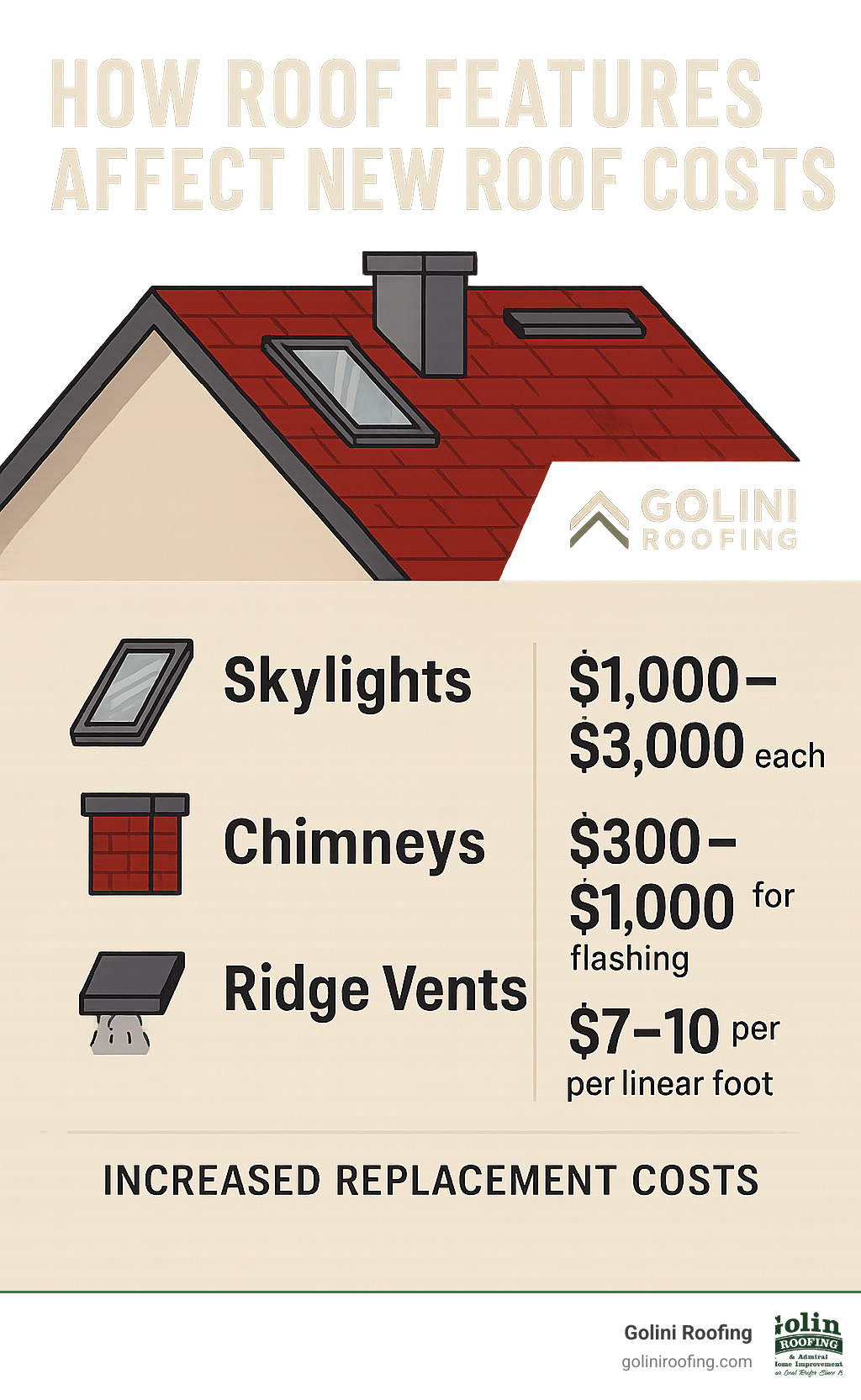
How much can skylights, chimneys, or ridge vents add per square foot?
When it comes to roof features like skylights and chimneys, it’s better to think of them as “add-ons” rather than increasing your cost of new roof per sq ft. Each element requires specialized attention that’s best calculated as a separate line item.
For skylights, expect to pay $300-$500 per unit just for proper re-flashing around an existing skylight. If you’re replacing the skylight itself (which I often recommend during a roof replacement), that jumps to $1,000-$3,000 depending on size and features.
Chimneys are another complexity point. Basic flashing might run $300-$1,000, but if the masonry needs repair or you want a custom copper flashing solution, you’re looking at $1,000-$3,000 or more.
Ventilation systems impact both cost and performance. Ridge vents typically cost $7-$10 per linear foot installed, while simple pipe boots (those rubber collars around plumbing vents) run $50-$150 each.
One often-overlooked expense is solar panel removal and reinstallation, which can add $1,500-$3,000 to your project.
For a typical 2,000 sq ft Massachusetts home with two skylights and one chimney, these features might add $1,600-$2,000 to your total. It’s one reason why comparing quotes can be tricky—some contractors might bundle these costs into their square footage rate, while others (like us) itemize them separately for transparency.
Conclusion
Understanding the true cost of new roof per sq ft feels like putting together a complex puzzle – each piece matters, from the shingles you choose to the quirks of your home’s design. While national averages give you a ballpark figure, your specific Massachusetts home has its own story to tell when it comes to pricing.
The wide price ranges we’ve explored throughout this article reflect industry averages based on internet data, not actual costs for Golini Roofing. Every home is unique, which is why we always recommend an in-person assessment to get numbers you can truly count on.
What makes Golini Roofing different in the Wakefield area isn’t just our 35+ years of experience – it’s our unwavering commitment to craftsmanship. Our hand-nailing technique might take more time than using pneumatic nail guns, but we’ve seen how this extra care helps roofs stand strong against Massachusetts weather. From howling nor’easters to summer thunderstorms, our meticulous approach pays dividends in durability and peace of mind.
We’ve spent decades serving our neighbors in Burlington, Lynnfield, North Reading, Reading, Stoneham, Wakefield, Wilmington, Winchester, and Woburn. This deep local experience means we understand the unique challenges Massachusetts homes face – from ice dam prevention to proper ventilation for our humid summers.
A new roof isn’t just another expense on your home maintenance list. It’s a critical investment that protects everything underneath it, improves your home’s energy efficiency, and adds significant value should you decide to sell. Understanding what makes up the cost of new roof per sq ft helps you make choices that balance today’s budget with tomorrow’s value.
Your home deserves a roof installed by people who care about doing things right. At Golini Roofing, that’s been our philosophy since day one, and it’s why so many of our customers come from referrals.
For personalized information about what a roof replacement might cost for your specific home, we invite you to learn more about roof replacement cost or reach out to us directly for a detailed assessment.
