

Plan Your Roofing Project with Confidence
A roof shingle square calculator helps you estimate the roofing materials needed for your project by converting your roof’s dimensions into the required number of shingle bundles.
Quick Answer: Using a Roof Shingle Square Calculator
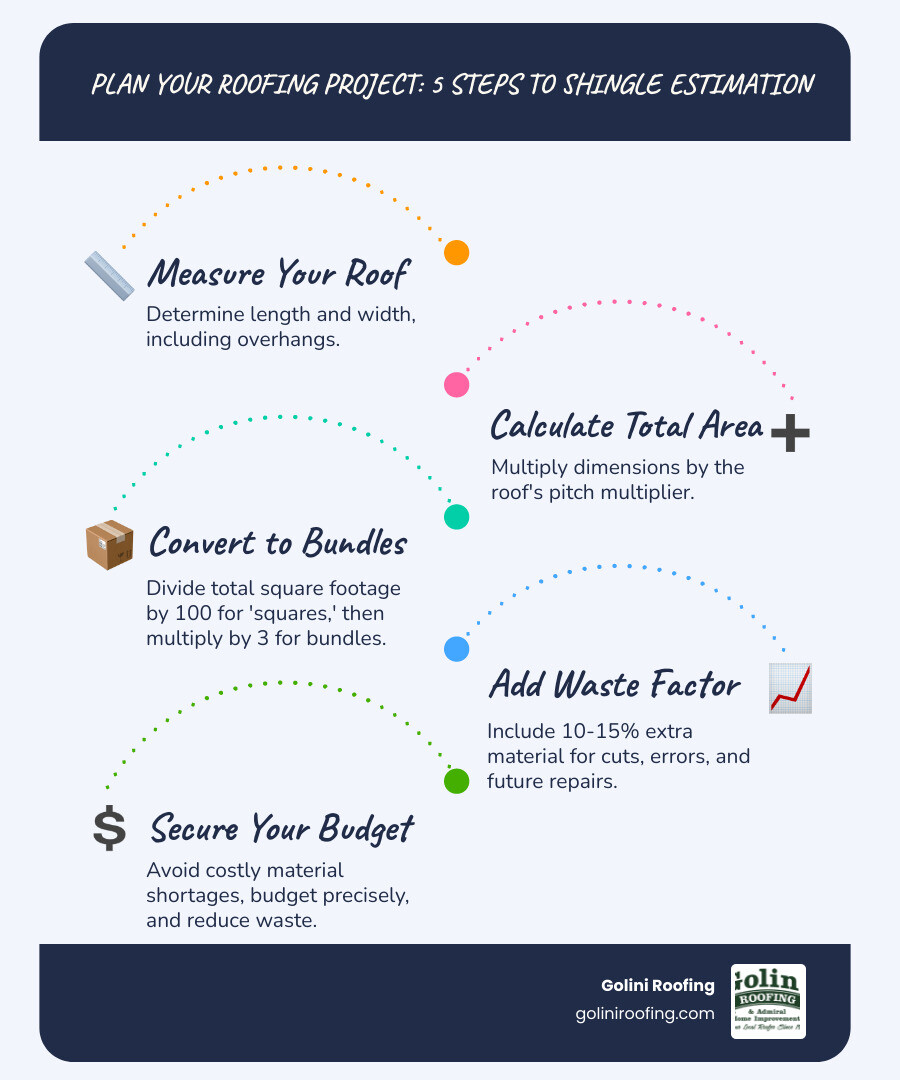
- Measure Your Roof – Determine the length and width of your roof, including overhangs.
- Calculate Total Area – Multiply dimensions by your roof’s pitch multiplier to get the actual surface area.
- Convert to Materials – Divide total square footage by 100 to get “squares,” then multiply by 3 to get the number of bundles needed.
- Add Waste Factor – Include 10-15% extra for cuts, mistakes, and future repairs.
Getting an accurate material estimate is the crucial first step in any roofing project. Ordering too few shingles causes delays, while ordering too many wastes money. Fortunately, you don’t need to be a roofing expert to calculate your needs. With the right measurements and a basic understanding of roofing terms, you can estimate your shingle requirements in minutes.
Accurate calculations help you:
- Avoid material shortages mid-project
- Budget more precisely
- Reduce waste and unnecessary expenses
I’m Jack Golini, and I’ve been helping homeowners in the North Shore area install quality roofs since 1982. I’ve learned that accurate material estimation is what separates smooth projects from frustrating ones. I’m here to walk you through the process.
Understanding Key Roofing Terms: Squares, Bundles, and Pitch
To use a roof shingle square calculator effectively, you need to understand a few key terms. They are industry standards that simplify material estimation.
What is a Roofing ‘Square’?
In roofing, a “square” is a unit of area equal to 100 square feet. Contractors use this universal term for estimates and quotes. Instead of saying “2,400 square feet,” a roofer will say “a 24-square roof.” This simplifies calculations for large areas. If your roof is 1,500 square feet, you have a 15-square roof.
Shingle Bundles and Their Coverage
Shingles are sold in bundles. A standard bundle of asphalt shingles covers about 33.3 square feet, meaning it takes three bundles to cover one roofing square. This ratio is key for ordering. However, coverage can vary by shingle type (e.g., 3-tab vs. architectural), so always check the manufacturer’s specifications. Be aware that an average bundle weighs 75-100 pounds, which is a factor for delivery and handling.
If you’re planning a roofing project in the Burlington, Lynnfield, North Reading, Reading, Stoneham, Wakefield, Wilmington, Winchester, or Woburn area, you can find more info about our roofing services on our website.
Decoding Roof Pitch and Why It Matters
Your roof’s pitch (its steepness) is a critical factor often overlooked. A steeper roof has more surface area than a flat one covering the same footprint, requiring more shingles.
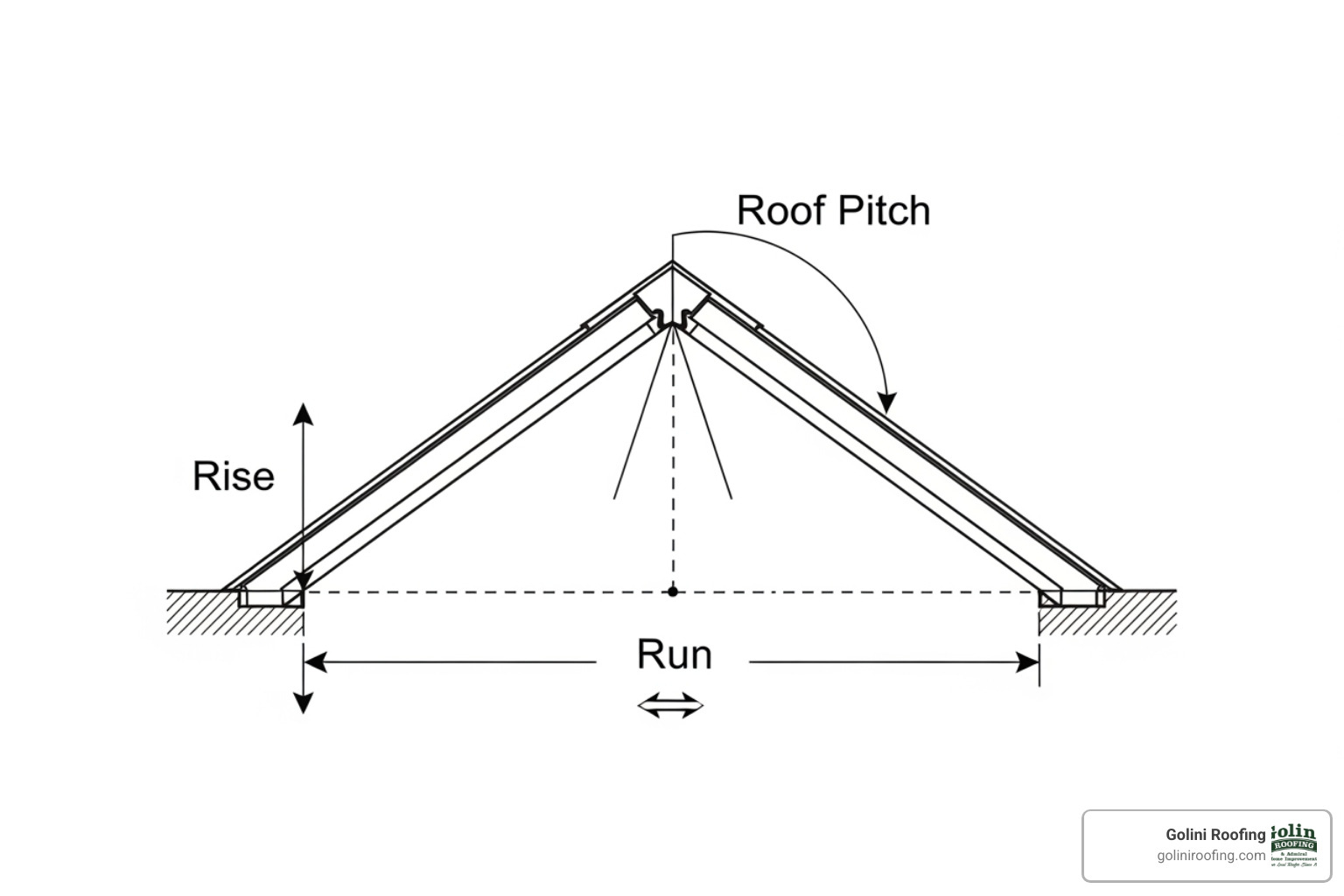
Pitch is expressed as a ratio of rise over run. The “rise” is the vertical increase in inches for every 12 inches of horizontal distance (the “run”). A “6/12 pitch” means the roof rises 6 inches for every 12 inches of run.
Pitch is important because it affects water drainage and, crucially for your estimate, the total surface area. A steeper pitch requires a “pitch multiplier” to convert your home’s flat footprint into the actual roof area, ensuring you order enough material. We’ll show you how to use these multipliers in the next section.
You can easily measure your roof’s pitch with a tool like the Johnson Pitch & Slope Locator, or with a level and tape measure if you can work safely on a ladder.
How to Manually Calculate Your Roof’s Square Footage
While a roof shingle square calculator is convenient, understanding the manual calculation is valuable for double-checking your numbers. Here’s how to do it yourself, step-by-step.
Step 1: Measure Your Roof’s Footprint
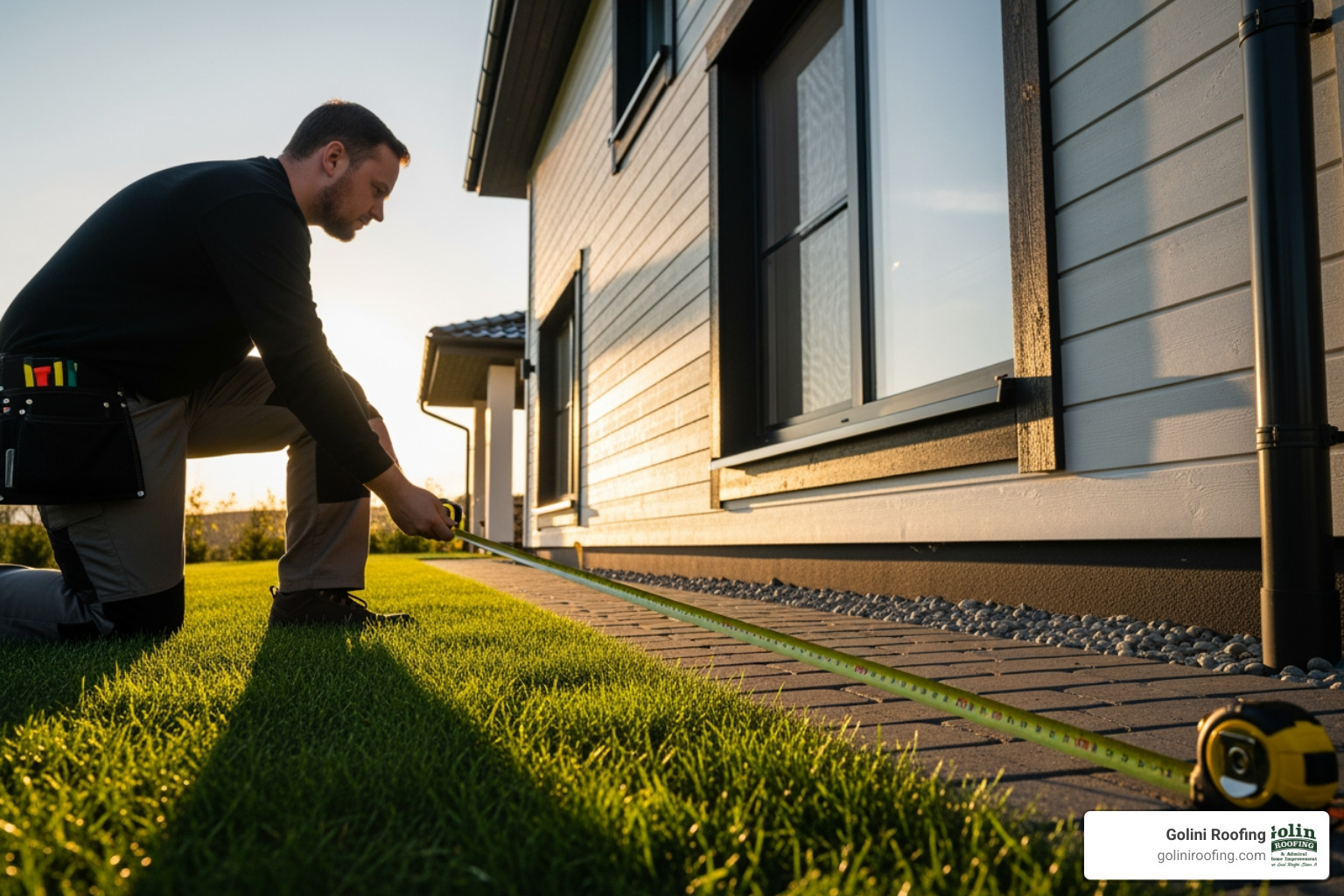
First, measure your home’s footprint from the ground. Use a tape measure to find the length and width of the house, making sure to include any eaves or overhangs. For a simple rectangular home, multiply the length by the width to get the footprint area. For example, a 40 ft x 30 ft house has a footprint of 1,200 square feet.
If your roof is complex (e.g., L-shaped), break it into smaller rectangular sections, measure each one, and calculate their areas separately.
Step 2: Find the Roof Pitch Multiplier
Because your roof is sloped, its surface area is larger than its flat footprint. The pitch multiplier adjusts for this. To find your pitch, you can safely use a 12-inch level and a tape measure on a rafter. Place the level horizontally, and from the 12-inch mark, measure vertically up to the roof deck. That number is the “rise.” A 6-inch rise gives you a 6/12 pitch.
You can also use a tool like the Johnson Pitch & Slope Locator for this. Once you know your pitch, find its corresponding multiplier from the list below.
Common Roof Pitch Multipliers:
- 4/12 pitch: 1.054 multiplier
- 6/12 pitch: 1.118 multiplier
- 8/12 pitch: 1.202 multiplier
- 12/12 pitch: 1.414 multiplier
Step 3: Calculate the Total Roof Area
Now, calculate the total roof area using this formula: Total Roof Area = Footprint Area × Pitch Multiplier.
Using our previous example: 1,200 sq ft (footprint) × 1.118 (6/12 pitch multiplier) = 1,341.6 sq ft. Round up to 1,342 sq ft.
To convert this to roofing squares, divide by 100 (13.42 squares). Since it takes three bundles per square, you’d need about 41 bundles (13.42 x 3).
For complex roofs, calculate the area of each section (using Area = 0.5 × base × height for triangles), apply the pitch multiplier, and add the totals together. While manual calculation is good for understanding the basics, a roof shingle square calculator or a professional is best for complex roofs.
Using a Roof Shingle Square Calculator for Fast, Accurate Results
While manual calculation is useful, a roof shingle square calculator is the fastest and most accurate way to estimate your materials. These online tools handle the complex math, letting you focus on planning your project.
Key Inputs for a Roof Shingle Square Calculator
A good roof shingle square calculator is simple to use. You’ll need to input a few key measurements for an accurate result:
- Roof Dimensions: The length and width of your roof’s footprint. Better calculators let you add multiple sections for complex roofs.
- Roof Pitch: Entered as a “rise over run” ratio (e.g., 6/12).
- Waste Factor: An extra percentage (typically 10-15%) for cuts and waste.
- Shingle Type: Different shingles (e.g., 3-tab vs. architectural) can have different coverage rates.
Accurate inputs are essential for reliable results, so double-check your measurements.
From Square Feet to Shingle Bundles: The Final Calculation
After you enter your data, the roof shingle square calculator performs the final steps. It divides your total roof area by 100 to determine the number of roofing squares. Then, it multiplies the squares by three (the typical number of bundles per square) to find the total bundles needed.
For example, a 1,342 sq ft roof is 13.42 squares, which requires 40.26 bundles (13.42 x 3). The calculator will automatically round this up to 41, as you can only buy whole bundles. This provides a small buffer before your waste factor is even added.
If you want to see this in action right now, you can Use our roof square footage calculator to get started on your estimate.
Benefits of an Online Roof Shingle Square Calculator
Online calculators offer significant benefits for planning your roofing project:
- Time Savings: Get an estimate in minutes, not hours.
- Error Reduction: Automated calculations eliminate human error.
- Complex Roofs: Easily handle calculations for dormers, valleys, and multiple sections.
- Budgeting: Knowing your material quantity helps you compare costs and budget effectively.
- Empowerment: A solid estimate helps you have more informed conversations with contractors.
While these tools are excellent for planning, they are still just an estimate. For final material orders, a professional assessment is invaluable to account for nuances a calculator can’t see.
If you’re looking for a Reliable Roofing Calculator to cross-reference your estimates, there are several reputable options available that will give you consistent, accurate results.
Factoring in Waste and Other Essential Materials
A complete roofing estimate goes beyond just the shingles. You must also account for material waste and other essential components for a durable, weathertight system.
Why You Need to Account for Waste
Your calculator gives you the exact roof area, but installation always creates waste from cuts needed for hips, valleys, and around chimneys. Complex roofs generate more waste than simple ones. It’s also wise to have extra shingles for any damaged in transit or for future repairs, as matching colors later can be difficult. If you need help with damaged shingles, you can Learn about our roof repairs we offer throughout Burlington, Lynnfield, North Reading, Reading, Stoneham, Wakefield, Wilmington, Winchester, and Woburn, MA.
Professionals follow the 10-15% rule for waste. Add 10% for a simple gable roof and 15% for a more complex roof with multiple angles. For example, if you calculate a need for 41 bundles, adding 15% waste means you should order 47 bundles (41 × 1.15 = 47.15, rounded up).
Estimating Underlayment, Drip Edge, and Nails
A complete roofing system includes several other critical materials:
-
Underlayment: This is your roof’s secondary water barrier. You’ll need ice and water shield, a self-adhering membrane, for eaves, valleys, and around penetrations to protect against ice dams, as required by local building codes. For the rest of the deck, you’ll use synthetic underlayment or felt paper.
-
Drip Edge: This metal flashing is installed on eaves and rakes to direct water away from the fascia. Measure the total linear feet of your roof’s perimeter to estimate the amount needed, adding 5-10% for overlap.
-
Roofing Nails: Use wide-headed nails designed for roofing. We use four nails per shingle for standard installations and six in high-wind areas. This amounts to roughly 320-480 nails per square. At Golini Roofing, we hand-nail every shingle for superior holding power.
-
Starter and Ridge Cap Shingles: Starter shingles are used for the first course at the eaves, while ridge caps cover the peaks (ridges and hips). Both are measured in linear feet.
-
Flashing and Sealant: You’ll need new flashing and sealant for areas where the roof meets a wall, chimney, or vent pipe to ensure a watertight seal.
-
Ventilation: Proper attic ventilation (a balance of intake and exhaust vents) is crucial for preventing moisture damage and extending your roof’s life.
Frequently Asked Questions about Estimating Shingles
Here are answers to the most common questions about calculating shingles.
How many bundles of shingles are in a square?
Typically, three bundles of standard asphalt shingles cover one roofing square (100 sq. ft.). This is because most bundles cover about 33.3 sq. ft. So, a 15-square roof would require 45 bundles (15 x 3). However, this can vary slightly with different shingle types, like architectural shingles. Always check the manufacturer’s specifications on the bundle to confirm coverage.
How much extra material should I order for waste?
It’s best practice to order 10-15% extra material for waste. Use 10% for simple gable roofs and 15% for more complex roofs with hips, valleys, and dormers. This overage accounts for cuts, installation mistakes, damaged shingles, and provides perfectly matched shingles for any future repairs. If your calculation shows you need 40 bundles, ordering 15% extra means you’d get 46 bundles (40 x 1.15 = 46).
Can I use a calculator for a complex roof?
Yes, a roof shingle square calculator works for complex roofs. The key is to break the roof down into simple shapes (rectangles, triangles). Calculate the area of each section, apply the pitch multiplier, and then add them together. Many online calculators allow you to input multiple sections to simplify this process.
However, for very intricate roofs, a professional measurement is highly recommended. An experienced contractor can identify complexities that are easily missed from the ground, ensuring a perfectly accurate material order. Use the calculator for a strong budget estimate, then have a pro confirm the numbers before purchasing.
Conclusion: From Accurate Estimate to Flawless Installation
You now understand how to use a roof shingle square calculator to estimate your material needs, from accounting for roof pitch to adding a waste factor. Accurate estimation is the foundation of a successful roofing project, allowing you to budget confidently and avoid delays.
While online calculators are excellent for planning, there’s no substitute for a professional assessment. An experienced roofer can spot hidden issues and ensure your material list is perfect. Every roof has unique details, and that’s where professional experience makes all the difference.
Here at Golini Roofing, we’ve served homeowners in Burlington, Lynnfield, North Reading, Reading, Stoneham, Wakefield, Wilmington, Winchester, and Woburn since 1982. We bring 35+ years of craftsmanship to every job, including our commitment to hand-nailing each shingle for superior durability.
Your roof shingle square calculator estimate is a great starting point. Let our team turn that estimate into a flawless installation. Get a professional estimate for your roofing project, and we’ll ensure your new roof is built with the meticulous care that has been our trademark for decades.