Insulating low slope residential roofs: Best Tips 2025
Why Proper Insulation Is Critical for Your Low-Slope Roof
Insulating low slope residential roofs presents unique challenges. These roofs require specialized approaches to manage moisture, prevent ponding water, and maintain energy efficiency, avoiding costly structural damage.
Key considerations for insulating low slope residential roofs:
- Drainage: Proper slope (minimum 1/4″ per foot) prevents water accumulation.
- Moisture control: Air barriers and vapor management prevent condensation damage.
- Assembly type: Choose between vented or unvented systems.
- Insulation materials: Rigid foam, mineral wool, or spray foam each offer distinct advantages.
- Code compliance: Meet minimum R-values for your climate zone.
- Professional installation: Proper air sealing and flashing are critical for long-term performance.
The stakes are higher with low-slope roofs because water is difficult to tame. Poor insulation choices can lead to membrane flutter, ice dams, and expensive moisture damage. Unlike steep roofs that shed water quickly, these systems must handle slow-moving water.
Average costs for insulating low slope residential roofs range from $3-$15 per square foot based on internet data, though complex projects can reach $25-$45 per square foot. These are not actual costs for Golini Roofing services.
I’m Jack Golini, and I’ve helped North Shore homeowners solve complex roofing challenges since 1982. When it comes to insulating low slope residential roofs, proper moisture management is key. Getting the insulation strategy right from the start prevents the costly callbacks and warranty issues that plague this type of work.
Why Your Low-Slope Roof Needs Special Attention
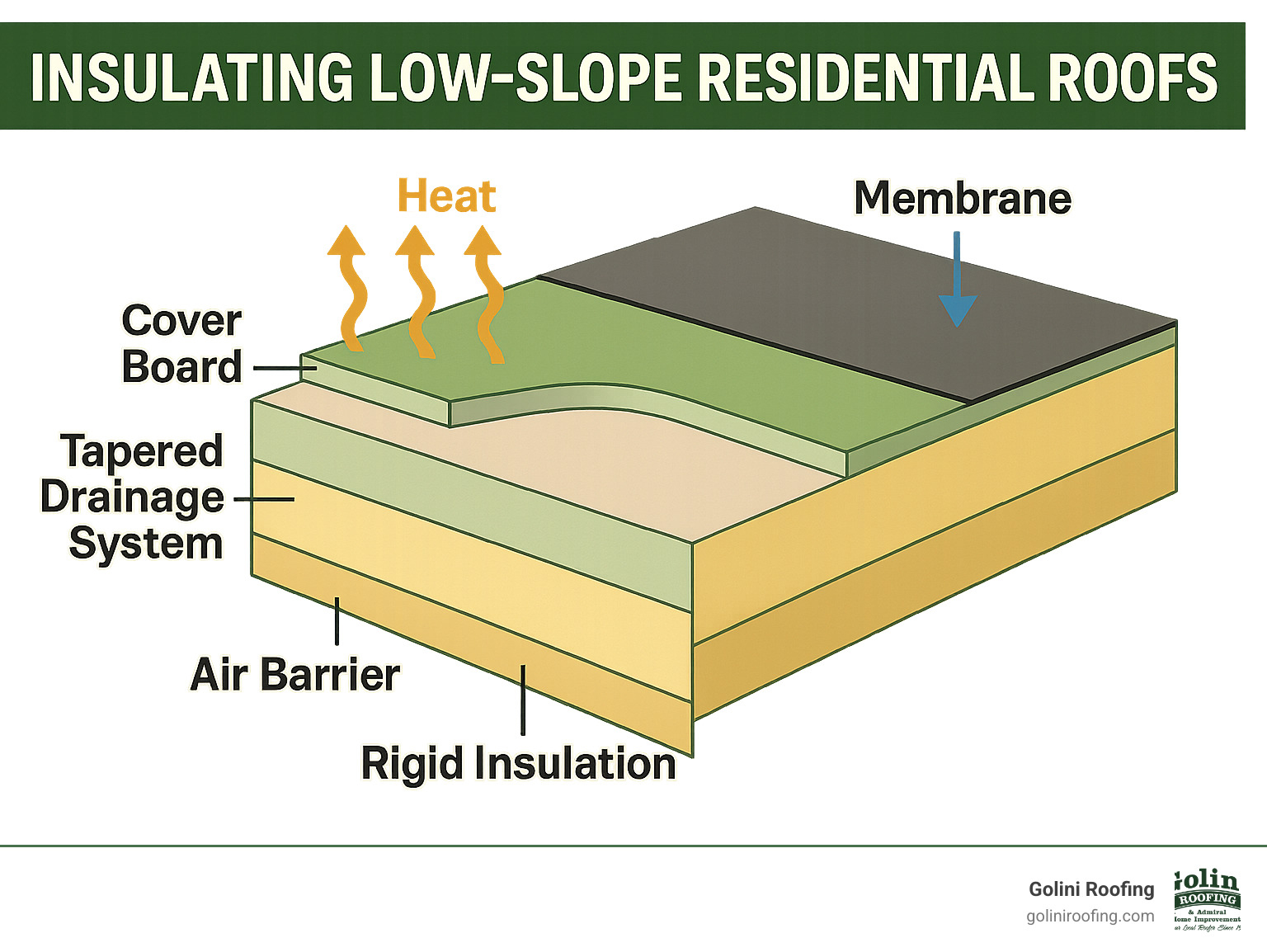
Low-slope roofs, often called “flat” roofs, are common on modern homes, additions, and garages. While they offer functional benefits, they demand careful insulation because water, gravity, and heat behave differently than on a steep roof.
The primary challenge is drainage. Even a slight dip can lead to ponding water, which shortens the roof’s life and can cause structural damage. Building codes typically specify a minimum slope of 2-percent to ensure water drains within 48 hours, preventing moisture issues.
Beyond drainage, moisture control is paramount. Warm, moist air from inside can condense on cool roof surfaces, causing damp sheathing, mold, and poor insulation performance. An effective air and vapor barrier is critical to prevent this.
Another factor is structural integrity, particularly concerning wind uplift. Low-slope roofs are prone to membrane fluttering when wind pressure differences cause the membrane to lift. A continuous air barrier is essential to prevent this and protect your roof.
Finally, effective insulating low slope residential roofs is key to your home’s energy efficiency and reducing fuel costs. A well-insulated roof keeps your home cool in summer and warm in winter. Without it, rooms below can have extreme temperatures, making your home uncomfortable and increasing energy bills.
Our team at Golini Roofing understands these unique challenges. We’re dedicated to ensuring your low-slope roof is not only beautiful but also a high-performing, energy-efficient component of your home. You can learn more about our comprehensive roofing services, including solutions for low-slope roofs, on our website: More info about our roofing services
A Guide to Insulation Materials for Low-Slope Roofs
Choosing the right insulation material is critical when insulating low slope residential roofs. You need a material that handles moisture, resists fire, and performs well acoustically, all within your budget. Understanding your options will save you headaches and money.
| Insulation Type | R-Value (per inch) | Cost (Relative) | Moisture Resistance | Fire Rating |
|---|---|---|---|---|
| Rigid Foam Boards | ||||
| – Polyiso | 5.6 – 6.5 | High | Good | Good |
| – XPS | 5.0 | Medium | Excellent | Good |
| – EPS | 3.6 – 4.2 | Low | Good | Good |
| Mineral Wool | 4.0 – 4.3 | Medium | Excellent | Excellent |
| Sprayed Polyurethane Foam | 6.0 – 7.0 | High | Excellent | Good* |
Note: SPF requires a protective coating for UV and fire resistance. R-values are approximate and vary by product density and manufacturer. Costs are general averages and can fluctuate based on market conditions and project specifics.
Rigid Foam Boards (EPS, XPS, Polyiso)
Rigid foam boards are a popular choice for low-slope roofing, delivering high thermal performance in a thin package.
Expanded Polystyrene (EPS) is a budget-friendly option. It can be manufactured in custom tapered configurations, providing both insulation and drainage in one product. Tapered blocks can be up to 40 inches thick, allowing for single-layer installation that can reduce labor and material costs by up to 30%.
Extruded Polystyrene (XPS) offers superior moisture resistance, making it ideal for protected membrane or green roofs. However, it is not compatible with hot asphalt applications.
Polyisocyanurate (Polyiso) delivers the highest R-value per inch among rigid foams. It has excellent dimensional stability, and high-density versions can serve as both insulation and a cover board. While more expensive, its performance often makes it a smart long-term investment.
Mineral Wool (Stone Wool)
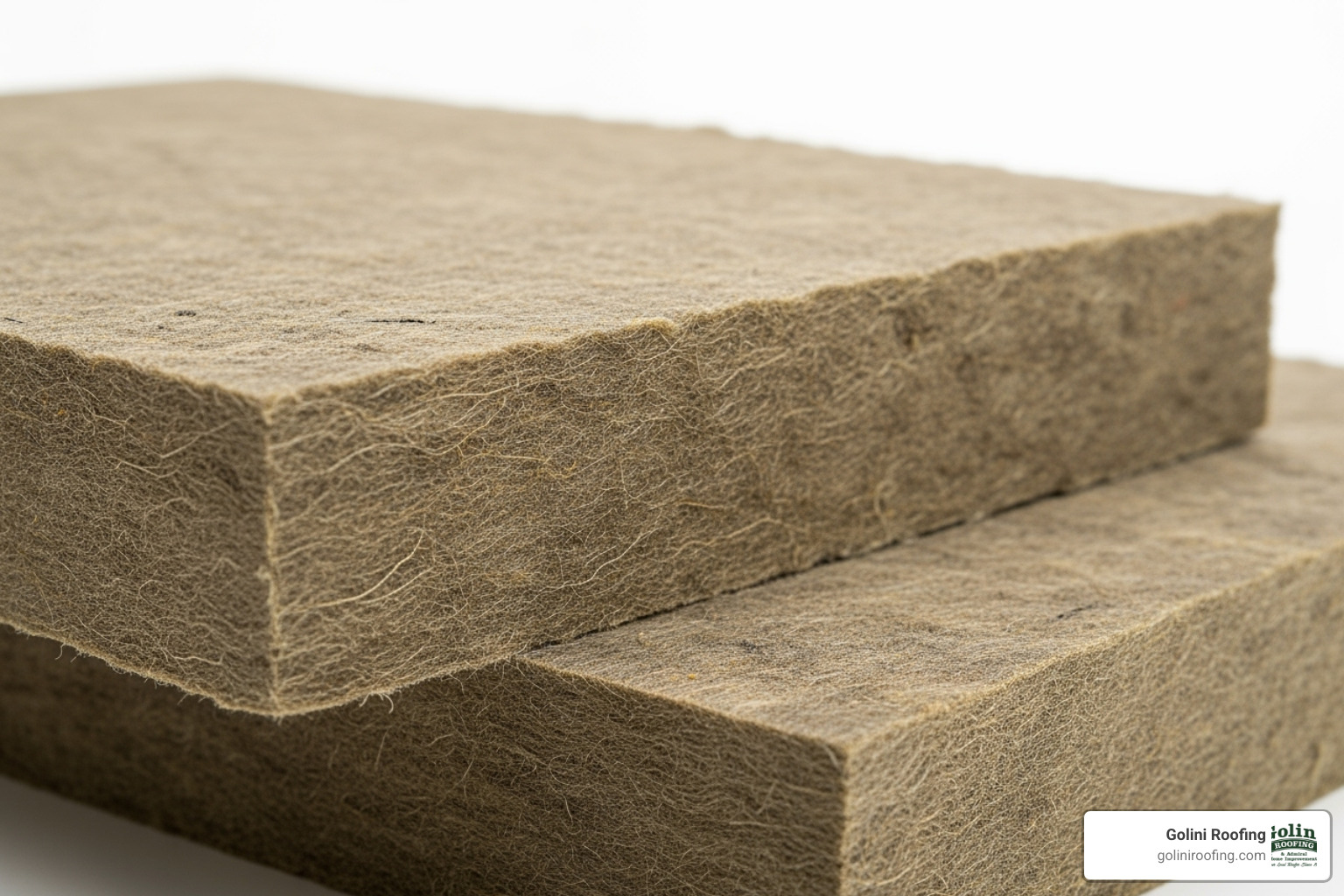
Mineral wool (stone wool) offers more than just thermal control; it also provides excellent fire safety, acoustic performance, and moisture management when insulating low slope residential roofs.
Fire resistance is a key benefit. Mineral wool is non-combustible, so it won’t burn, spread flames, or produce toxic smoke, making it ideal for areas with wildfire risk.
Its unique fiber structure is exceptional at acoustic performance, absorbing sound from rain, hail, or traffic. It helps roof assemblies meet strict acoustic standards (STC and OITC).
For moisture resistance, mineral wool is vapor-permeable, allowing the roof assembly to dry, but it does not readily absorb water.
It is also highly durable, maintains its shape, resists damage from foot traffic, and can sometimes be reused.
Sprayed Polyurethane Foam (SPF)
Sprayed Polyurethane Foam (SPF) acts as both insulation and a waterproofing system. It expands to create a seamless, closed-cell foam barrier against heat and air transfer.
Its air barrier properties are a major advantage. SPF forms a continuous layer that eliminates thermal bridges and air leaks, making it ideal for sealing around penetrations and irregular surfaces.
As a waterproofing layer, its seamless application leaves no joints for water to penetrate. Its excellent adhesion to substrates makes it a good choice for retrofit projects.
However, SPF’s main weakness is its UV protection requirement. It must be covered with a protective coating or membrane to prevent degradation from sunlight. The application process is also weather-dependent, but when installed correctly, SPF creates a highly effective thermal and moisture barrier.
The Great Debate: Vented vs. Unvented Roof Assemblies
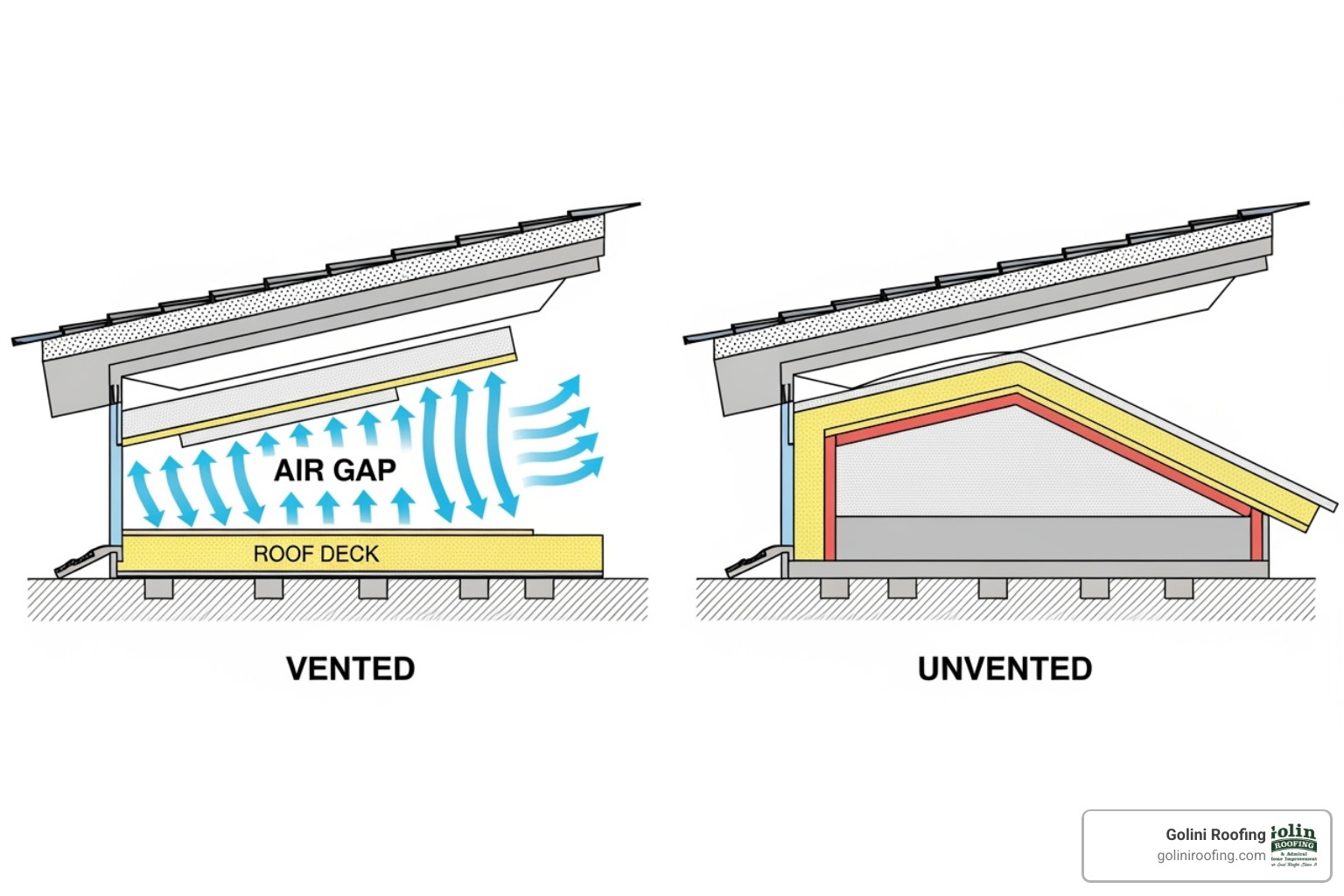
When insulating low slope residential roofs, a fundamental choice is between a vented or unvented assembly. This decision impacts moisture management, energy performance, and construction. It’s a choice between two philosophies: the traditional vented approach, which lets moisture escape, and the modern unvented approach, which blocks moisture from entering. Both can be effective but have different requirements.
The Traditional Vented Approach
A vented assembly has an air gap between the insulation and the roof deck, allowing airflow to carry away moisture. This system requires adequate soffit vents for intake and cupola vents for exhaust. A critical component is an airtight ceiling plane below the insulation to prevent warm, moist air from causing condensation in the cold roof assembly.
This approach also increases framing depth requirements to accommodate both insulation and the air gap. While traditional, this method is tricky to execute perfectly. Poor ventilation can lead to poor moisture removal and the potential for ice dams in cold climates.
The Modern Unvented (Hot Roof) Approach
Unvented assemblies, or “hot roofs,” prevent condensation by keeping the roof deck warm as part of the home’s conditioned attic space. This design requires no ventilation. It uses air-impermeable insulation (like rigid foam or closed-cell spray foam) to block moisture. Any incidental moisture can dry to the interior, resulting in simpler construction.
There are five proven ways to create an effective unvented low-slope roof:
- Exterior rigid foam only – 6 or more inches above the roof deck
- Exterior rigid foam plus interior insulation – combining 2-4 inches of exterior foam with fiberglass or cellulose between rafters
- Exterior spray foam plus interior insulation – closed-cell foam on top with air-permeable insulation below
- Interior spray foam only – closed-cell foam applied directly to the underside of the sheathing
- Interior spray foam plus blown-in – moderate spray foam thickness with additional blown-in insulation
The best method depends on your project, budget, and climate. The key is effective moisture management and meeting insulation goals.
Our expertise at Golini Roofing extends to all types of roof assemblies. If you’re experiencing issues with your current roof, whether it’s related to insulation, leaks, or general wear, our team can help. You can find more information about our roof repair services here: More info about roof repairs
Best Practices for Insulating Low Slope Residential Roofs
With insulating low slope residential roofs, proper installation is as important as the materials. After decades in roofing, I’ve seen that attention to detail prevents most common problems. Here are the practices that ensure a professional-grade installation.
Creating a Bulletproof Air and Moisture Barrier
On low-slope roofs, air leakage kills performance. Tiny gaps allow warm, moist air into the roof assembly, causing condensation and long-term damage.
Air barrier continuity is essential. The barrier must be continuous across the roof and connect seamlessly to the wall’s air barrier. Sealing deck seams with quality tapes or membranes is a critical step that professionals never rush. Self-adhered membranes installed over the deck provide a primary air and water control layer and protect the home during construction.
Meticulous flashing details around every penetration are crucial, as poor flashing is the number one cause of leaks. Finally, a robust air barrier and proper membrane attachment prevent membrane flutter, which is caused by wind and can lead to premature failure.
For homeowners who want to dive deeper, resources like Building Science Corporation provide excellent insights: Parapets – Where Roofs Meet Walls, BSI-050
The Critical Role of Cover Boards
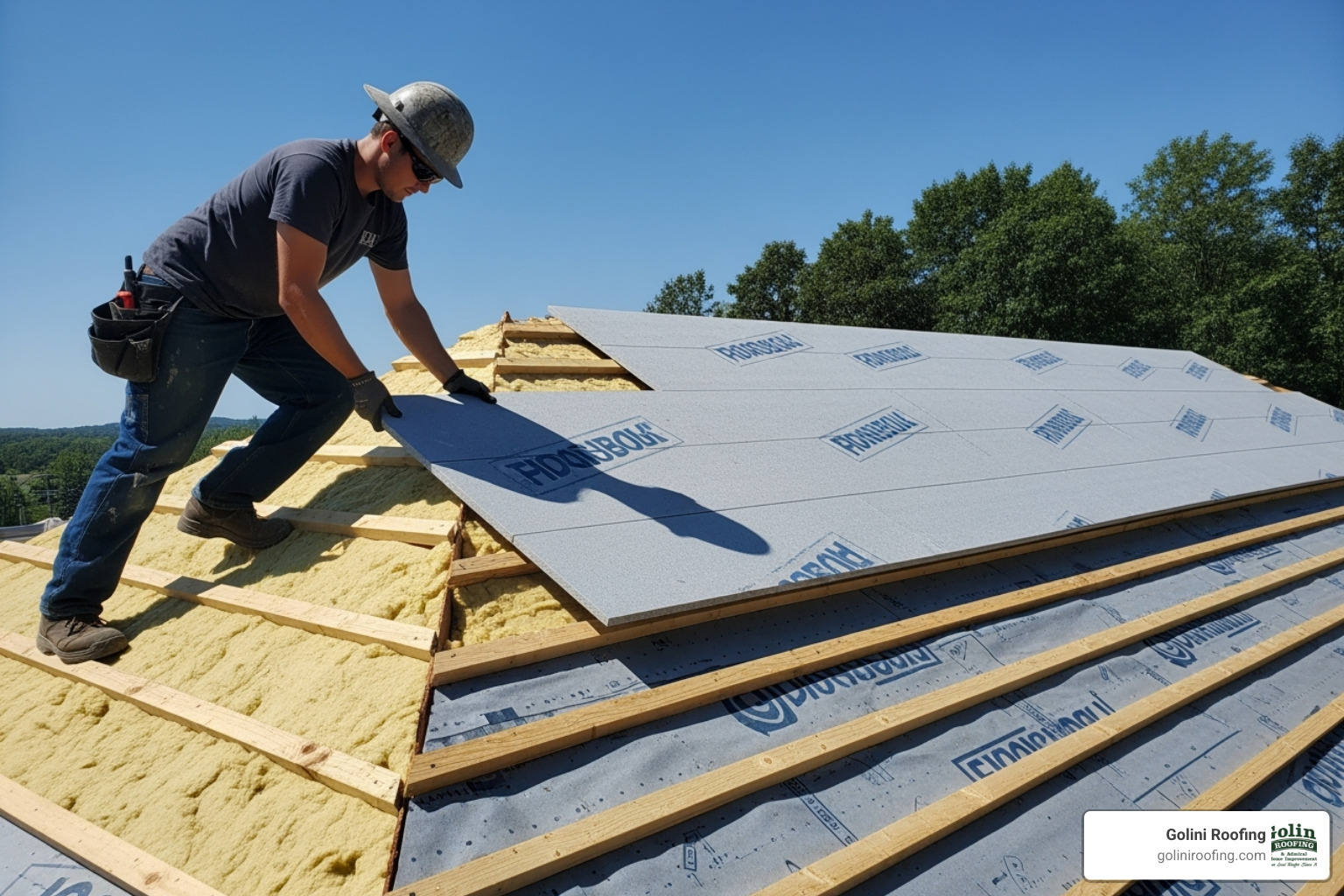
While not always required by code, cover boards are strongly recommended by the National Roofing Contractors Association. They act as a bodyguard for your insulation.
Cover boards protect the insulation from damage during installation and provide impact resistance against hail. They also improve fire resistance and wind uplift resistance by providing a stable substrate for the membrane. Common options are gypsum board (for moisture/fire resistance) and fiberboard (for insulation/handling). The choice depends on your climate and project needs.
Solving Drainage with Tapered Insulation
Water management is key. A low-slope roof must have positive drainage, meaning water clears within 48 hours to prevent damage to the roof membrane.
Tapered insulation is an neat solution that creates this slope without expensive structural changes. These systems are designed for eliminating ponding water by directing it efficiently to drains. Custom slopes using tapered EPS offer great flexibility, simplifying installation and reducing labor costs by up to 30% compared to traditional methods.
Building code slope requirements (typically 1/4 inch per foot) are easily met or exceeded with tapered systems, which can also correct for uneven decks. The result is a roof engineered for optimal water management from day one.
Performance, Safety, and Code Considerations
Properly insulating low slope residential roofs is about more than thermal performance; it’s about safety, durability, and comfort. Overlooking these factors leads to serious problems.
Matching Your Insulation to Your Climate Zone
Your insulation needs to perform in all seasons, and your specific climate zone dictates the requirements. The International Residential Code (IRC) provides these guidelines.
In cold climates like ours in Massachusetts, the goal is to prevent condensation by keeping the roof deck above the dew point. The IRC sets minimum R-values for exterior insulation to achieve this. For example, in Zone 5, unvented assemblies need at least R-20 of exterior insulation.
Hot climates focus on keeping heat out, often combining high R-values with reflective materials. Mixed climates must handle both, and a good rule of thumb is to place at least 40% of the total R-value as exterior insulation for proper condensation control.
Wind, Fire, and Acoustic Performance
A well-designed roof also protects against wind, fire, and noise.
Wind uplift resistance is critical, especially on the North Shore. We follow ASCE 7 standards, using specific fastening patterns and fully adhered membranes to resist powerful wind forces that can cause catastrophic failure.
For more on this topic, Building Science Corporation offers a detailed look: Uplifting Moments – Roof Failures, BSI-019
Fire ratings are also crucial. Using non-combustible materials like stone wool significantly improves safety, which is vital in wildfire-prone or dense urban areas.
Finally, Sound Transmission Class (STC) and Outdoor-Indoor Transmission Class (OITC) ratings measure how well your roof blocks outside noise. Materials like stone wool excel at sound absorption, creating a quieter home by dampening noise from traffic or weather.
The bottom line? When we’re insulating low slope residential roofs, we’re engineering a complete building envelope that protects your family and your investment for decades to come.
Frequently Asked Questions about Insulating Low Slope Residential Roofs
Here are answers to the most common questions homeowners ask about insulating low slope residential roofs.
How thick should my low-slope roof insulation be?
The required thickness depends on your location and goals. Climate zone is the starting point. The International Residential Code (IRC) sets minimum R-values, which vary by region. In Massachusetts (Zone 5), a baseline for exterior insulation in unvented assemblies is R-20 to R-25.
Rigid board insulation is typically installed in multiple layers with staggered joints to prevent thermal bridging. My advice is to exceed code minimums; the extra investment pays off in long-term comfort and energy savings.
Can I put new insulation over my old low-slope roof?
Yes, installing new insulation over an old roof (a “re-cover”) is often possible and cost-effective, but with key considerations. The existing roof must be structurally sound and dry. We always inspect the deck to ensure it can handle the added weight and that any existing moisture issues are resolved first.
The new system must meet current building codes for R-value and slope, and material compatibility is crucial. We select new materials that work with the existing roof system.
What is the most cost-effective way for insulating low slope residential roofs?
This depends on whether you prioritize low upfront cost or long-term value.
For lowest upfront cost, tapered Expanded Polystyrene (EPS) is often the winner due to lower material costs and faster installation. However, the cheapest option can cost more long-term. Higher-performing materials like Polyiso or stone wool offer greater energy savings and durability.
Sprayed Polyurethane Foam (SPF) is more expensive but provides both insulation and waterproofing, though it requires regular coating maintenance.
Average costs for insulating low slope residential roofs range from $3-$15 per square foot based on internet data, though complex projects can reach $25-$45 per square foot. These are not actual costs for Golini Roofing services.
My advice: don’t decide on initial cost alone. A properly insulated roof with the right R-value, drainage, and installation is a long-term investment that protects your home and saves money for decades. It’s the kind of value we’ve helped homeowners in Wakefield, Burlington, Lynnfield, North Reading, Reading, Stoneham, Wilmington, Winchester, and Woburn achieve for over three decades.
Partner with the Experts for a High-Performance Roof
Properly insulating low slope residential roofs is a specialized craft that requires deep knowledge and hands-on experience. Your roof and insulation are critical systems. When they work together perfectly, your roof performs for decades. When they don’t, you face moisture problems, high utility bills, and avoidable repairs.
At Golini Roofing, we’ve been solving these complex roofing challenges since 1982. We understand how materials perform in New England’s challenging climate, how to create effective air barriers, and why proper drainage is critical to your roof system’s success.
Our commitment to meticulous craftsmanship sets us apart. Our signature precision, known from our hand-nailing technique for shingles, applies to every detail of our work, from sealing deck seams to installing tapered insulation for perfect drainage. We treat each step as critical to your roof’s long-term success.
Choosing a contractor can be overwhelming. We take the time to explain our recommendations clearly, so you understand how each decision impacts your home’s performance and your family’s comfort.
Our service area includes homeowners throughout Massachusetts, including Wakefield, Burlington, Lynnfield, North Reading, Reading, Stoneham, Wilmington, Winchester, and Woburn. We understand the specific challenges our local climate presents.
Ready to move forward with confidence? We’d love to discuss your project and show you how proper insulation can transform your low-slope roof into a high-performance asset.
Contact us for a professional consultation
