

Why Understanding Roof Replacement Costs Matters for Your Home
Learning how to estimate roof shingle replacement is a critical skill for any homeowner. A new roof is a major investment, with most homeowners spending between $7,000 and $14,500. Complex projects with premium materials can exceed $25,000. Understanding these costs upfront helps you budget effectively and evaluate contractor quotes with confidence.
Here’s a quick overview of the estimation process:
- Measure your roof’s square footage.
- Convert to roofing squares (1 square = 100 sq ft).
- Calculate material costs for your chosen shingles.
- Add labor costs (typically 50-60% of the total).
- Include additional expenses like tear-off, permits, and potential repairs.
Since no two roofs are the same, your neighbor’s quote won’t match yours. Factors like roof size, pitch, and materials create unique pricing for every home. This guide breaks down what drives replacement costs and provides a simple calculation method so you can create a reliable budget.
I’m Jack Golini, and I’ve been helping North Shore homeowners with their roofing needs since 1982. My experience has taught me what goes into an accurate estimate and how to help homeowners understand the value of quality craftsmanship.
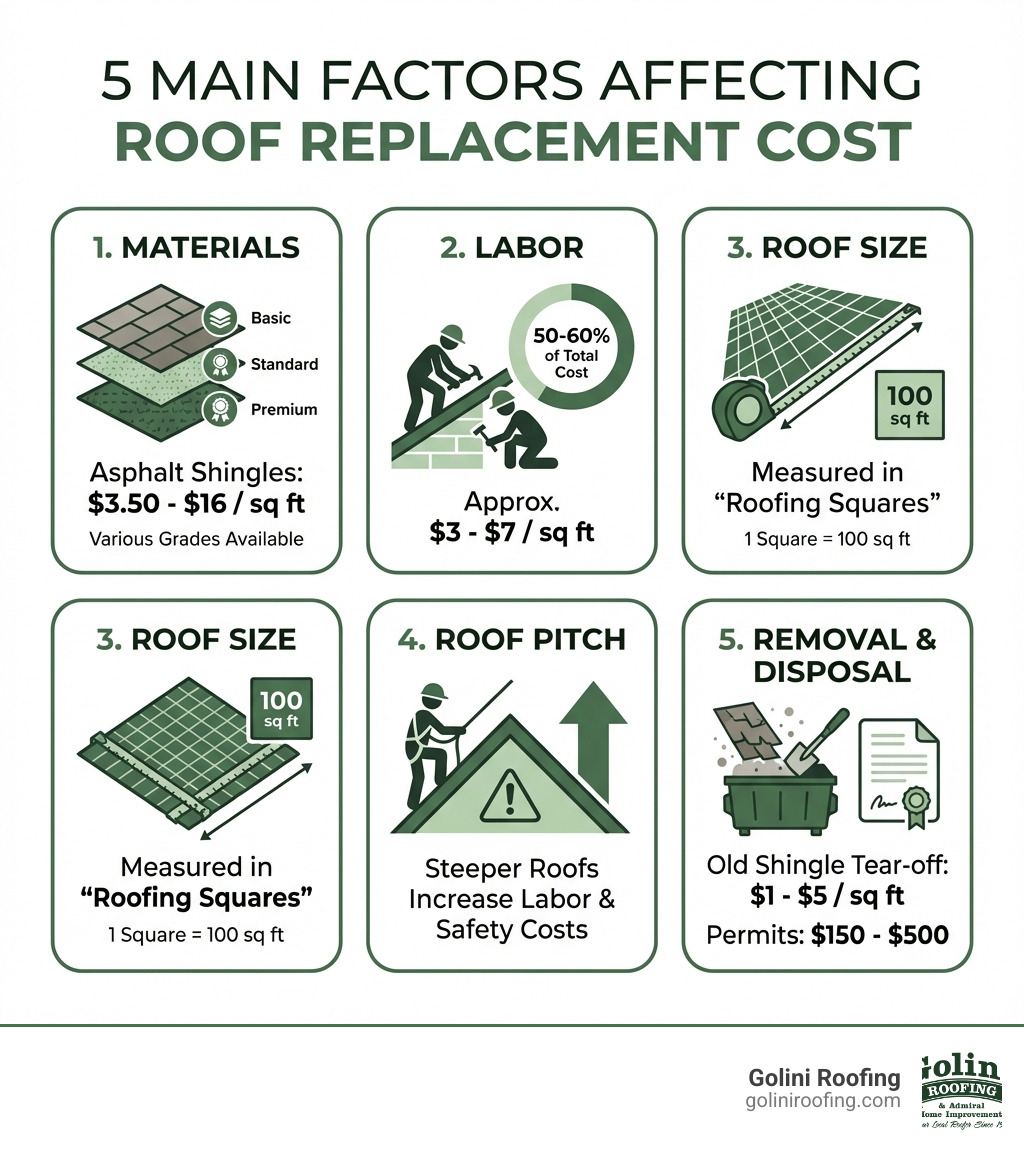
Deconstructing the Price Tag: Key Factors in Your Shingle Replacement Cost
Understanding what goes into a roof cost estimate empowers you to make informed decisions. Let’s break down the main components that shape your shingle replacement expenses.
Material Selection: More Than Just Color
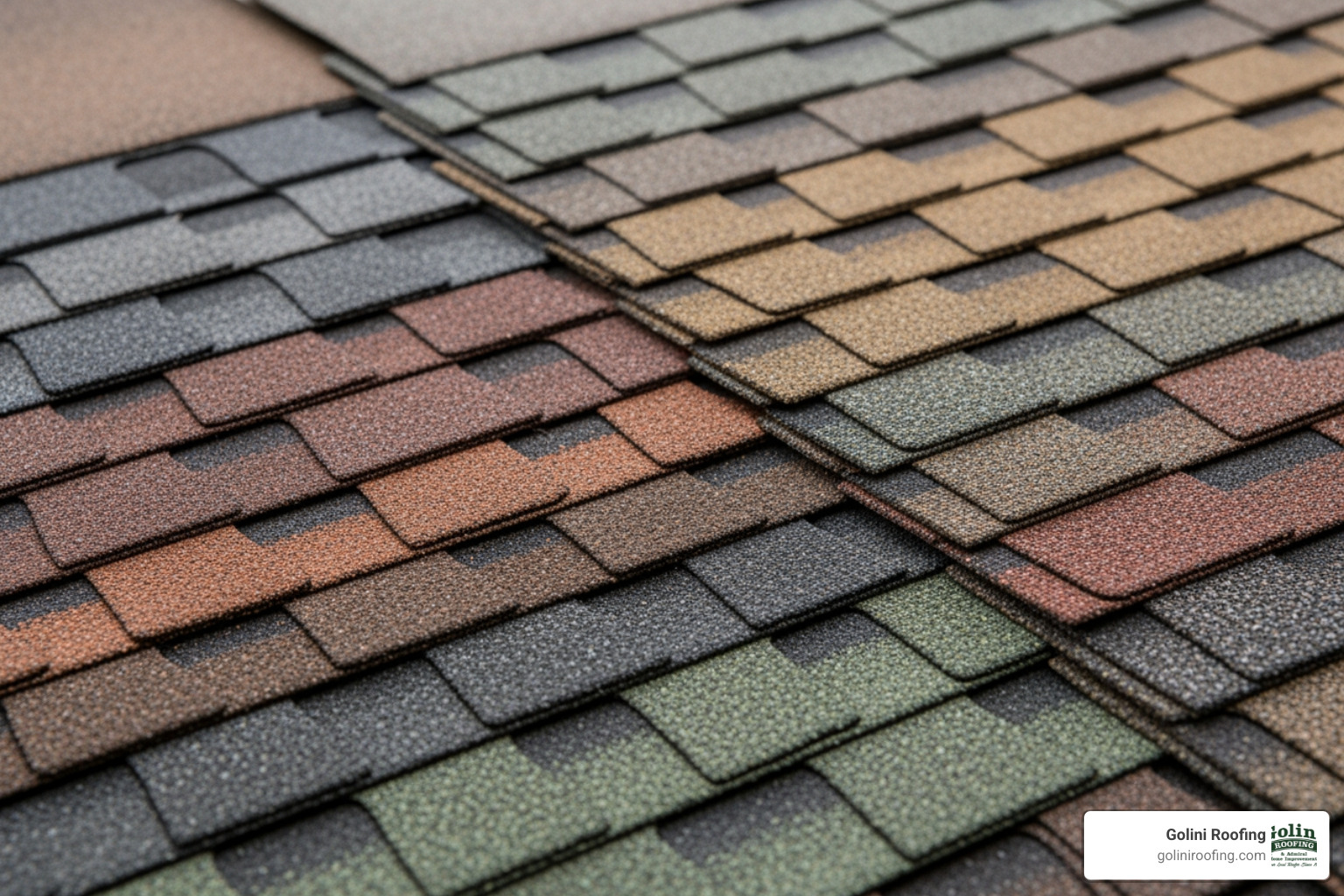
The type of shingle you choose is a primary cost driver. Asphalt shingles are popular in Massachusetts for their affordability and performance. The two main types are 3-tab and architectural shingles.
- 3-Tab Shingles: The most economical option, with a flat, uniform appearance. They are a classic choice for budget-conscious projects, costing around $3.50 to $5.00 per square foot installed and lasting 15-20 years.
- Architectural Shingles: Thicker, more durable, and offer a multi-dimensional look. They are today’s most common choice for an upgrade in aesthetics and longevity, typically ranging from $4.00 to $8.50 per square foot installed and lasting 25-30 years. Premium options can cost more.
Choosing the right residential roofing shingles involves balancing aesthetics, budget, and desired lifespan.
| Shingle Type | Average Cost Per Sq. Ft. (Installed)* | Typical Lifespan | Aesthetics |
|---|---|---|---|
| 3-Tab Asphalt | $3.50 – $5.00 | 15-20 years | Flat, uniform, classic |
| Architectural Asphalt | $4.00 – $8.50 | 25-30 years | Textured, multi-dimensional, modern |
*Note: These are average costs based on internet data and not actual costs for Golini Roofing. Prices can vary widely based on specific product lines, regional factors, and installation complexity.
Labor: The Biggest Slice of the Pie
Labor typically accounts for 50% to 60% of your total project cost, averaging $3.00–$7.00 per square foot. This cost reflects crew expertise, job complexity, and safety protocols. At Golini Roofing, we hand-nail each shingle. While nail guns are faster, we believe hand-nailing provides a more secure and durable installation, ensuring the longevity of your investment.
A simple, low-sloped roof requires less labor than a steep, multi-story roof with dormers and valleys, which demands more time and specialized safety equipment. For more on how labor costs are calculated, you can explore resources like Labor Wages and Costs: Building a Unit-Price System.
Roof Size and Pitch: The Math of Your Roof
Your roof’s total area and its slope (pitch) are fundamental to its replacement cost. The total surface area is measured in square feet and then converted into roofing squares (1 square = 100 sq. ft.). This industry-standard unit simplifies material and pricing calculations. You can learn more about this at What is a Roofing Square in Measurement.
The pitch of a roof describes its steepness. A steeper pitch increases the cost due to:
- Increased Labor: Slower, more demanding work.
- Safety Equipment: Requires more elaborate scaffolding and harnesses.
- Material Handling: More difficult to move materials safely.
- Waste Factor: More cuts are needed, increasing material waste.
The “Hidden” Costs: What Else to Budget For
Several other costs can impact your final price. Homeowners often overlook these when budgeting.
-
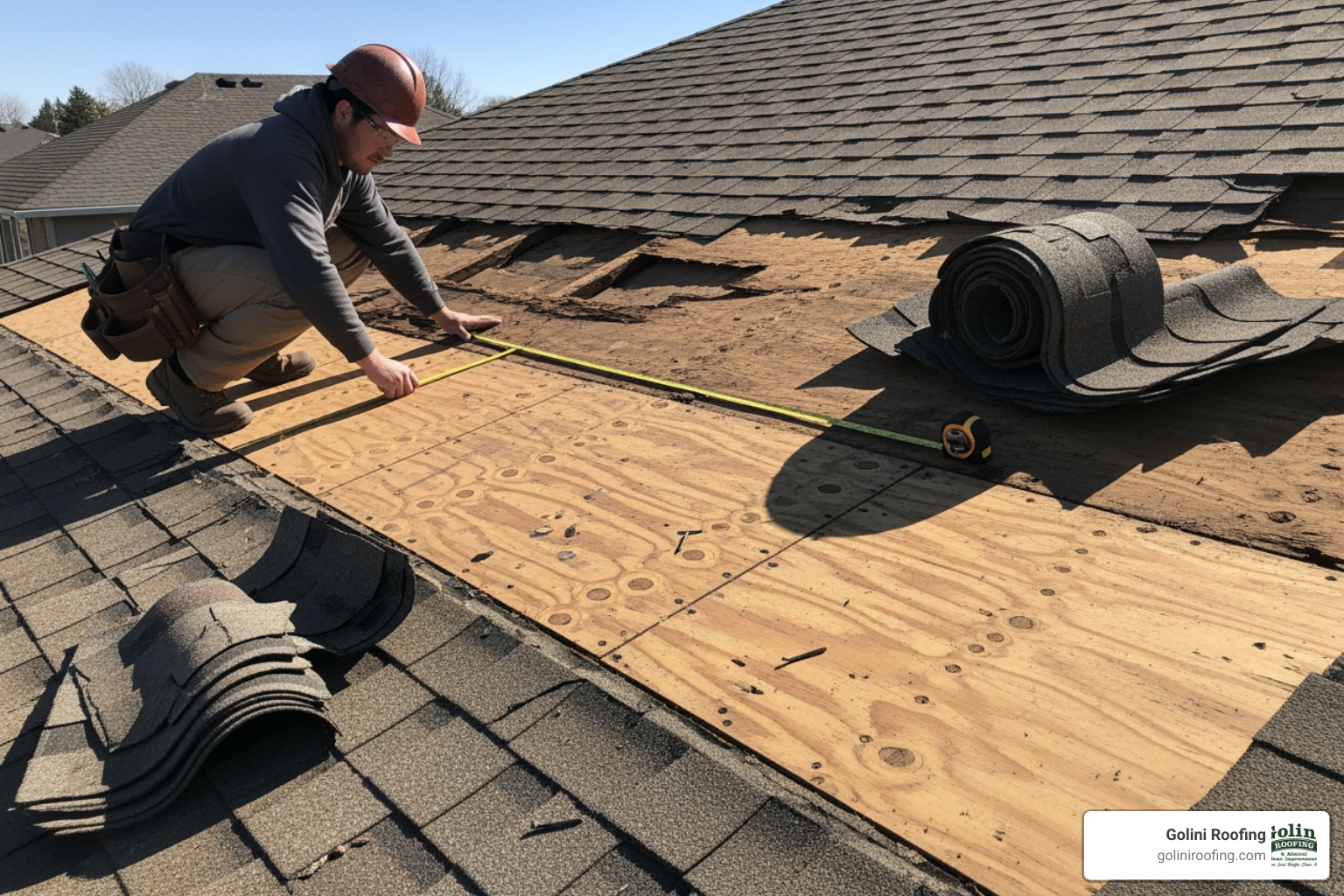
Old Roof Removal (Tear-Off): Removing and disposing of old materials typically costs $1-$5 per sq. ft. This includes dumpster rental and landfill fees. Learn more about Roof tear off cost.
-
Underlayment Replacement: This protective barrier beneath the shingles must be replaced if old or damaged, costing around $1.50 to $2.10 per sq. ft.
-
Roof Decking Repair: The plywood or OSB sheathing must be sound. If rot or damage is found during tear-off, repairs can cost $2.20 to $3.00 per sq. ft. for the affected area.
-
Permits and Inspections: Most Massachusetts towns, including our service areas, require permits for roof replacements. Fees typically range from $100 to $500.
-
Fascia and Soffit Replacement: If the boards along your roofline (fascia) or under the eaves (soffit) are damaged, it’s wise to replace them during the project. Costs vary, with soffit at $2.80 – $5.28 per linear foot and fascia at $4.25 – $8.62 per linear foot.
How to Estimate Roof Shingle Replacement: A 4-Step Calculation Guide
This section provides a framework for creating a rough estimate for a new roof. While not a substitute for a professional quote, a manual calculation gives you a valuable baseline.
Step 1: Measure Your Roof’s Total Square Footage
First, determine the actual surface area of your roof.
- Measure the Footprint: Measure the length and width of your home, including extensions like garages or porches.
- Add Overhangs: Add the length of your roof’s overhangs (typically 1-2 feet) to each side.
- Calculate Base Area: Multiply the adjusted length and width (e.g., 52 ft x 32 ft = 1,664 sq. ft.).
- Factor in Roof Pitch: A sloped roof has more surface area than its footprint. To adjust, multiply the base area by a “pitch multiplier.” For example, a common 7/12 pitch has a multiplier of about 1.16. (1,664 sq. ft. x 1.16 = ~1,930 sq. ft.).
- For Complex Roofs: Measure each plane, dormer, and valley separately and add them together. For very complex roofs, an online roof shingle calculator or a professional measurement is recommended.
Step 2: Calculate Your “Roofing Squares” and Material Needs
With your total square footage, you can calculate material needs.
- Convert to Roofing Squares: Divide your total square footage by 100 (e.g., 1,930 sq. ft. / 100 = 19.3 squares).
- Calculate Shingle Bundles: It takes about 3 bundles of asphalt shingles to cover one roofing square. (19.3 squares x 3 bundles/square = 58 bundles).
- Account for Other Materials: Remember to include underlayment, ice & water shield (critical for Massachusetts winters), drip edge, flashing, ridge cap shingles, nails, and sealant.
- Add a Waste Factor: Always add 10% for a simple roof or 15-20% for a complex roof to account for cuts and waste. (58 bundles x 1.10 waste factor = 64 bundles).
Step 3: Factor in Labor and Additional Costs
Next, add labor and other common expenses.
- Labor Rates: Labor averages $3.00–$7.00 per square foot. Multiply your total square footage by a mid-range rate (e.g., 1,930 sq. ft. x $4.00/sq. ft. = $7,720).
- Tear-Off and Disposal: Add costs for old roof removal, typically $1.00-$5.00 per square foot.
- Permit Fees: Budget $150-$500 for local permits.
- Contingency Fund: Set aside 10-20% of your total estimate for unexpected issues like rotted decking.
Combining these figures gives you a solid preliminary new shingle roof estimate.
Step 4: Putting It All Together: An Example of how to estimate roof shingle replacement
Let’s apply this to a hypothetical 2,000 sq. ft. roof (20 squares) in Wakefield, MA, with a 15% waste factor.
1. Material Costs (Architectural Shingles):
- Shingles: 69 bundles needed (20 squares x 3 bundles/sq x 1.15 waste). At an average material cost of $5.00/sq. ft., this is $10,000.
- Underlayment & Other Supplies: Underlayment, ice & water shield, flashing, nails, etc., can add $5,500 – $6,500.
- Total Estimated Material Cost: $15,500 – $16,500
2. Labor Costs:
- At $3.00–$7.00 per sq. ft., labor for a 2,000 sq. ft. roof ranges from $6,000 – $14,000.
3. Additional Costs:
- Tear-off & Disposal: At $0.40 – $2.00 per sq. ft., this adds $800 – $4,000.
- Permit: $150 – $500.
- Contingency (Decking/Fascia): Budget $740 – $1,400 for potential repairs.
4. Total Estimated Range:
- Low End: $15,500 (Materials) + $6,000 (Labor) + $800 (Tear-Off) + $150 (Permit) = ~$22,450 (plus contingency)
- High End: $16,500 (Materials) + $14,000 (Labor) + $4,000 (Tear-Off) + $500 (Permit) = ~$35,000 (plus contingency)
This example shows how much does roof replacement cost. These are estimates based on general data, not a quote from Golini Roofing.
Making the Right Call: Repair, Replace, DIY, or Pro?
Deciding on the best course of action for your home and budget is the next step. Should you repair a leak or replace the whole roof? Can you do it yourself, or is a professional essential?
When to Repair vs. When to Replace Your Shingles
Understanding the difference between a roof repair and replacement is key.
Consider a Repair if:
- The damage is localized (a few missing shingles, a small leak).
- Your roof is relatively young (under 15 years old) and otherwise in good shape.
- You need a temporary fix before a planned replacement.
Consider a Replacement if:
- Your roof is near or past its 15-30 year lifespan.
- Damage is widespread (curling, cracking, missing granules).
- You have frequent leaks or a sagging roof deck.
- You plan to sell your home soon, as a new roof is a major selling point.
A professional inspection can provide a clear recommendation.
The Great Debate: DIY vs. Hiring a Professional Roofer
While DIY roofing can seem like a way to save money, it carries significant risks.
DIY Pros & Cons:
- Pro: Potential savings on labor costs.
- Cons: High safety risks from falls, need for expensive specialized tools, steep learning curve for proper installing roof shingles, and risk of voiding material warranties. Improper installation can lead to leaks and costly structural damage from moisture, as detailed in the EPA’s Moisture Control Guidance for Building Design.
Hiring a Pro:
- Pros: Expertise, efficiency, safety, and quality workmanship. Professionals are insured and typically offer warranties on both materials and labor, providing peace of mind.
- Cons: Higher upfront cost.
For a full replacement, the benefits of hiring a professional almost always outweigh the risks of DIY.
How to Choose a Reliable Roofing Contractor for an Accurate Quote
Finding the right contractor is crucial. Here’s what to look for:
- License and Insurance: Ensure they are licensed in Massachusetts and carry both general liability and workers’ compensation insurance.
- Reviews and References: Look for a strong local track record and positive client feedback.
- Get Multiple Itemized Quotes: Get at least three detailed, written quotes to compare materials, labor, and other costs.
- Understand the Warranty: Ask about both the manufacturer’s and the contractor’s warranties.
- Look for Local Experience: A contractor familiar with local weather and building codes is a plus.
- Watch for Red Flags: Be wary of unusually low bids, demands for full payment upfront, high-pressure tactics, or a lack of a written contract.
Following these steps will help you find a trustworthy partner. For more tips, see our guide on How to find local roofers.
Frequently Asked Questions about Roof Shingle Estimates
How many estimates should I get for a new shingle roof?
We recommend getting at least three itemized estimates. This allows you to compare pricing, material recommendations, and the scope of work from different contractors. A detailed roofing estimate helps you make an apples-to-apples comparison and understand exactly what you’re paying for.
Can I put new shingles over my old ones to save money?
This practice, called a “roof-over,” can save on tear-off costs but is generally not recommended. It can hide underlying problems like rotted decking, trap moisture, and may void the new shingle warranty. The added weight and uneven surface can also reduce the new roof’s lifespan. A full tear-off is almost always the better long-term investment, as it allows for a proper inspection and installation.
How does a new roof impact my home’s resale value?
A new roof significantly boosts resale value. It’s a major selling point for buyers, offering peace of mind and improved curb appeal. Roofing replacements consistently provide a strong return on investment (ROI). Additionally, a modern, well-ventilated roof can improve energy efficiency and may even lead to lower home insurance premiums, making your home more attractive on the market.
Get a Professional and Accurate Shingle Replacement Estimate
We hope this guide has helped you understand how to estimate roof shingle replacement. Creating your own estimate is an excellent way to budget and prepare for conversations with contractors.
However, for a truly reliable price, a professional roof inspection is essential. An experienced roofer can spot subtle issues, accurately measure complex roofs, and recommend the best materials. At Golini Roofing, we provide detailed, transparent estimates backed by our meticulous, hand-nailed craftsmanship.
When you’re ready for a precise quote for your shingle replacement in Burlington, Lynnfield, North Reading, Reading, Stoneham, Wakefield, Wilmington, Winchester, or Woburn, reach out to us. Get a replace roof shingles estimate you can trust.