
Asphalt Shingle Roof Estimate: 10 Powerful Cost Drivers 2025
Why Getting an Accurate Asphalt Shingle Roof Estimate is Your First Step to Success
An asphalt shingle roof estimate can range from $4.50 to $12.25 per square foot, but most homeowners pay between $10,500 and $28,500 for a complete replacement on a typical 3,000 square foot roof. Here’s what you need to know:
Quick Estimate Formula:
• Materials: $1.50–$5.50 per square foot
• Labor: $1.50–$3.00 per square foot
• Removal: $1.00–$5.00 per square foot
• Total Range: $4.50–$12.25 per square foot installed
Note: These are average internet-based costs and not actual Golini Roofing pricing.
Whether you’re dealing with missing shingles after a storm or planning a full replacement, understanding the true cost drivers helps you budget properly and avoid contractor surprises. The difference between a $10,000 quote and a $25,000 quote often comes down to factors like roof complexity, material grade, and regional labor rates.
The reality? Most homeowners underestimate their roofing costs by 20-30% because they don’t account for removal, permits, or the hidden complexities that every roof presents.
I’m Jack Golini, and I’ve been helping North Shore homeowners steer asphalt shingle roof estimates since 1982, completing thousands of projects with our signature hand-nailed craftsmanship. Over my 35+ years in roofing, I’ve seen how a proper asphalt shingle roof estimate can save homeowners from costly surprises and ensure they get the quality roof their home deserves.
What Makes Asphalt Shingles America’s Favorite Roof?
Walk through any neighborhood in America, and you’ll notice something interesting – most roofs are covered with asphalt shingles. There’s a simple reason for this dominance: asphalt shingles hit the sweet spot between affordability, durability, and curb appeal that homeowners have been looking for since the 1900s.
The magic starts with their composition. Each shingle begins with a sturdy fiberglass mat that acts like the backbone. This gets coated with asphalt for waterproofing, then topped with ceramic granules that protect against UV rays and give the shingle its color and texture. The result? A lightweight roofing material that earns a UL Class A fire rating and can handle winds up to 110-130 mph, depending on the grade you choose.
But here’s where it gets interesting for your asphalt shingle roof estimate – not all asphalt shingles are created equal. The three main types serve very different budgets and performance needs.
3-tab shingles are the economy car of roofing. They typically last 15-20 years and cost around $80-$130 per square for materials (though prices can range much higher depending on your location and market conditions). At about 2.2 pounds per square foot, they’re lightweight and provide solid basic protection. However, many manufacturers are phasing them out as better options become more affordable.
Architectural shingles – also called dimensional shingles – are where most homeowners find their sweet spot. These workhorses last 20-35 years and offer improved wind resistance up to 130 mph. What really sets them apart is their attractive dimensional look that mimics expensive materials like wood shake or slate, without the maintenance headaches.
The premium option, luxury shingles, can last 25-40 years and dramatically boost your home’s curb appeal. While they typically cost 10-20% more than standard architectural shingles, they often include algae resistance and beefed-up warranty coverage that can make the extra investment worthwhile.

What really makes asphalt shingles shine is their incredible versatility. Modern manufacturing has come a long way from the basic black shingles of decades past. Today’s options include realistic wood grain textures, convincing slate-like appearances, and a rainbow of colors to complement any architectural style. Those ceramic granules don’t just provide UV protection – they create the visual depth and texture that can make your roof a genuine asset to your home’s appearance.
When you’re planning your roofing project, the material choice significantly impacts your overall costs. The difference between 3-tab and luxury shingles might seem small per square foot, but it adds up quickly when you’re covering an entire roof.
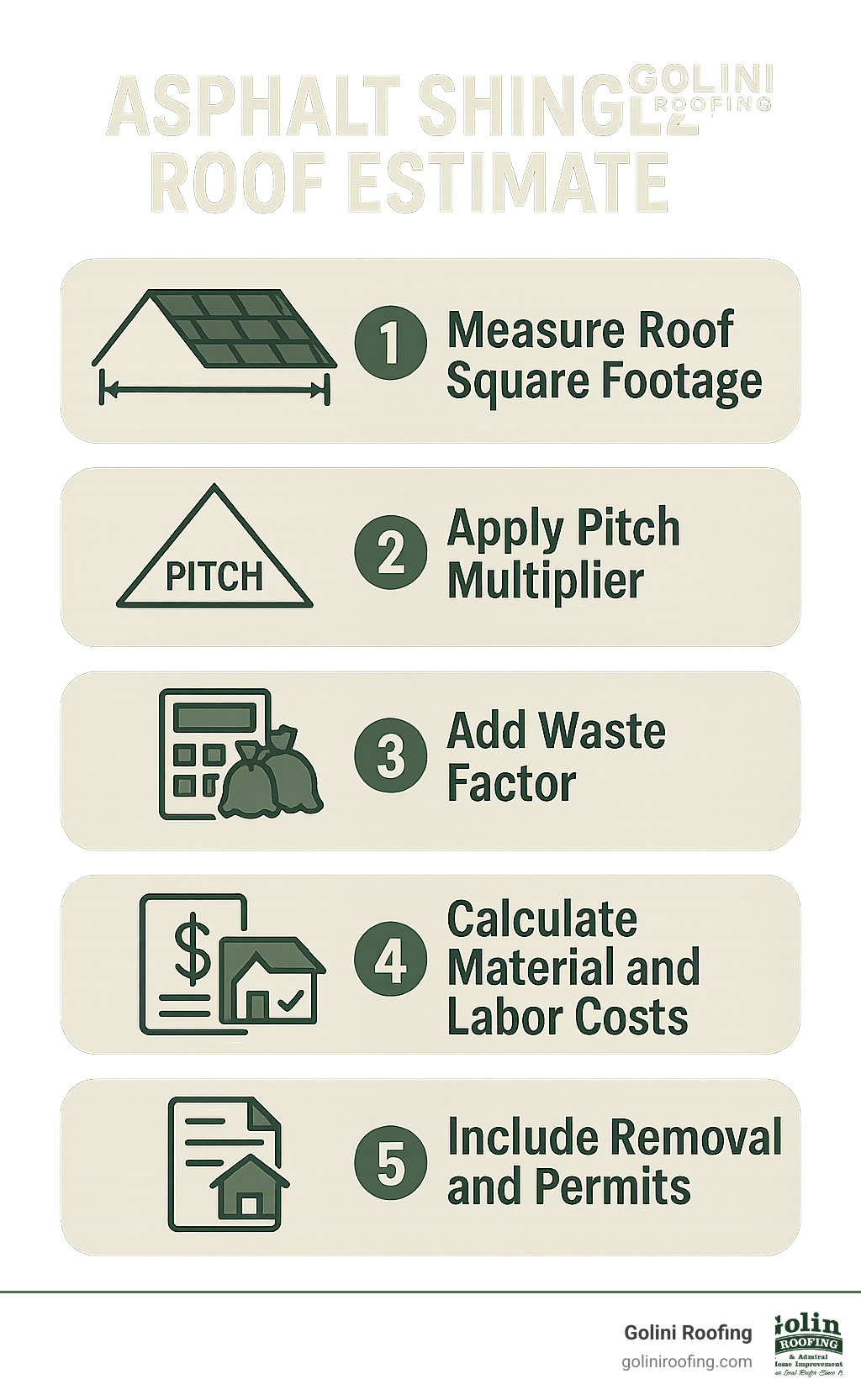
Asphalt Shingle Roof Estimate – Step-By-Step DIY Math
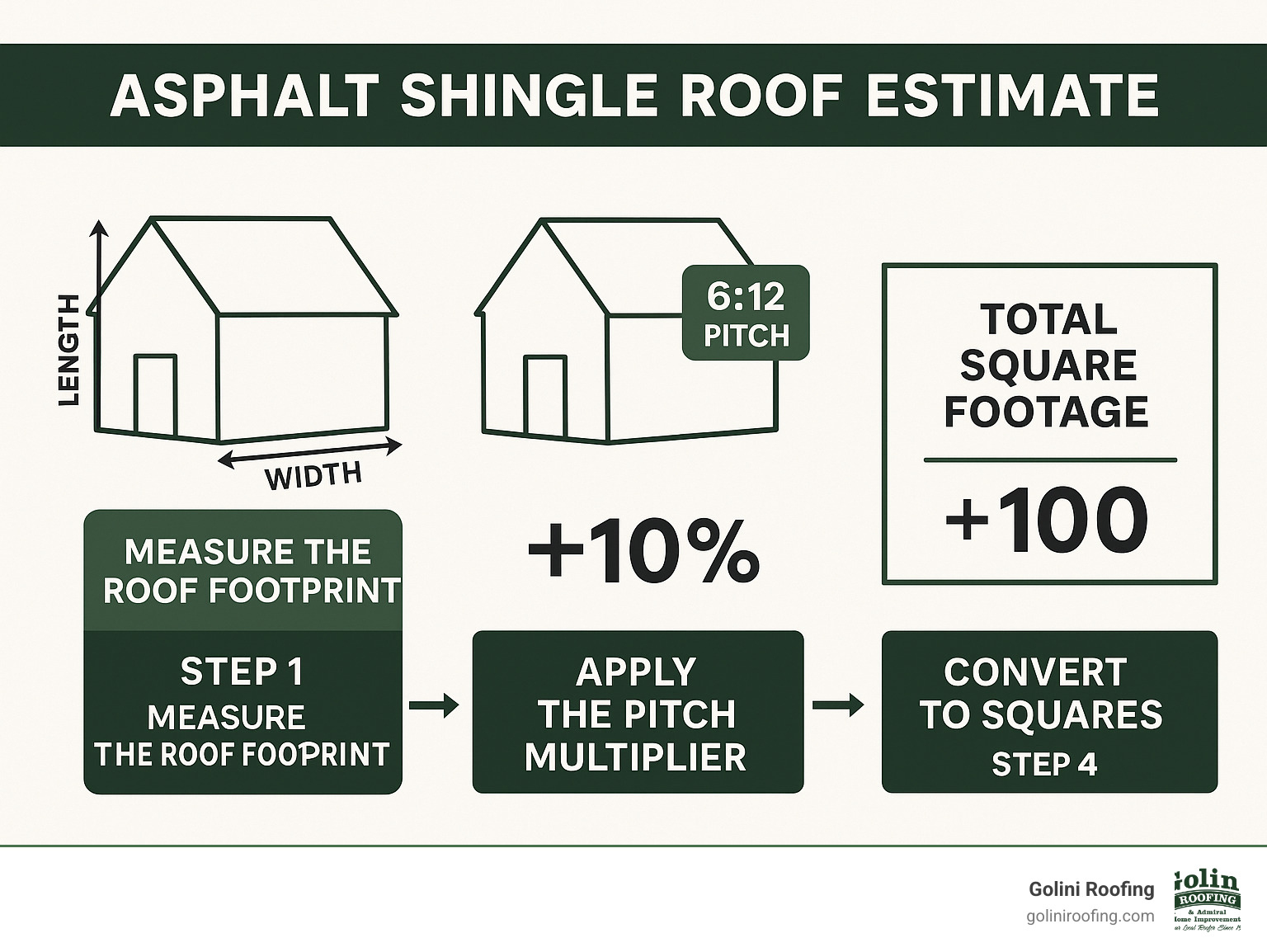
Getting your own asphalt shingle roof estimate isn’t rocket science, but it does require understanding how roofing professionals think about measurements. The secret lies in knowing that everything revolves around “squares” – and no, we’re not talking geometry class here. One roofing square equals exactly 100 square feet of roof surface.
Here’s where it gets interesting: your home’s footprint and your actual roof area are two completely different numbers. That cozy 2,000 square foot ranch might actually need 22-25 squares of shingles once you factor in the roof’s slope and complexity. The steeper your roof, the more surface area you’re covering.
The math follows a logical sequence that every contractor uses. Start by measuring your roof’s footprint – length times width for each section. Then comes the pitch multiplier, which accounts for your roof’s slope. A flat roof gets a multiplier of 1.0, but a standard 6:12 pitch roof needs 1.12 times more material. Got a steep 12:12 pitch? You’re looking at 41% more surface area than the footprint suggests.
Don’t forget the waste factor – even the most skilled roofers need extra material for cuts, mistakes, and future repairs. Simple roofs need about 10% extra, while complex roofs with lots of angles and dormers require 15% or more. Finally, convert your total square footage to squares by dividing by 100, then figure out your bundle needs since most shingles come 3-4 bundles per square.
If you want to skip the math headaches, our Roof Square Footage Calculator walks you through each step with helpful prompts and automatic calculations.
Calculate Your Asphalt Shingle Roof Estimate Like a Pro
Creating a professional-quality asphalt shingle roof estimate starts with having the right tools and – more importantly – staying safe while you measure. Never attempt to climb on your roof without proper safety equipment, especially if it’s steep, wet, or showing signs of damage. You can get excellent measurements from the ground using a long measuring tape and some basic math.
Modern technology makes roof measuring surprisingly accessible. LiDAR-enabled smartphone apps can provide remarkably accurate measurements just by pointing your phone at the roof sections. Satellite imagery tools give you rough estimates for initial planning, while digital calculators automatically handle the pitch multipliers and waste factors that trip up most homeowners.
For those serious about accuracy, drone measurements provide professional-level results, though most homeowners can achieve their goals with simpler ground-based methods. The key is measuring systematically and paying attention to the details that affect cost.
Watch out for the complexity multipliers that can dramatically impact your estimate. Dormers and bump-outs add both material and labor costs. Valleys and hips require special flashing work that takes extra time. Chimneys and other roof penetrations need custom fitting and sealing. Even overhangs and soffits contribute to your total area calculation.
The EPA’s scientific research on roof moisture control emphasizes how proper ventilation and vapor barriers affect long-term roof performance – factors that influence both material choices and installation complexity in your estimate.
Cost Per Square Foot Breakdown for an Asphalt Shingle Roof Estimate
Understanding how costs break down helps you create a realistic asphalt shingle roof estimate and spot the warning signs in contractor quotes that seem too good to be true. The numbers tell a clear story about where your roofing dollars actually go.
Material costs range from $1.50 to $5.50 per square foot depending on your shingle choice. Basic 3-tab shingles fall in the $1.50-$2.50 range, while architectural shingles typically run $2.00-$4.00 per square foot. Luxury shingles command premium pricing at $3.00-$5.50 per square foot, but they deliver superior durability and curb appeal.
Labor costs typically run $1.50 to $3.00 per square foot, though this varies significantly based on roof complexity and regional labor rates. Simple roofs with easy access stay toward the lower end, while complex roofs with steep pitches, multiple angles, or difficult access can push costs higher. Steep pitch roofs often carry a 20-50% labor premium due to safety requirements and slower installation.
Removal costs add another $1.00 to $5.00 per square foot to your project. Single-layer tear-offs usually cost $1.00-$2.00 per square foot, while removing multiple layers can reach $2.00-$5.00 per square foot. Don’t forget disposal fees, which typically add $0.25-$0.30 per square foot for hauling away the old materials.
| Shingle Type | Material Cost/Sq Ft | Lifespan | Wind Rating | Warranty |
|---|---|---|---|---|
| 3-Tab | $1.50–$2.50 | 15-20 years | 60 mph | 20-25 years |
| Architectural | $2.00–$4.00 | 20-35 years | 110-130 mph | 30-50 years |
| Luxury | $3.00–$5.50 | 25-40 years | 130+ mph | 50 years-Lifetime |
Note: These are average internet-based costs and not actual Golini Roofing pricing.
Here’s something most homeowners don’t realize: labor typically accounts for about 60% of your total roofing investment. This is exactly why installation quality matters so much for long-term performance. At Golini Roofing, we hand-nail every single shingle rather than using pneumatic guns, ensuring superior holding power that lasts decades – though this meticulous approach requires more time and skill than standard installation methods.
10 Cost Drivers That Can Inflate or Shrink Your Quote
Your asphalt shingle roof estimate can vary wildly based on factors that many homeowners don’t consider upfront. I’ve seen quotes for similar-sized homes differ by $15,000 or more, and it usually comes down to these ten key cost drivers.
Roof size is the obvious starting point, but here’s where it gets interesting – larger roofs actually cost less per square foot due to economies of scale. A 1,200 square foot roof might run $8-10 per square foot, while a 3,000 square foot roof could drop to $6-7 per square foot for the same materials and quality.
Roof pitch and stories can make your contractor’s job significantly harder. Once you hit a 6:12 pitch or steeper, expect labor costs to jump 20-50%. Multi-story homes add another layer of complexity (literally), requiring more safety equipment and slower installation speeds.
Valleys and dormers are where costs really start climbing. Each valley needs special flashing and careful shingle work, typically adding $100-$300 per linear foot to your project. Dormers create multiple roof planes that turn a straightforward job into a puzzle of angles and intersections.
Material grade selection offers one of the biggest decision points in your budget. Jumping from basic 3-tab to architectural shingles might add $2,000-$5,000 to a typical project, but you’re also getting 10-15 more years of life and much better curb appeal.
Underlayment upgrades represent smart money spent. Standard felt runs about $0.30 per square foot, while synthetic underlayment costs $0.50-$0.70 per square foot but offers superior protection. Ice and water shield for critical areas like valleys and eaves adds another $1-$2 per square foot but prevents costly ice dam damage.
Flashing and penetration work around chimneys, skylights, and vents requires custom metalwork and careful sealing. Each penetration typically adds $150-$500 to your project cost, depending on complexity. This study on flashing repair costs shows why proper flashing installation matters so much for long-term performance.
Gutter integration can either save or cost you money. Adding new gutters to your roofing project typically runs $1,000-$6,500, but coordinating the work saves mobilization costs and ensures everything works together properly.
Permits and inspections vary dramatically by location. Some towns charge $250 for a permit, while others hit you for $1,500 or more. Factor in inspection fees and potential re-inspection costs if work doesn’t meet code on the first try.
Disposal fees for old roofing materials can shock homeowners. Removing and disposing of old shingles costs $1-$5 per square foot, with some areas having limited disposal options that drive costs even higher.
Seasonal demand creates the biggest pricing swings of all. Spring and summer installations can cost 15-30% more due to high demand, while fall and winter work (when weather permits) often offers better pricing. Smart homeowners plan ahead to take advantage of off-season rates.
Note: These are average internet-based costs and not actual Golini Roofing pricing.
Stretching Your Roofing Dollars & Boosting Home Value
A new asphalt shingle roof estimate might feel like a major expense, but here’s some good news: Remodeling Magazine’s 2023 Cost vs. Value report shows roof replacements deliver a solid 61.1% return on investment. That means a $20,000 roof replacement typically adds about $12,200 to your home’s value – not bad for something that also keeps you dry!
The key is making smart decisions that maximize both your savings upfront and your home’s long-term value.
Think prevention, not just replacement. Regular maintenance can stretch your roof’s lifespan by 5-10 years, which is like getting free money. Annual inspections, keeping gutters clean, and fixing small problems before they become big ones costs far less than starting over. We recommend professional inspections every 2-3 years and definitely after major storms – catching a few loose shingles early beats dealing with water damage later.
The overlay versus tear-off decision can significantly impact your budget. Installing new shingles over existing ones saves $1-$3 per square foot in removal costs, but it’s only smart if you have just one existing layer and your deck is solid. Most building codes limit you to two total layers anyway, and overlays prevent proper deck inspection. Sometimes the cheaper option today costs more tomorrow.
Timing your project strategically can save serious money. Booking during fall or winter (when weather cooperates) often saves 15-30% on labor costs. Contractors appreciate steady work during slower periods and typically offer better pricing. You might have to wait for a good weather window, but your wallet will thank you.
Don’t overlook financing and grant opportunities. Many roofing contractors offer financing programs that let you spread costs over time. Some utility companies provide rebates for energy-efficient materials, and veterans or seniors may qualify for special grant programs in certain areas. A little research can uncover surprising savings.
If storm damage triggers your roof replacement, proper documentation and professional assessment help maximize your insurance settlement. Work with contractors experienced in insurance claims – they know how to present damage in ways insurance adjusters understand and can help ensure you receive fair compensation.
Strategic DIY preparation can trim labor costs without compromising safety. While we never recommend DIY shingle installation (seriously, leave that to the pros), homeowners can handle prep work like moving outdoor furniture, clearing landscaping around the house, and organizing delivery areas. Every hour you save the crew is money in your pocket.
For comprehensive cost planning strategies, our Estimate the Cost of a New Roof guide provides additional insights for maximizing your roofing investment and getting the most value from every dollar spent.
Finding the Right Contractor & Avoiding Common Mistakes
Choosing the right contractor makes the difference between a roof that lasts 15 years and one that lasts 35 years. With over 35 years of experience serving the North Shore, we’ve seen how quality installation techniques dramatically impact long-term performance. The wrong choice can turn your asphalt shingle roof estimate into a costly nightmare.
Getting three written bids is your first line of defense against contractor problems. Legitimate contractors will provide itemized quotes showing materials, labor, permits, and cleanup costs. Be especially wary of door-to-door salespeople who show up after storms promising quick fixes – they’re often gone before you find problems with their work.
The difference between a $10,000 bid and a $15,000 bid often comes down to quality details that aren’t immediately obvious. That cheaper quote might use thinner underlayment, skip proper flashing, or rely on inexperienced crews who rush through installations.
Licenses and insurance verification protects you from financial disaster. Massachusetts requires roofing contractors to carry workers’ compensation and liability insurance, but many homeowners simply take the contractor’s word for it. Always ask for certificates and verify coverage directly with insurance companies. If someone gets hurt on your property and the contractor lacks proper insurance, you could be liable for medical bills and lawsuits.
Manufacturer certifications separate professional contractors from weekend warriors. Quality contractors maintain certifications with major shingle manufacturers like GAF, Owens Corning, or CertainTeed. These programs require ongoing training and often provide improved warranty coverage. At Golini Roofing, our certifications allow us to offer extended manufacturer warranties that protect your investment.
The installation method reveals everything about a contractor’s commitment to quality. Hand-nailing versus pneumatic installation might seem like a minor detail, but it significantly impacts long-term performance. Pneumatic guns can overdrive nails, damaging shingles, or underdrive them, reducing holding power. Our hand-nailing approach takes longer but ensures precise nail placement and proper depth control, reducing the risk of blow-offs and leaks.
Warranty fine print trips up many homeowners who assume all warranties are the same. Manufacturer warranties cover material defects, while workmanship warranties cover installation issues. Understanding what’s covered, for how long, and what actions might void coverage can save thousands down the road. Quality contractors stand behind their work with comprehensive workmanship warranties – we offer both because we’re confident in our craftsmanship.
Low-ball offers are red flags that should make you run, not walk, away. Extremely low bids often indicate corner-cutting on materials, labor, or safety protocols. Contractors who underbid typically make up costs through surprise change orders or by using substandard materials. You’re not just buying shingles – you’re buying peace of mind.
Safety protocols reveal a contractor’s professionalism and protect your property. Professional contractors maintain strict safety standards, including proper equipment, training, and insurance coverage. Ask about safety procedures and observe whether crews follow OSHA guidelines. Contractors who skimp on safety often cut corners elsewhere too.
For detailed information about our installation process and quality standards, visit our Asphalt Shingle Roof Installation page.
Frequently Asked Questions about Asphalt Shingle Roof Estimates
How often should asphalt shingles be replaced?
The lifespan of asphalt shingles varies dramatically based on the type you choose and where you live. Three-tab shingles typically need replacement after 15-20 years, while architectural shingles can protect your home for 20-35 years. Luxury shingles offer the longest protection, often lasting 25-40 years when properly maintained.
Climate plays a huge role in determining how long your asphalt shingle roof estimate timeline should account for replacement. In scorching hot climates like Arizona, intense UV exposure and constant thermal cycling can wear out shingles in just 14 years. Here in Massachusetts, our more moderate climate often allows the same shingles to last well over 25 years.
Proper attic ventilation is like giving your roof a breath of fresh air – it prevents heat buildup that can literally cook your shingles from below. We’ve seen well-ventilated roofs outlast poorly ventilated ones by 5-10 years, even with identical materials.
You’ll know it’s time to start planning a new asphalt shingle roof estimate when you notice curling or missing shingles, find granules collecting in your gutters like sand, spot moss or algae growth, find interior leaks or water stains, or when your roof hits the 20-year mark for standard shingles. Don’t wait until you’re catching rainwater in buckets – planning ahead saves money and stress.
Can I install asphalt shingles myself without voiding warranties?
While YouTube might make roofing look easy, DIY shingle installation is rarely worth the risk and almost always voids your manufacturer warranties. Most shingle warranties specifically require installation by certified professionals to remain valid – and there’s good reason for that requirement.
Safety hazards top the list of concerns. Roofing consistently ranks among the most dangerous construction activities, with falls causing serious injuries every year. Add electrical lines, steep pitches, and heavy materials, and you’re looking at significant risk.
Warranty voidance means you could lose thousands in coverage if materials fail prematurely. Building code violations can create problems when selling your home, and insurance issues may arise if DIY work causes damage to your property or neighbors’ homes.
At Golini Roofing, our hand-nailing technique takes years to master properly. Each nail must hit the right spot at the perfect depth – too shallow and shingles blow off, too deep and you create leak points. Professional installation ensures proper techniques, appropriate materials, and full warranty protection that far outweighs any labor cost savings.
Does location really change the estimate that much?
Location can dramatically swing your asphalt shingle roof estimate by 50-100% or more, making it one of the biggest factors in final pricing. Labor costs vary enormously between regions – roofing work in Boston typically costs 40-60% more than in rural areas due to higher wages, living costs, and stricter regulations.
Transportation distances from manufacturing centers affect material costs significantly. Local supplier competition and availability create price variations, while building code requirements in different areas may mandate specific upgraded materials that cost more upfront.
Weather considerations also drive regional differences. Areas prone to hurricanes require higher wind-rated materials, while northern climates need better ice dam protection. These aren’t just suggestions – they’re often code requirements that affect your estimate.
Regional cost multipliers help adjust national pricing averages. The Northeast, including Massachusetts, typically runs 110-130% of national averages. The West Coast often sees 120-150% of national pricing, while the Southeast might enjoy 85-95% of national averages, and the Midwest generally falls between 90-110% of national pricing.
This is why getting local quotes matters so much more than relying on online calculators. Your asphalt shingle roof estimate needs to reflect real local conditions, not generic national averages that might be completely off-base for your area.
Conclusion
Getting an accurate asphalt shingle roof estimate might seem overwhelming at first, but you now have the tools to steer this important investment with confidence. The wide range of $4.50–$12.25 per square foot reflects the reality that every roof is unique – your neighbor’s simple ranch might cost half what your Victorian with multiple dormers requires.
Remember: These pricing ranges represent average internet-based costs and not actual Golini Roofing pricing.
The difference between a successful roofing project and a costly nightmare often comes down to preparation and choosing the right team. Measure carefully, understand what drives your costs up or down, and never rush into a decision based on price alone. A roof that costs $2,000 less upfront but fails after 15 years instead of 30 isn’t really a bargain.
After 35 years of hand-nailing shingles across the North Shore, I’ve learned that quality installation matters more than almost any other factor. We take pride in our meticulous approach because we know that every properly placed nail means years of additional protection for your family and your investment.
Your next steps are straightforward: Start with accurate measurements, get multiple detailed quotes from licensed contractors, and ask plenty of questions. Don’t let anyone pressure you into signing on the spot – legitimate contractors understand that replacing your roof is a major decision that deserves careful consideration.
Whether you’re in Burlington dealing with storm damage or in Winchester planning ahead for an aging roof, the principles remain the same. Plan thoroughly, measure accurately, and choose a contractor who stands behind their work with both skill and integrity.
Ready to move forward? Our New Roof Estimate Calculator gives you a great starting point for planning your budget. From there, we’re always happy to provide a detailed assessment that takes into account your roof’s unique characteristics and your specific needs.
Remember – a quality asphalt shingle roof estimate isn’t just about today’s costs. It’s about making an investment that protects your home and family for decades to come.
