
Cost to repair flat roof ponding: 1st Smart Step
What is Flat Roof Ponding and Why Is It a Problem?
The cost to repair flat roof ponding ranges from $75 to $500 for basic drainage fixes, but can escalate to $750-$2,500 for structural repairs when ponding causes sagging or membrane damage. Here’s what you need to know about ponding repair costs:
Quick Cost Breakdown:
- Minor drainage cleaning: $75-$500
- Adding new drains: $1,500-$2,500 per drain
- Membrane patching: $300-$1,750
- Structural sagging repair: $750-$2,500
- Major repairs/replacement: $3,000-$12,000+
Note: These are average costs based on industry data and not specific to Golini Roofing services.
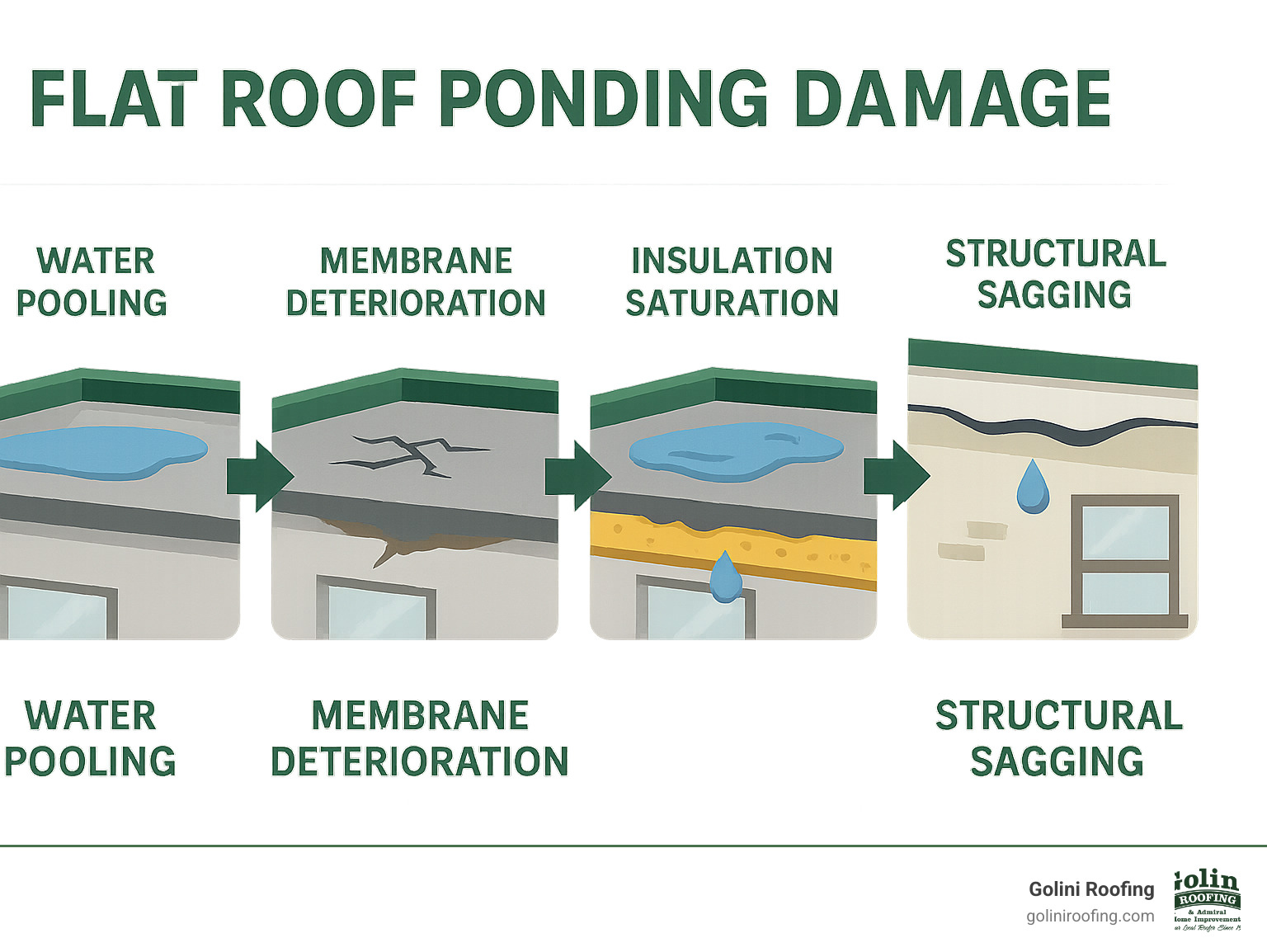
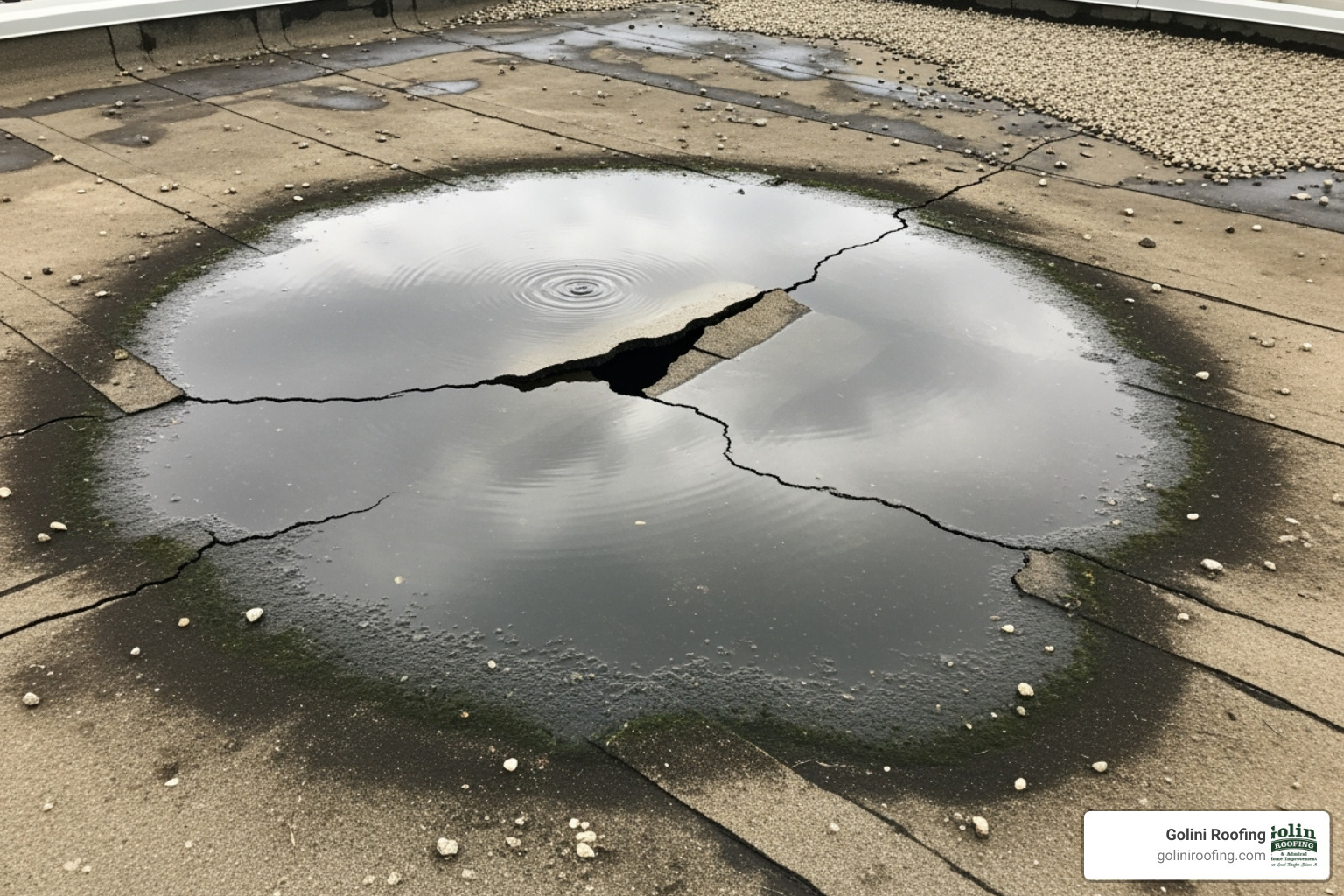
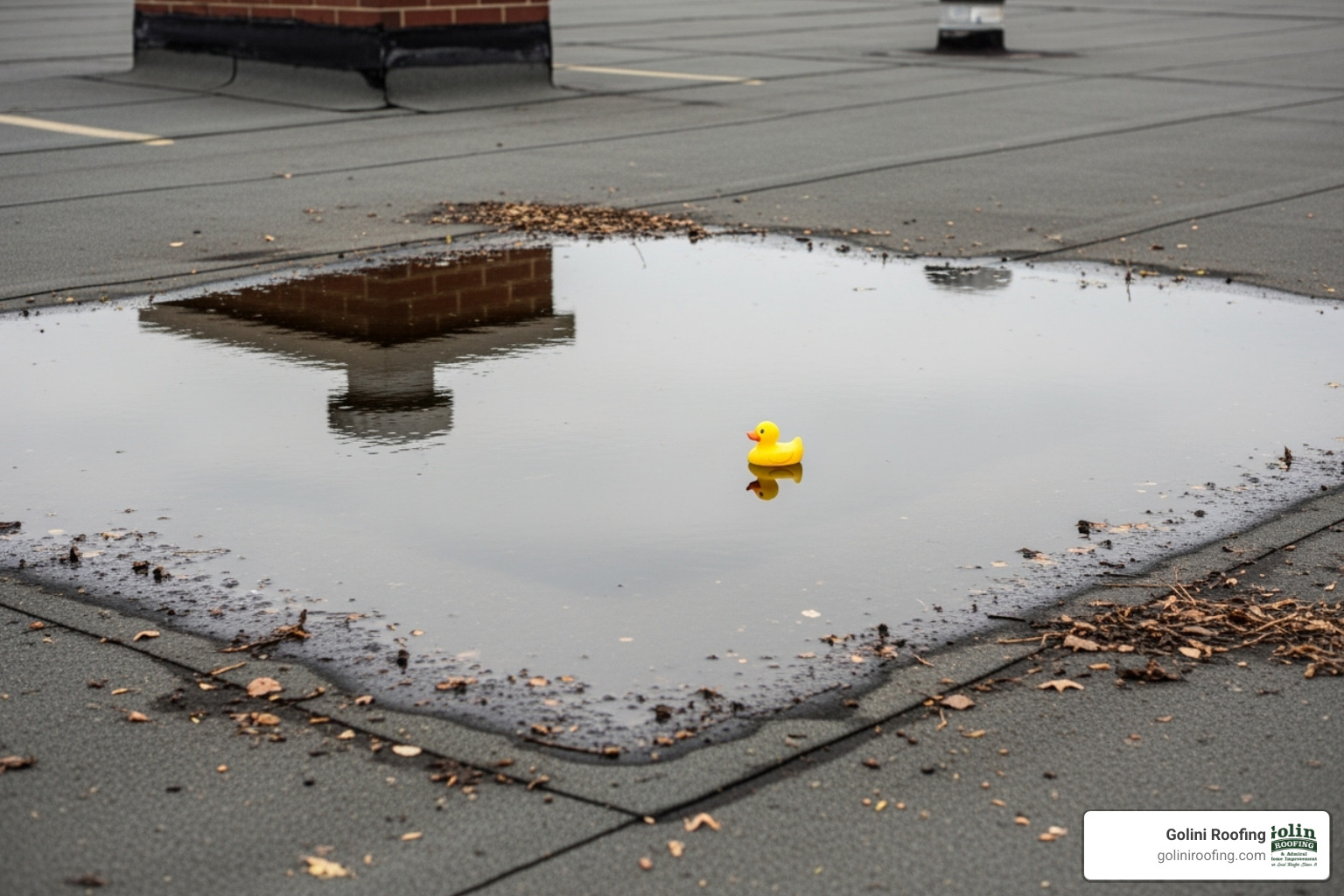
Flat roof ponding happens when water sits on your roof for more than 48 hours after rainfall. What starts as a small puddle can quickly become a serious structural threat to your home.
Standing water weighs about 5.2 pounds per square foot for each inch of depth. That means just two inches of ponding water adds over 10 pounds per square foot to your roof structure – weight it wasn’t designed to handle long-term.
The real danger comes from what happens next. Prolonged water exposure breaks down roofing materials, saturates insulation, and can lead to roof deck sagging, leaks, and even structural collapse. According to the National Roofing Contractors Association, any water ponding for more than 48 hours requires professional evaluation.
I’m Jack Golini, and I’ve been helping North Shore homeowners solve flat roof problems since 1982. Over my 35+ years in roofing, I’ve seen how understanding the cost to repair flat roof ponding early can save homeowners thousands in emergency repairs later.
Cost to repair flat roof ponding terms to learn:
Understanding the Cost to Repair Flat Roof Ponding
When homeowners ask me about the cost to repair flat roof ponding, I always start with the honest truth: it depends entirely on what’s happening up there. After three decades of climbing onto flat roofs across the North Shore, I’ve seen everything from $75 drain cleanings to $12,000 roof replacements – all because of ponding water.
The national average for flat roof repairs sits between $300 and $1,250 for a typical 1,500-square-foot roof, with most homeowners paying around $750. But here’s what those averages don’t tell you: ponding damage has a sneaky way of escalating fast. What starts as a minor drainage issue can quickly become structural damage that pushes costs well over $2,500.
Note: These are average costs based on industry data and not specific to Golini Roofing services.
Professional repairs typically run $3 to $15 per square foot, but the real story is in the details. A simple drain cleaning might cost you less than your monthly coffee budget, while fixing structural sagging from years of ignored ponding can rival the cost of a small car.
Here’s what I typically see for common ponding-related problems:
| Issue Type | Average Cost Range |
|---|---|
| Clogged Drains / Water Pooling | $75 – $500 |
| Minor Sagging | $750 – $2,500 |
| Membrane Patching | $300 – $1,750 |
For broader context on home maintenance expenses, you can check resources about flat roof repair costs to see how roof repairs compare to other home improvements.
How Repair Severity Impacts the Cost to Repair Flat Roof Ponding
The severity of your ponding problem is like a medical diagnosis – catching it early makes all the difference in your wallet. I’ve walked homeowners through this progression more times than I can count, and it always follows a predictable (and increasingly expensive) path.
Clogged drains are the best-case scenario. When leaves or debris block your drainage system, you’re looking at a simple fix. Professional drain cleaning typically costs $75 to $500 and is a simple, effective solution.
Minor sagging is where things get more serious. When water sits long enough to compress your roof membrane and insulation, you’ll start seeing low spots that hold even more water. This vicious cycle costs $750 to $2,500 to break, often by adding materials to restore proper slope.
Compressed insulation creates a “trampoline effect.” Saturated insulation feels bouncy underfoot because it has lost both its thermal properties and structural integrity, requiring replacement of the affected areas.
Structural damage is the nightmare scenario. When ponding water rots the roof deck and supporting rafters, major reconstruction is often needed. Rafter repairs can cost $300 to $1,700 per rafter, while roof decking replacement runs $2 to $5 per square foot.
For more information about various roof repair scenarios, visit our roof repairs page.
How Roof Material and Size Affect Repair Costs
Not all flat roofs are created equal, and the material covering yours plays a huge role in determining the cost to repair flat roof ponding. Material choice affects both the complexity of repairs and the price tag.
EPDM rubber membrane repairs typically run $6 to $18 per square foot. This durable black rubber can shrink or get punctured. White EPDM costs more but offers energy savings.
TPO and PVC membranes fall into a similar price range. These single-ply membranes resist water well but can have seam failures or punctures. Repairs require specific techniques.
Modified bitumen is often the most economical to repair at $3 to $7 per square foot. This torch-applied material can blister and crack but is relatively forgiving for patch repairs.
Metal flat roofs cost $5 to $15 per square foot to repair. While durable, metal can leak at seams due to expansion and contraction. It rarely suffers structural damage from ponding.
Concrete roofs require specialized repair techniques costing $4 to $10 per square foot. These roofs are nearly indestructible but can crack during freeze-thaw cycles.
The roofing industry works with many materials, each with unique characteristics that affect repair approaches and costs.
Roof size directly impacts your total bill. A small 1,000-square-foot flat roof might see minor ponding repairs costing $500 to $1,200, while the same repair on a larger roof could easily double or triple those costs.
Labor and location factors add another layer to pricing. Professional roofers typically charge $50 to $150 per hour, and here in Massachusetts, we’re on the higher end of that range due to our skilled workforce and higher cost of living. Emergency repairs add $100 to $200 to your bill, with most companies charging a minimum emergency fee of $150 to $200.
Common Repair Methods and Their Associated Costs
Over the years, I’ve developed a toolkit of proven methods for tackling ponding problems. Each approach has its place, and the key is matching the right solution to your specific situation.
Drain cleaning remains my go-to first step. At $75 to $500, it’s the cheapest solution and often the most effective. I always check drainage first.
Adding new drains becomes necessary when your existing drainage system can’t handle the water load. Installing additional drainage points costs $1,500 to $2,500 per drain, but it’s often a permanent solution.
Applying roof coatings works well for widespread minor surface issues. At $1 to $4 per square foot, a quality coating can seal small cracks and extend your roof’s life. I often recommend this as preventative maintenance.
Installing tapered insulation addresses the root cause of many ponding problems: inadequate slope. This method uses specialized insulation panels, such as tapered polyiso foam, to create the proper pitch and direct water toward drains.
Membrane patching handles isolated damage from punctures or small tears. Costs typically range from $150 to $1,500 depending on the patch size and material. Proper technique is key to avoid creating dams that worsen ponding.
Solutions: From Minor Fixes to Major Overhauls
When it comes to flat roof ponding, the solution isn’t always obvious. Sometimes you’re looking at a simple drain cleaning, while other times you’re facing a complete roof replacement. The trick is being proactive rather than reactive – catching problems early before they snowball into major headaches.
After 35+ years in this business, I’ve learned that accurately identifying the root cause is everything. A puddle on your roof might look like a simple drainage problem, but it could be masking deeper structural issues. That’s why we always start with a thorough assessment before recommending any solution.

When is a Minor Repair Sufficient?
Many ponding issues can be resolved with targeted, cost-effective repairs if caught in the early stages, before widespread damage occurs.
Early-stage ponding is your best-case scenario. If water has only recently started sitting on your roof beyond the 48-hour mark, and there’s no visible membrane damage or structural sagging, a minor intervention often does the trick.
Localized issues are another prime candidate for minor repairs. If a small depression is collecting water or debris has blocked a specific drain, targeted repairs usually solve it without breaking the bank.
The most common fix? Clogged drains or scuppers. Often, the problem is just leaves and debris blocking the drainage system. A thorough cleaning can restore proper water flow for as little as $75 to $500. For comprehensive drainage maintenance, check out our gutter services.
Minor membrane patches also fall into this category. If ponding is caused by a small puncture or tear, patching can be a smart solution. These repairs typically range from $150 to $500 – a small price to pay compared to letting the problem escalate.
The key with minor repairs is prevention. Early detection and swift action keep the cost to repair flat roof ponding manageable.
When is a Roof Replacement the Better Option?
Sometimes, a full roof replacement is the smarter financial move over repeated repairs. While nobody wants to hear they need a new roof, there are situations where it’s the best long-term choice.
Widespread saturated insulation is a major red flag. When a significant portion of your roof’s insulation is waterlogged, repairs often aren’t enough. A roof that feels like a trampoline underfoot indicates saturated insulation, which has lost its insulating capacity and adds dangerous weight to your structure.
Significant structural sagging indicates your roof’s foundation is compromised. This isn’t surface-level ponding anymore – it’s your roof deck failing under prolonged water weight. At this point, you’re often approaching full replacement costs anyway.
Age matters too. Most flat roofs last 10 to 25 years. If your roof is near the end of its lifespan and has chronic ponding issues, a fresh start makes more sense than continuous patching.
Chronic leaks are another telltale sign. If you’re constantly dealing with leaks in different areas, your entire roof system is likely failing. The cumulative cost to repair flat roof ponding and associated problems can quickly exceed replacement costs.
Let’s talk numbers. While major sagging repairs might run $750 to $2,500, a full flat roof replacement typically costs $7,000 to $12,000 for a standard 1,500 square foot roof. These are average costs based on industry data, not specific to Golini Roofing services.
Yes, it’s a significant upfront investment. But replacement brings long-term peace of mind and improved energy efficiency. According to the National Association of Realtors’ 2022 Remodeling Impact Report, homeowners typically recoup 100% return on investment with roof replacement.
We’ll always be honest about whether a repair makes sense or if replacement is the better path forward. The right solution today saves you money tomorrow.
Prevention and Maintenance to Avoid Future Costs
Here’s the truth about the cost to repair flat roof ponding: the smartest money you’ll ever spend is on prevention. Homeowners who invest in regular maintenance save thousands compared to those who wait for problems to show up.
Proactive maintenance isn’t just about avoiding repair costs. It’s about extending your roof’s lifespan by up to 15 years, keeping your energy bills low, and ensuring your warranty stays valid. Many manufacturers will void your warranty if they find you haven’t maintained proper drainage—a costly findy after damage occurs.
Essential Preventative Measures
The good news? Preventing ponding doesn’t require rocket science. Most of the essential steps are straightforward.
Regular inspections are your first line of defense. I tell all my clients in Wakefield, Reading, and the surrounding communities to check their roof twice a year—once in spring and again in fall. You’re looking for standing water that lingers more than two days after rain, debris buildup, or signs that the roof feels “spongy.”
Professional inspections every three to five years catch subtle issues that untrained eyes miss. We’ve found problems during routine inspections that would have cost homeowners $5,000+ if left unaddressed.
Debris removal is critical. Flat roofs are magnets for leaves, branches, and dirt. This debris blocks water flow and holds moisture against your roof surface, accelerating wear. A simple roof cleaning twice a year typically costs $150-$300.
Gutter and drain cleaning is absolutely essential. I’ve seen too many expensive repairs that started with a clogged drain. Check your drains monthly, especially after heavy storms. A $75 drain cleaning beats a $1,500 ponding repair every time.
Trimming overhanging trees serves double duty. Branches drop debris that clogs drains and can puncture your roof membrane during storms. Keep them trimmed back at least six feet from your roof edge.
The most important factor is proper initial installation. A flat roof needs “positive drainage”—a slight slope that guides water toward drains. When we install tapered insulation and position drains correctly from day one, we’re preventing ponding problems before they can start.
DIY vs. Professional: Weighing the Real Cost to Repair Flat Roof Ponding
The urge to save money with DIY repairs is strong. For basic tasks like sweeping debris or clearing easily accessible gutters, DIY makes sense.
However, when it comes to actual ponding repairs, DIY attempts often create bigger, more expensive problems.
Safety is the first concern. Flat roofs can be deceptively dangerous, especially when wet or structurally compromised. Don’t risk getting hurt to save a few dollars.
Making the problem worse is surprisingly common. We’re often called to fix ponding issues that worsened after a homeowner applied the wrong sealant or used improper materials, sometimes creating dams that trap more water.
Diagnosing the real problem requires experience. Is the ponding caused by a clog, structural sagging, or failed insulation? An incorrect diagnosis means your repair won’t work, and you’ll still need to pay a professional.
Voiding your warranty is a costly risk. Most flat roof manufacturers require professional repairs to maintain warranty coverage. One DIY attempt could void your entire roof warranty, leaving you responsible for replacement costs.
The hidden costs of DIY often make it more expensive than hiring a professional from the start. For anything beyond basic cleaning, call a professional to protect your biggest investment.
Frequently Asked Questions about Flat Roof Ponding Costs
Over the years, I’ve answered hundreds of questions about flat roof ponding. These three come up in almost every conversation I have with concerned homeowners in Wakefield, Reading, and surrounding areas.
How long can water sit on a flat roof before it’s a problem?
The golden rule, backed by the National Roofing Contractors Association (NRCA), is that water still sitting on your flat roof 24 to 48 hours after rainfall stops is a ponding problem that needs attention.
Why such a short timeframe? Water sitting longer than 48 hours starts a destructive cycle. Your roof membrane begins breaking down at an accelerated rate. I’ve seen TPO membranes in ponding areas age three times faster than the dry sections of the same roof.
According to Martin J. Fradua of the University of Massachusetts, continuous ponding doesn’t just damage the surface – it saturates insulation, creates leaks, and can compromise your roof’s structural integrity. What starts as a simple puddle can quickly escalate the cost to repair flat roof ponding into thousands of dollars.
The 48-hour rule exists because that’s when permanent damage typically begins. After that point, you’re dealing with the beginning of roof failure.
Can ponding water void my flat roof warranty?
Yes, chronic ponding water can absolutely void your flat roof warranty. Most manufacturers are very clear about this, excluding coverage for damage caused by standing water because their systems are designed to shed water, not hold it.
Manufacturers may deny claims for ponding areas while covering dry sections, leaving you with partial repair bills because ponding issues weren’t addressed promptly.
Documentation is your best friend here. Keep records of any ponding issues and the steps you’ve taken to address them. Taking proactive action to fix drainage problems shows the manufacturer you’re maintaining your roof properly, which can help preserve your warranty coverage.
How much more does a full flat roof replacement cost than a major repair?
A major repair for ponding damage typically runs $750 to $2,500, depending on the extent of structural sagging, membrane patching, or insulation replacement.
A full flat roof replacement, on the other hand, averages $7,000 to $12,000 for a typical 1,500 square foot roof. While that’s a significant jump, it’s sometimes the smarter financial choice.
Note: These are average costs based on industry data and not specific to Golini Roofing services.
Repeatedly paying for repairs can sometimes cost more than a replacement in the long run. A full replacement gives you a fresh start with a new 10-25 year lifespan, depending on the material you choose.
The National Association of Realtors’ 2022 Remodeling Impact Report shows that homeowners typically recoup 100% of their investment in roof replacement, making it one of the few home improvements that pays for itself.
The key is an honest assessment. If your roof is approaching the end of its expected lifespan and you’re dealing with chronic ponding, replacement often makes more sense than repeated repairs.
Protect Your Investment with Professional Ponding Repair
After three decades of climbing onto flat roofs across Massachusetts, I can tell you one thing for certain: flat roof ponding never fixes itself. What starts as a harmless-looking puddle becomes a costly nightmare faster than you’d think.
The cost to repair flat roof ponding might seem daunting at first glance, but here’s the reality – ignoring it costs far more. That small pool of water sitting on your roof right now? It’s working 24/7 to break down your membrane, saturate your insulation, and weaken your roof structure. Every day you wait, the repair bill grows.
We’ve seen homeowners in Wakefield, Reading, and Burlington turn a $300 drain cleaning into a $12,000 roof replacement simply by waiting too long. Don’t let that be your story.
The key is addressing ponding issues early, before they spiral out of control. Whether it’s a clogged drain that needs clearing, damaged insulation requiring replacement, or structural sagging that demands immediate attention, tackling the problem now saves you thousands later.
At Golini Roofing, we don’t believe in quick fixes or band-aid solutions. Our meticulous craftsmanship means we identify the root cause of your ponding problem and solve it properly the first time. When we install tapered insulation, we ensure perfect slope for drainage. When we patch a membrane, we use the right materials and techniques to prevent future issues.
Your flat roof is protecting one of your biggest investments – your home. After 35+ years of serving homeowners throughout Stoneham, Wilmington, Winchester, and Woburn, we understand that quality work today prevents emergency calls tomorrow.
Don’t wait until that small puddle becomes a major problem. Contact us for a professional flat roof assessment and let us help you protect your investment with solutions that last.
