
Flat Roofing Lynnfield MA: 10 Best Proven Solutions 2025
The Flat Roof Advantage in New England
If you’re looking for flat roofing services in Lynnfield, MA, here’s what you need to know:
- Local Expert: Golini Roofing specializes in flat roof installation, repair, and replacement in Lynnfield
- Common Materials: EPDM rubber, TPO, PVC, and modified bitumen are the most popular flat roofing options
- Average Timeline: Most flat roof installations can be completed in just one day
- Lifespan: With proper maintenance, flat roofs in Lynnfield typically last 20-40 years
- Weather Considerations: Flat roofs in Lynnfield need proper drainage systems to handle New England snow and ice
Flat roofing Lynnfield MA solutions offer unique advantages for both residential and commercial property owners in Massachusetts’ North Shore. Unlike traditional pitched roofs, flat roofing systems provide cost-effective coverage for buildings while creating usable space and streamlining maintenance. In Lynnfield’s challenging New England climate, a properly installed flat roof must balance durability, energy efficiency, and weather resistance.
The popularity of flat roofs in Lynnfield continues to grow as modern materials have dramatically improved performance and longevity. Whether you’re considering a new installation, replacement, or repair for your home or business, understanding the fundamentals of flat roofing systems is essential for making informed decisions.
I’m Jack Golini, owner of Golini Roofing with over 35 years of experience installing and maintaining flat roofing Lynnfield MA solutions that withstand our region’s harsh weather patterns while providing exceptional value for property owners.
Understanding Flat Roofing Basics in Lynnfield, MA
Flat roofs have been sheltering buildings for centuries, but here in New England, they require some special attention. If you’re considering a flat roofing Lynnfield MA project, you might be surprised to learn that “flat” is a bit of a misnomer. These roofs actually have a gentle slope—typically less than 10 degrees and often as slight as ¼ inch per foot—just enough to guide rainwater toward drains rather than letting it pool.
Lynnfield’s weather patterns demand thoughtful roof design. Our Massachusetts State Building Code requires flat roofs to support at least 30 pounds per square foot of snow load, with specific calculations based on your property’s unique location and dimensions. Before breaking ground on any roofing project, you’ll need to visit the Lynnfield Building Department for proper permits—they usually review applications within 1-2 weeks, so plan accordingly!
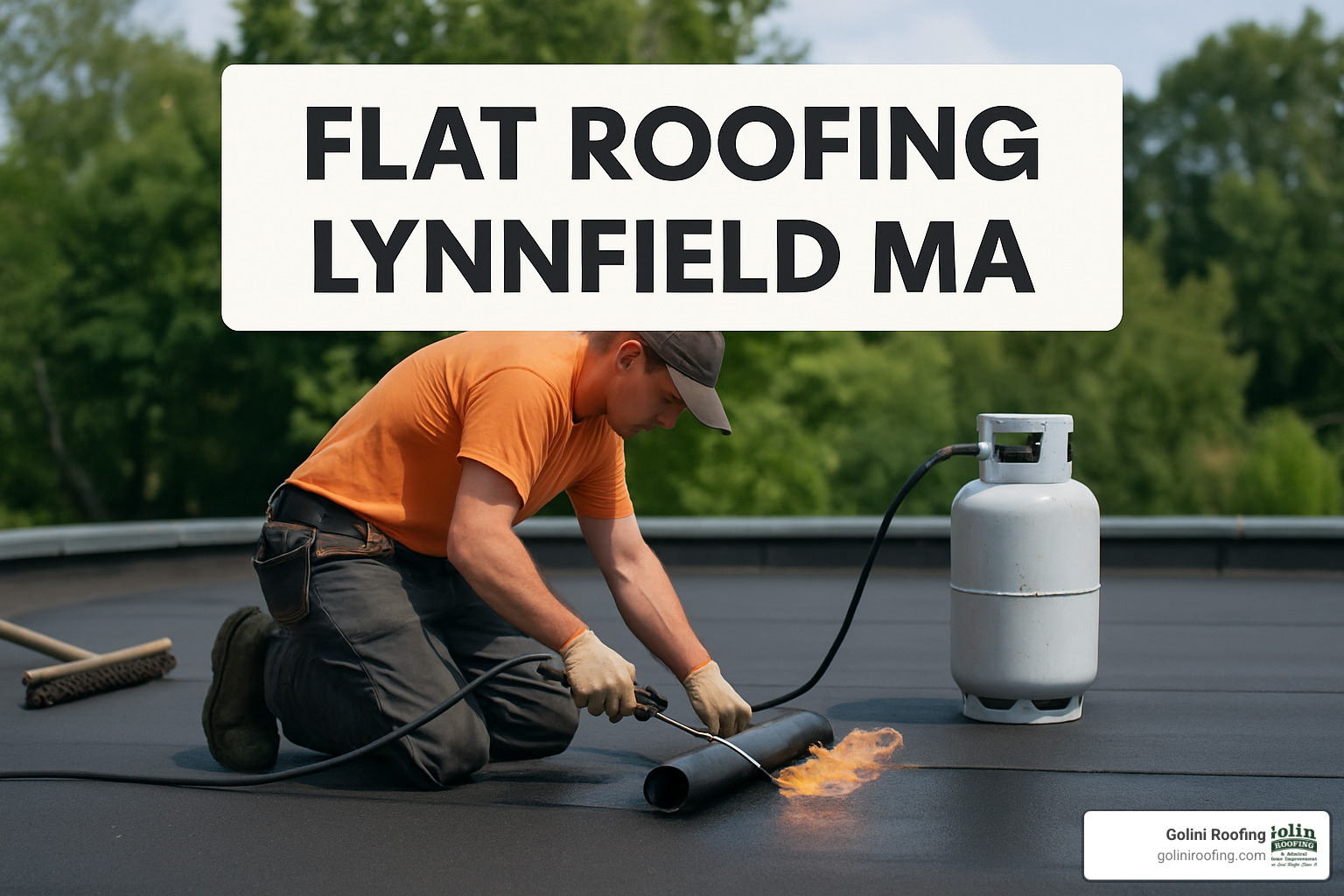
Think of a flat roof as a carefully engineered sandwich. The structural deck (usually wood or metal) forms the base, topped by a vapor barrier that blocks moisture from sneaking in. Next comes the insulation board—often polyisocyanurate—which keeps your heating and cooling inside where it belongs. The waterproof membrane serves as your main defense against the elements, while a properly designed drainage system guides water safely away from your building. When these components work together harmoniously, they create a roofing system that can stand up to Lynnfield’s four distinct seasons.
What Is a Flat Roof & How It Differs From Pitched Roofs
A flat roof’s defining characteristic is its minimal slope, typically between ¼”:12″ and 2″:12″. From street level, these roofs appear completely horizontal, though that slight pitch makes all the difference in water management.
The fundamental difference between flat and pitched roofs comes down to how they handle precipitation. Pitched roofs let gravity do the heavy lifting—rain and melting snow simply flow downward into gutters. Flat roofs, however, need more engineering finesse. They rely on carefully designed drainage systems with tapered insulation, internal drains, scuppers, or slight slopes to direct water toward collection points.
Why might you choose a flat roofing Lynnfield MA system? For starters, flat roofs offer valuable usable space—perfect for mounting HVAC equipment, installing solar panels, creating rooftop gardens, or even designing outdoor living areas. They’re generally more cost-effective than pitched alternatives due to simpler structure and reduced materials. Many homeowners and businesses appreciate their modern, clean aesthetic that complements contemporary architecture. Maintenance is often simpler too, as these roofs are safer to walk on for inspections and repairs. Inside your building, flat roofs eliminate the need for attics, maximizing your interior volume.
The tradeoff, of course, is that flat roofs demand more attention to drainage details and specialized waterproofing systems designed specifically for low-slope applications.
Flat Roof Lifespan & Inspection Schedule
How long will your flat roofing Lynnfield MA system last? That depends on several factors, including material choice, installation quality, and how diligently you maintain it. With proper care, today’s flat roofing systems can serve you well for 20-50 years.
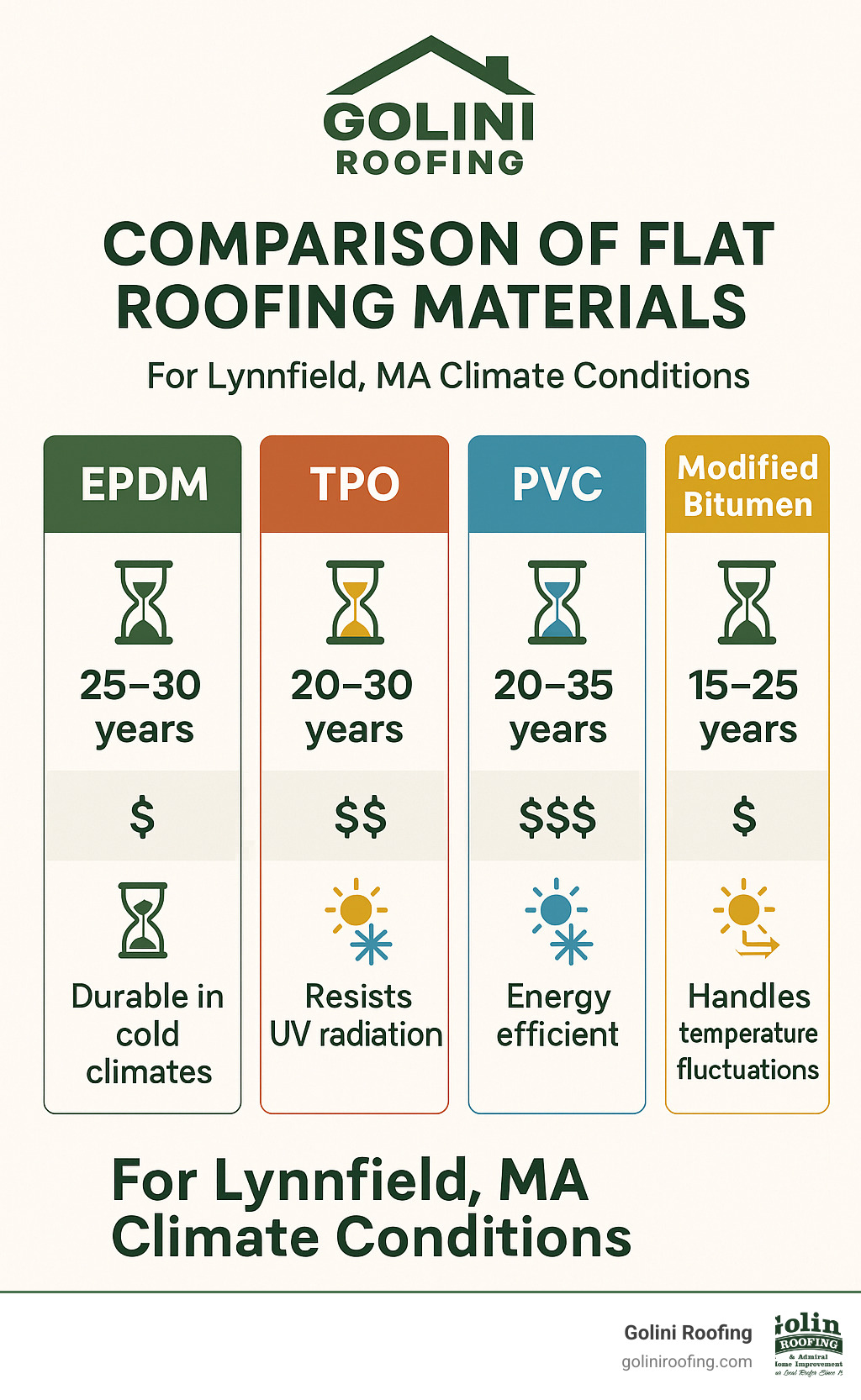
EPDM rubber membranes typically last 25-30 years, while TPO single-ply systems generally provide 20-30 years of service. PVC membranes often reach the 25-35 year mark, and modified bitumen systems usually deliver 20-30 years of protection. Traditional built-up roofing (BUR) typically performs for 15-25 years before needing replacement.
To maximize your flat roof’s lifespan in our challenging New England climate, I recommend a proactive inspection schedule. Plan for professional inspections twice yearly—once in spring after winter’s harsh freeze-thaw cycles have done their work, and again in fall before snow season arrives. After significant weather events—particularly heavy snowfalls, ice storms, or high winds—it’s wise to check for damage. As a homeowner, performing quick monthly visual assessments of drainage points, membrane condition, and flashing can help catch small issues before they become big problems.
During professional inspections, our team at Golini Roofing looks for early warning signs like water that remains on your roof more than 48 hours after precipitation, membrane seams that are separating or bubbling, deteriorating flashing around roof penetrations, clogged drains or scuppers, and signs of UV damage to the membrane.
Catching these issues early through regular Roofing Services Lynnfield MA can save you thousands in potential repair costs while significantly extending your roof’s useful life. In roofing as in healthcare, prevention is always more affordable than emergency treatment!
Best Flat Roofing Materials for Lynnfield Homes & Businesses
When choosing a flat roofing Lynnfield MA material, you’ll want something that can handle our unique New England weather challenges. From winter’s heavy snow loads to summer heat waves and those occasional hurricane-force winds, your roof needs to be up to the task!
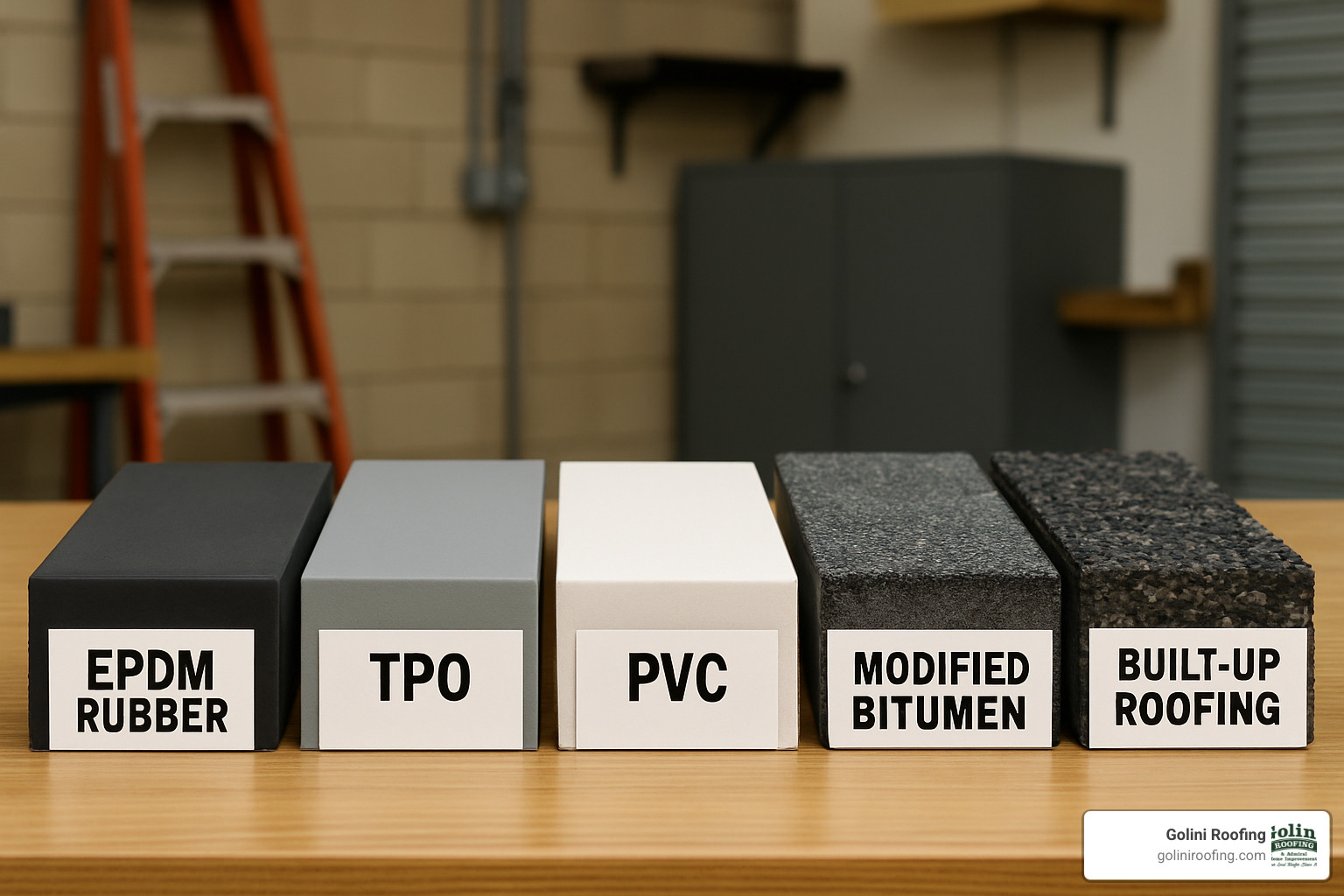
I’ve installed countless flat roofs throughout Lynnfield over the years, and I’ve seen which materials perform best for different situations. Let me walk you through your options:
| Material | Lifespan | Cost Range* | Best For | Key Advantages |
|---|---|---|---|---|
| EPDM Rubber | 25-30 years | $4-12/sq ft | Large commercial | Excellent ponding resistance, UV stable |
| TPO | 20-30 years | $5-14/sq ft | Energy-conscious | Reflective surface, heat-welded seams |
| PVC | 25-35 years | $7-16/sq ft | Restaurants, labs | Chemical resistance, highly durable |
| Modified Bitumen | 20-30 years | $6-15/sq ft | Residential | Walkable, puncture-resistant, color options |
| Built-Up Roofing | 15-25 years | $5-12/sq ft | High-traffic areas | Multi-layer protection, gravel finish |
*Cost ranges based on internet data, not actual Golini Roofing pricing. Actual costs may vary based on project specifics.
EPDM Rubber Membranes
EPDM rubber has been my go-to workhorse for many flat roofing Lynnfield MA projects, especially larger commercial buildings. These synthetic rubber sheets come in massive 10-foot wide rolls that allow us to cover large areas with fewer seams—which means fewer potential leak points.
What makes EPDM perfect for our Lynnfield climate is its incredible temperature flexibility. It stays pliable from 40 below zero all the way up to 300°F, so it won’t crack during our bitter winter freezes or degrade during summer heat waves. It’s also remarkably forgiving with ponding water, which can be a lifesaver during those slow spring melts when water might sit on your roof for days.
For budget-conscious property owners, EPDM often provides the best value. The EPDM Roofing Association has extensive research showing these roofs often exceed their expected lifespan with minimal environmental impact. The traditional black color absorbs heat (though white is available at a premium), which can be either a benefit in winter or a drawback in summer depending on your building’s needs.
TPO & PVC Single-Ply Systems
If you’re looking for energy efficiency and modern technology for your flat roofing Lynnfield MA project, TPO and PVC membranes might be your best bet. I’ve seen a dramatic increase in requests for these materials over the past decade, and for good reason.
Both TPO and PVC feature heat-welded seams that create what’s essentially a single piece of material covering your entire roof. When I install these systems, I use specialized equipment that fuses the seams at over 900°F, creating bonds actually stronger than the membrane itself. This means water simply has nowhere to go but to your drains.
The brilliant white surface of these roofs reflects sunlight rather than absorbing it, keeping your building significantly cooler during summer months. Many of my commercial clients have reported noticeable drops in their cooling costs after switching to these “cool roof” materials. They’re also perfect companions for solar panel installations, making them forward-thinking choices if renewable energy is in your future plans.
For restaurants or industrial buildings in Lynnfield, I often recommend PVC specifically. Its superior resistance to grease, chemicals and punctures makes it worth the higher investment for these applications. One restaurant owner told me their previous roof had been damaged by kitchen exhaust, but their PVC roof has remained pristine for over a decade now.
Modified Bitumen Torch-Down & Self-Adhered
For Lynnfield homes and smaller commercial buildings, modified bitumen often hits the sweet spot between durability, aesthetics, and cost. I’ve installed countless mod-bit roofs on residential properties throughout the area, and they continue to perform beautifully year after year.
What makes modified bitumen special is how it combines traditional asphalt technology with modern polymer additives to create a material that’s tough enough for our harsh New England winters. The finished surface is about four times thicker than a standard EPDM membrane, giving you excellent protection against accidental punctures.
Homeowners particularly appreciate that modified bitumen comes in various granular surface colors that can complement the architectural shingles on other parts of their home. It’s also incredibly walkable—you can safely shovel snow off these roofs without worrying about damaging the membrane, which is a huge advantage during those heavy Lynnfield snow seasons.
For homes with roof decks or rooftop patios, modified bitumen’s durability under foot traffic makes it my top recommendation. Its self-sealing properties also provide an extra layer of protection against ice dam-related leaks during harsh winters.
Over my 35+ years installing flat roofing Lynnfield MA systems, I’ve seen modified bitumen consistently deliver excellent value and performance for residential applications. That’s why it remains one of our most popular options for Flat Roof Replacement projects throughout the community.
flat roofing lynnfield ma: Installation, Maintenance & Costs
When it comes to installing a flat roofing Lynnfield MA system, you’re not just getting a roof—you’re investing in peace of mind for decades to come. At Golini Roofing, we’ve spent over 35 years perfecting our installation techniques to ensure your flat roof stands up to everything New England weather throws at it.
Most homeowners are pleasantly surprised to learn that a residential flat roof installation can typically be completed in just one day, minimizing disruption to your family routine. For our commercial clients, projects generally take between 2-5 days depending on the size and complexity of your building. Our crews work efficiently but never rush the details—especially around those critical areas like drainage points and roof penetrations where problems typically develop.
We’re also proud of our environmental commitment. During tear-offs, we recycle over 90% of the old roofing materials through specialized processing facilities. It’s our way of keeping Lynnfield beautiful while reducing our environmental footprint.
When budgeting for your flat roofing Lynnfield MA project, several factors will influence the final investment:
Your roof’s size and accessibility make a significant difference—a simple, easy-to-access roof naturally costs less than one with multiple levels or limited access. The condition of your existing roof matters too, as extensive tear-off and deck repairs add to the project scope. Your choice of membrane type, insulation requirements, and any drainage improvements will also impact your budget.
Based on internet data (not actual Golini Roofing pricing), flat roof installations in Massachusetts typically range from $6-$18 per square foot, with premium systems potentially exceeding $25 per square foot. These figures include everything from tear-off to final inspection. For a starting point on your specific project, the Roofing Calculator can provide a helpful estimate before you consult with professionals.
Step-by-Step flat roofing lynnfield ma Installation Process
A quality flat roofing Lynnfield MA installation follows a carefully orchestrated sequence that ensures your roof will perform beautifully for decades:
We begin with thorough site preparation, protecting your landscaping and setting up safety barriers. If we’re replacing an existing roof, we’ll carefully remove the old materials down to the structural deck, inspecting for any hidden damage that needs addressing.
Next comes the foundation of your new roofing system. We clean and prepare the deck, then install a vapor barrier to prevent moisture from condensing within your roof assembly. This critical layer is often overlooked but makes a huge difference in preventing interior moisture problems.
The insulation phase follows, with high-R-value boards (typically polyisocyanurate) installed in multiple layers with staggered joints for maximum thermal efficiency. Where needed, we’ll use tapered insulation to create positive drainage slopes that direct water toward scuppers or internal drains.
Then comes the star of the show—your new membrane. Whether you’ve chosen EPDM, TPO, PVC, or modified bitumen, we install it precisely according to manufacturer specifications. EPDM gets carefully positioned and adhered, TPO and PVC membranes have their seams hot-air welded for watertight integrity, and modified bitumen systems are applied using the appropriate method for your specific system.
We pay special attention to flashing—waterproofing those vulnerable areas around penetrations, edges, and transitions. After securing the perimeter with appropriate edge metal or termination bars, we conduct a thorough inspection and testing process to verify everything is perfect before we clean up and leave your property spotless.
Each step requires specific expertise, which is why all our crews receive factory training on major membrane systems. This ensures both installation excellence and full warranty compliance for your flat roofing Lynnfield MA project.
Average flat roofing lynnfield ma Cost Breakdown
Understanding where your money goes helps you evaluate proposals and budget appropriately. Based on industry averages (not specific to Golini Roofing), here’s how flat roof replacement costs typically break down:
Materials typically represent 40-60% of your total investment. This includes the membrane itself (15-25%), insulation (10-20%), fasteners and adhesives (5-8%), and flashings and edge metal (8-12%). The quality and thickness of these materials directly impact your roof’s longevity.
Labor accounts for roughly 35-50% of the project cost, covering tear-off and disposal (10-15%), the actual installation (20-30%), and supervision and quality control (5-10%). This is where experience really matters—skilled installation makes all the difference in how your roof performs.
Permits and inspections generally run 2-5% of the total, while overhead and contingencies account for 10-15%.
For perspective, internet data suggests a typical 1,500 square foot flat roof in Lynnfield might cost between $9,000 and $27,000, with premium systems potentially reaching $37,500 or more. These figures represent industry averages based on online research, not actual Golini Roofing pricing.
Several factors can significantly impact your specific project cost. Difficult roof access might require special equipment. Structural repairs become necessary if we find deck damage. Code upgrades—particularly additional insulation—might be required to meet current energy standards. Drainage improvements or special details around skylights and HVAC units add complexity as well.
For a deeper dive into replacement costs, our guide on How Much Does It Cost to Replace a Flat Roof? provides valuable insights.
Maintenance Checklist & Schedule
Your flat roofing Lynnfield MA system is an investment worth protecting. With proper maintenance, you’ll maximize performance and avoid costly repairs. Here’s a practical schedule that works for Lynnfield’s climate:
Monthly checks are something any homeowner can handle. Take a quick walk around, clearing debris from your roof surface and drainage points. Check for obvious damage and make sure water is flowing freely through drains and scuppers. After rainstorms, keep an eye out for ponding water that remains for more than 48 hours—this can indicate drainage issues that need addressing.
Professional inspections twice yearly are well worth the modest cost. We recommend scheduling these in spring (after winter’s freeze-thaw cycles) and fall (before snow season). During these visits, we’ll examine the membrane for damage, check all seams, assess flashings and terminations, clean and test drainage systems, and evaluate sealants around penetrations.
Annual maintenance should include a complete roof cleaning to remove dirt and biological growth, resealing of penetrations and flashings as needed, repair of any minor membrane damage, and documentation of your roof’s condition with photos.
Every five years, consider a more comprehensive assessment including an infrared moisture scan to detect hidden issues, membrane testing, and evaluation for reflective coating application if you have a TPO or PVC roof.
Winter brings special challenges in Lynnfield. Snow removal becomes critical when accumulation exceeds 12 inches or when ice dams form. Always use plastic snow shovels with rounded edges rather than metal tools, and leave 2 inches of snow on the roof surface to protect the membrane during removal.
For more information about ongoing maintenance costs and strategies, our Flat Roof Cost resource page provides valuable guidance to help you protect your investment for decades to come.
Weather Challenges & Problem-Solving for Lynnfield Flat Roofs
Living in Lynnfield means your flat roof faces a gauntlet of weather extremes throughout the year. With winter snowfalls often exceeding 50 inches and temperatures swinging from below-zero freezes to sweltering 90°F summer days, flat roofing Lynnfield MA systems need to be tough as nails to keep your property protected.

The New England climate throws quite a few curveballs at your flat roof. Those freeze-thaw cycles we experience? They’re constantly pushing and pulling at your roof’s membrane, stressing seams and flashings with each temperature swing. When winter storms dump heavy snow, your roof bears the weight while also facing the threat of ice dams forming at the edges. Come summer, intense UV exposure beats down on your membrane, especially on darker surfaces that absorb heat. And let’s not forget those famous nor’easters, with winds that test even the most securely fastened roofing systems.
Perhaps the most insidious challenge is ponding water – those innocent-looking puddles that form after rainstorms when drainage isn’t quite right. In Lynnfield’s climate, these puddles become particularly problematic during freeze-thaw transitions, when water expands as it freezes, creating pressure points on your roofing membrane.
At Golini Roofing, we’ve spent decades adapting our approach to these unique New England challenges. We don’t just install a roof – we engineer a system designed specifically for Lynnfield conditions, with reinforced edge securement, strategic fastening patterns in vulnerable areas, and drainage designs that account for our local precipitation patterns.
We’re big believers in prevention. That’s why we often recommend protective coatings for certain membrane types. These coatings can add 5-10 years to your roof’s lifespan, boost resistance to UV damage and harsh weather, improve your building’s energy efficiency, and seal minor surface cracks before they turn into leaks and headaches.
For roofs already showing signs of weather stress, we use non-destructive testing methods like infrared scanning to spot hidden moisture before it causes serious structural damage. Think of it as an early-warning system for your roof’s health.
Common Flat Roof Problems & Fixes in Lynnfield
Even the best-installed flat roofing Lynnfield MA systems can develop issues over time. Here’s what we commonly see and how we address these problems:
When seams begin to fail due to adhesive breakdown or membrane shrinkage, water finds its way in. We reinforce these vulnerable areas using material-specific techniques – EPDM seam tape for rubber roofs, heat welding for TPO and PVC membranes, or torch-fusion for modified bitumen systems.
Punctures and tears are almost inevitable over a roof’s lifetime. Whether from fallen branches during a storm, maintenance work, or even animal activity, these wounds in your roofing membrane need prompt attention. We patch these areas using compatible materials that restore the roof’s watertight integrity.
Membrane shrinkage often reveals itself through pulled flashings or stretched material at the roof’s edges. This aging process requires careful remediation through strategic relaxation cuts and reinforcement, along with flashing replacement to ensure proper coverage.
Those bubble-like blisters you might spot while inspecting your roof? They’re typically caused by trapped moisture or air between membrane layers. Our approach involves carefully releasing the pressure, thoroughly drying the substrate, and patching with appropriate materials to restore the roof’s integrity.
Clogged drainage is perhaps the most preventable issue, yet one we frequently address. When debris accumulates or drainage design isn’t optimal, water pools on your roof. Our solutions range from thorough drainage cleaning to installing additional drains or adding tapered insulation to improve water flow.
Flashing deterioration around vents, pipes, and roof edges is particularly common in our harsh climate. UV exposure and thermal cycling take their toll on these critical components. We replace damaged flashings with proper termination details to ensure long-term waterproofing.
The key to minimizing repair costs? Early detection through regular inspections. Small issues caught early typically cost a fraction of what they’ll cost if allowed to develop into major problems.
Snow & Ice Management Strategies
Winter in Lynnfield puts your flat roof to the ultimate test. Effective snow and ice management isn’t just about preventing leaks – it’s about protecting your building’s structural integrity.
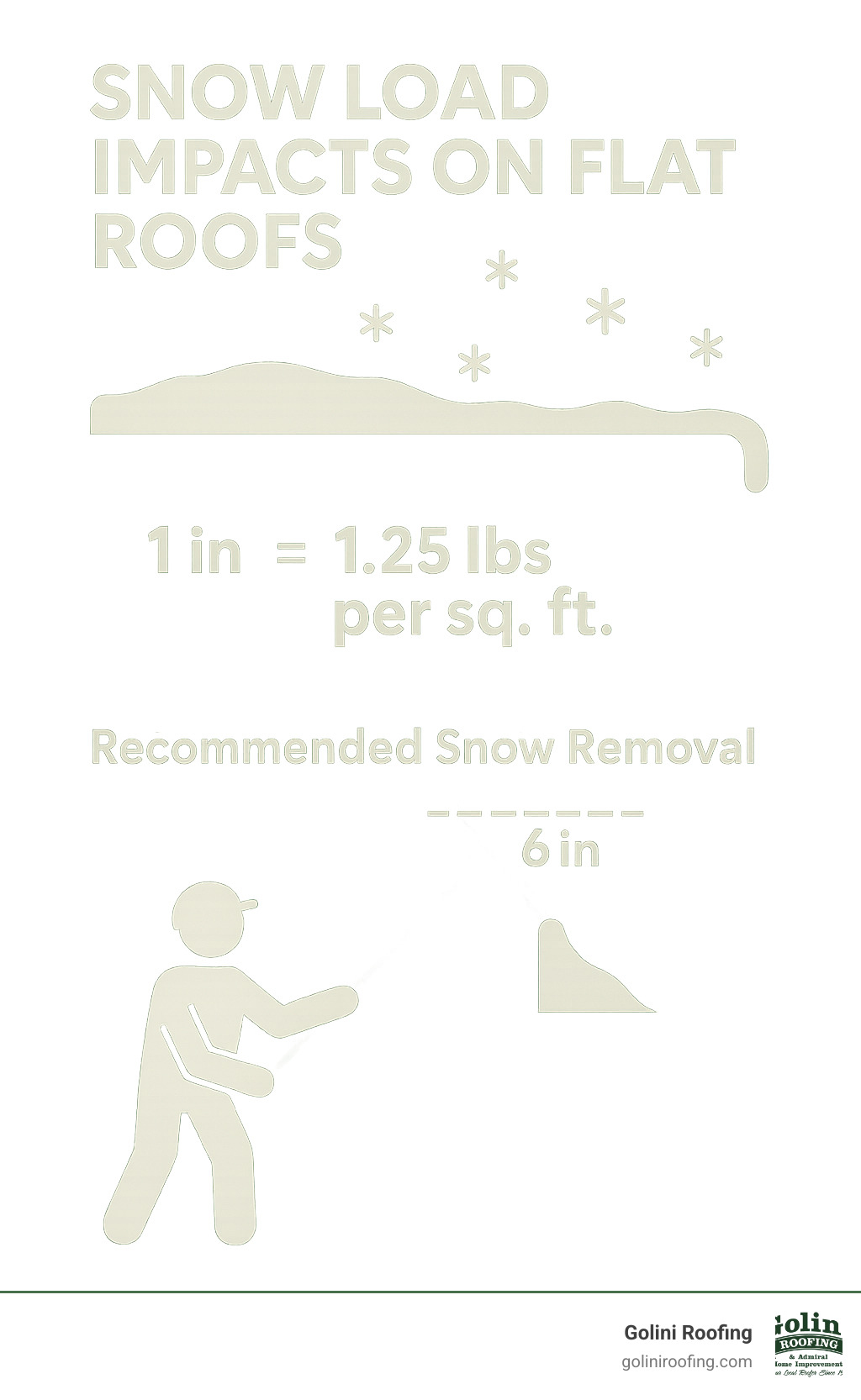
Smart design choices make a world of difference when winter hits. Tapered insulation systems create positive drainage pathways even under heavy snow, while reinforced membrane systems stand up to the weight and movement of ice and snow. Properly sized drains placed in strategic locations ensure meltwater can escape even during partial thaws. For problem areas, heat trace systems prevent ice dam formation at roof edges and keep drainage pathways clear.
When the snow starts piling up, having a plan is essential. We recommend snow removal when accumulation exceeds 12 inches or creates uneven loading that could stress your roof structure. Always use plastic snow removal tools that won’t damage the membrane – metal shovels are a flat roof’s worst enemy. Remember to leave about 2 inches of snow during removal as a protective buffer for the membrane underneath. For recurring ice dam issues, strategically placed heat cables can prevent formation in critical drainage paths.
After major storms, quick response is crucial. Our emergency services include rapid deployment for snow removal before excessive loads can accumulate, safe techniques for breaking up ice without damaging your roof, and temporary drainage solutions to create pathways for meltwater during thaw cycles.
For commercial property owners in Lynnfield, we strongly recommend establishing a seasonal maintenance contract with professionals experienced in flat roofing Lynnfield MA systems. This ensures you’ll have priority service during winter weather events when everyone in town is suddenly looking for roofing help.
With proper preventative design, regular maintenance, and prompt attention to emerging issues, your flat roof can successfully weather Lynnfield’s challenging climate for decades to come.
Choosing a Flat Roofing Contractor & Warranty Tips
Finding the right professional for your flat roofing Lynnfield MA project isn’t just about getting a good price—it’s about securing decades of worry-free protection for your home or business. After helping hundreds of Lynnfield property owners with their roofing needs, I’ve seen how the right contractor makes all the difference in long-term performance.
Before signing any contract, make sure your roofing professional has the proper credentials. Massachusetts requires contractors to hold both a Construction Supervisor License (CSL) and Home Improvement Contractor (HIC) registration—these aren’t just formalities, they’re your first line of protection. Equally important is comprehensive insurance coverage, including workers’ compensation and at least $1 million in liability insurance. Without these, you could be personally liable if something goes wrong during your project.
Look for contractors with manufacturer certifications for the materials they install. These certifications mean they’ve received specialized training and can offer you full warranty coverage. At Golini Roofing, we’ve invested countless hours ensuring our teams are certified across all major flat roofing systems, which allows us to provide the strongest warranty options available.
Local experience matters tremendously when it comes to flat roofing Lynnfield MA solutions. A contractor who understands our unique New England weather patterns—from heavy snow loads to summer humidity cycles—will design your roof system accordingly. After 35+ years serving the North Shore, we’ve developed installation techniques specifically adapted to Lynnfield’s climate challenges.
Don’t skip checking references! Ask for addresses of completed projects in your area that you can drive by, and contact information for previous clients. A reputable contractor will gladly provide these, as satisfied customers are their best advertisement. For more detailed guidance on finding the right Roof Installer Lynnfield MA, our website offers a comprehensive selection guide.
Questions to Ask Before Signing
When you’re interviewing potential contractors for your flat roofing Lynnfield MA project, asking the right questions can reveal volumes about their professionalism and expertise. Start with the basics about your specific project: “Will you provide a detailed written estimate with material specifications?” and “What’s the timeline from contract to completion?” Understanding crew size and supervision arrangements is also crucial—you want to know who’s actually working on your roof and who’s responsible for quality control.
Dig into their technical knowledge with questions about drainage solutions, insulation recommendations, and how they’ll handle roof penetrations. A knowledgeable contractor should explain these aspects in terms you can understand, without resorting to confusing jargon. They should be able to justify their recommendations based on your specific building structure and Lynnfield’s climate conditions.
Business practices matter just as much as technical skill. Request copies of licenses, insurance certificates, and warranty documentation before making any commitments. Understand their payment schedule, how they handle unexpected issues, and their process for addressing any concerns after installation. I always recommend asking about their waste disposal practices too—environmentally responsible contractors will have a clear plan for recycling old roofing materials.
Don’t be shy about asking these questions! A quality contractor welcomes them as an opportunity to demonstrate their expertise and build trust. At Golini Roofing, we believe an informed customer makes the best long-term partner, which is why we take the time to provide thorough answers to all your questions about flat roofing Lynnfield MA projects.
Understanding Warranty Options
Navigating flat roof warranties can feel like reading a foreign language, but understanding these protections is crucial for your peace of mind. There are typically two types of warranties you’ll encounter: manufacturer material warranties and contractor workmanship warranties.
Manufacturer warranties cover the roofing materials themselves and typically range from 10-30 years depending on the system quality. Standard coverage usually addresses material defects only, while premium “NDL” (No Dollar Limit) warranties provide more comprehensive protection without financial caps on repair costs. For the best protection, look for “system warranties” that cover all components including insulation and accessories, not just the membrane.
The workmanship warranty from your contractor is equally important, as it covers the quality of the installation itself. Most contractors offer 2-5 years of coverage, but at Golini Roofing, we stand behind our flat roofing Lynnfield MA installations with a full 10-year workmanship warranty—one of the most generous in the industry. This reflects our confidence in our installation methods and materials.
Pay close attention to warranty exclusions and maintenance requirements. Many warranties become void without documented regular maintenance, and most don’t cover damage from extreme weather events or owner negligence. If you’re planning to sell your property, check if the warranties are transferable to new owners, as this can add significant value to your home.
The warranty claim process matters too. Ask how quickly the contractor responds to service calls and what their typical resolution timeline looks like. A workmanship warranty is only as good as the company behind it—a 20-year warranty from a company that’s been in business for just 2 years should raise some concerns!
At Golini Roofing, we not only provide our own robust workmanship warranty but also help our clients register for and understand manufacturer warranties, which can extend up to 30 years for premium systems with proper maintenance. This dual protection gives our Lynnfield customers the confidence that their flat roof investment is thoroughly protected for decades to come.
Frequently Asked Questions about Flat Roofing in Lynnfield
How often should I inspect my flat roof in Lynnfield?
If you own a flat roofing Lynnfield MA system, regular inspections are your best defense against unexpected problems. I recommend scheduling professional inspections twice a year – once in spring after winter has done its worst, and again in fall before snow season arrives. These strategic timing points help catch seasonal damage when it’s fresh and fixable.
Between these professional check-ups, take a few minutes each month for a quick visual scan of your roof. Look for obvious issues like debris piling up near drains or any visible damage to the membrane. After major storms roll through (and we get our fair share in New England!), it’s worth taking another look to catch any new problems.
What happens during a professional inspection? We’ll examine every inch of your membrane surface, check all seams for potential separation, test your drainage systems, inspect all flashings, and document everything with photos. This creates a visual history of your roof’s condition that proves invaluable over time.
As a homeowner, the most important maintenance you can do is keeping those drainage points clear. A clogged drain on a flat roof can cause ponding water that weighs hundreds of pounds – potentially leading to structural issues or accelerated membrane deterioration. It’s the roofing equivalent of flossing your teeth – a small effort that prevents big problems!
Sticking to this inspection schedule helps you catch small issues before they become major headaches, extending your roof’s life and protecting your investment for years to come.
Can a flat roof be energy-efficient in New England’s climate?
Absolutely! Modern flat roofing Lynnfield MA systems can be surprisingly energy-efficient, even with our challenging New England weather. The key is proper design that accounts for both our freezing winters and increasingly hot summers.
The foundation of an energy-efficient flat roof starts with robust insulation. We typically recommend polyisocyanurate insulation with an R-value of 30 or higher for Lynnfield properties. This keeps heat where you want it – inside during winter and outside during summer. Tapered insulation systems pull double duty by creating proper drainage slopes while maintaining thermal performance throughout the roof.
Your membrane choice makes a significant difference too. White TPO or PVC membranes reflect the summer sun, reducing cooling costs during hot months. Even if you prefer EPDM for its durability, white coatings can be applied to improve its reflective properties. For homeowners who want a more traditional look, modified bitumen with light-colored granular surfaces offers a good balance of aesthetics and efficiency.
The energy savings are substantial – properly designed flat roofs can reduce heating and cooling costs by 15-30% compared to outdated systems. I’ve had customers call me after their first summer with a new reflective roof, amazed at the difference in their upstairs temperatures and energy bills.
As a bonus, flat roofs provide the perfect platform for solar panel installation. The clean, open surface allows for optimal panel placement and easy maintenance access. Many of our Lynnfield customers have combined high-efficiency roofing with solar installations to maximize their energy savings and potentially qualify for attractive tax incentives.
What permits are required for a flat roof replacement in Lynnfield?
Navigating permits might seem intimidating, but for flat roofing Lynnfield MA replacements, the process is straightforward. You’ll need a building permit from the Lynnfield Building Department before work begins – and at Golini Roofing, we handle this entire process for our customers.
The permit application typically requires several components: a completed building permit form, detailed project specifications (materials, installation methods, etc.), a basic site plan showing your building’s location, and proof of your contractor’s proper licensing. If you’re significantly changing the weight of your roofing system, structural calculations may also be needed. Additionally, you’ll need to demonstrate that your new roof meets current energy code requirements for insulation values.
The typical processing time runs about 1-2 weeks for standard residential projects. For emergency situations (like after storm damage), expedited options may be available – just ask us about this if you’re in a time crunch.
Once approved, your project will require inspections at key points. Typically, there’s an inspection before the membrane is installed (to check deck condition and insulation) and a final inspection upon completion. Sometimes the initial inspection may be waived for straightforward replacements, but the final inspection is always required.
Special considerations apply in certain situations. If your property is in a historic district, additional aesthetic requirements may come into play. Commercial buildings face more stringent code compliance rules, and changing from one roof type to another (like pitched to flat) requires additional permitting steps.
Having managed hundreds of permit applications in Lynnfield, our team at Golini Roofing has developed excellent relationships with local building officials. We understand exactly what documentation is needed and how to present it properly, preventing those frustrating delays that can push back your project timeline.
Conclusion
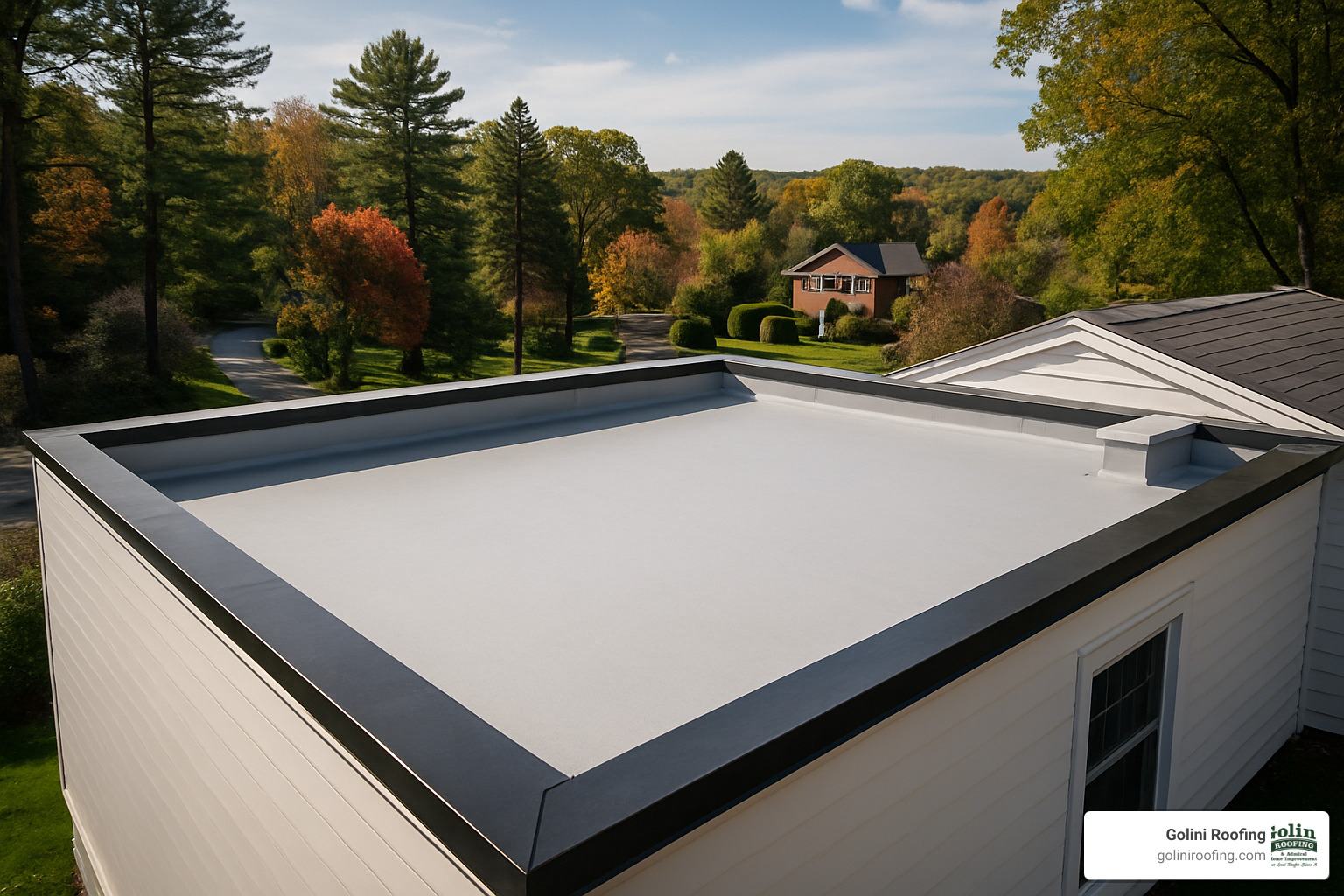
When it comes to protecting your Lynnfield property, a well-designed flat roofing Lynnfield MA system is truly an investment in peace of mind. After helping hundreds of local property owners over the past three decades, I’ve seen how quality materials combined with expert installation can deliver 20-40 years of reliable performance, even through our challenging New England winters.
The beauty of modern flat roofing isn’t just in its clean, contemporary lines – it’s in the remarkable versatility and efficiency these systems offer. Whether you’re a homeowner looking to maximize usable space or a business owner seeking cost-effective protection for your commercial property, today’s flat roofing options deliver impressive performance while accommodating everything from rooftop gardens to solar panel installations.
What makes a successful flat roofing Lynnfield MA project? It starts with understanding our unique local climate challenges. Those nor’easter winds, heavy snow loads, and dramatic freeze-thaw cycles demand specific design considerations that general roofing contractors from outside our region might miss. Working with experienced local professionals ensures your roof is built to handle Lynnfield’s specific weather patterns while meeting all local building codes.
Maintenance plays a crucial role in maximizing your flat roof’s lifespan. Those bi-annual inspections we discussed earlier aren’t just suggestions – they’re essential investments that can add years to your roof’s service life while preventing costly emergency repairs. A small issue caught early typically costs a fraction of what it might become if left unaddressed through several seasons.
At Golini Roofing, we take tremendous pride in our craftsmanship and attention to detail on every flat roofing Lynnfield MA project we undertake. Our 35+ years serving the North Shore has taught us exactly what works – and what doesn’t – in our unique climate. We’re not just installing roofs; we’re protecting families, businesses, and investments with systems designed to perform for decades.
Whether you’re planning a new construction project, facing the replacement of an aging system, or simply need expert repairs to address specific issues, I encourage you to research thoroughly and choose contractors with proven expertise in flat roofing applications. Ask questions, check references, and verify credentials – your roof is too important to trust to just anyone.
For personalized guidance custom to your specific property needs, our team at Golini Roofing is always here to help. We’ll walk you through material options, design considerations, and maintenance requirements to ensure your flat roof provides decades of worry-free protection for your Lynnfield property.
Ready to explore your flat roofing options? Visit our More info about local roofing services page or give us a call today to schedule a no-obligation consultation and free estimate. Your perfect roof is just a conversation away.
