
Gutter Sizes: 3 Steps to Optimal Protection
Why Gutter Sizing is Crucial for Your Home’s Health
Gutter sizes determine whether your home stays protected or suffers costly water damage. The wrong size can lead to overflowing gutters that cause foundation problems, basement flooding, and rotted fascia boards.
Standard residential gutter sizes:
- 5-inch gutters – Standard for most homes, handles up to 5,520 sq ft of roof area
- 6-inch gutters – Holds 50% more water, handles up to 7,960 sq ft of roof area
- Depth differences – 5-inch gutters are 3.5″ deep, 6-inch gutters are 3.75″ deep
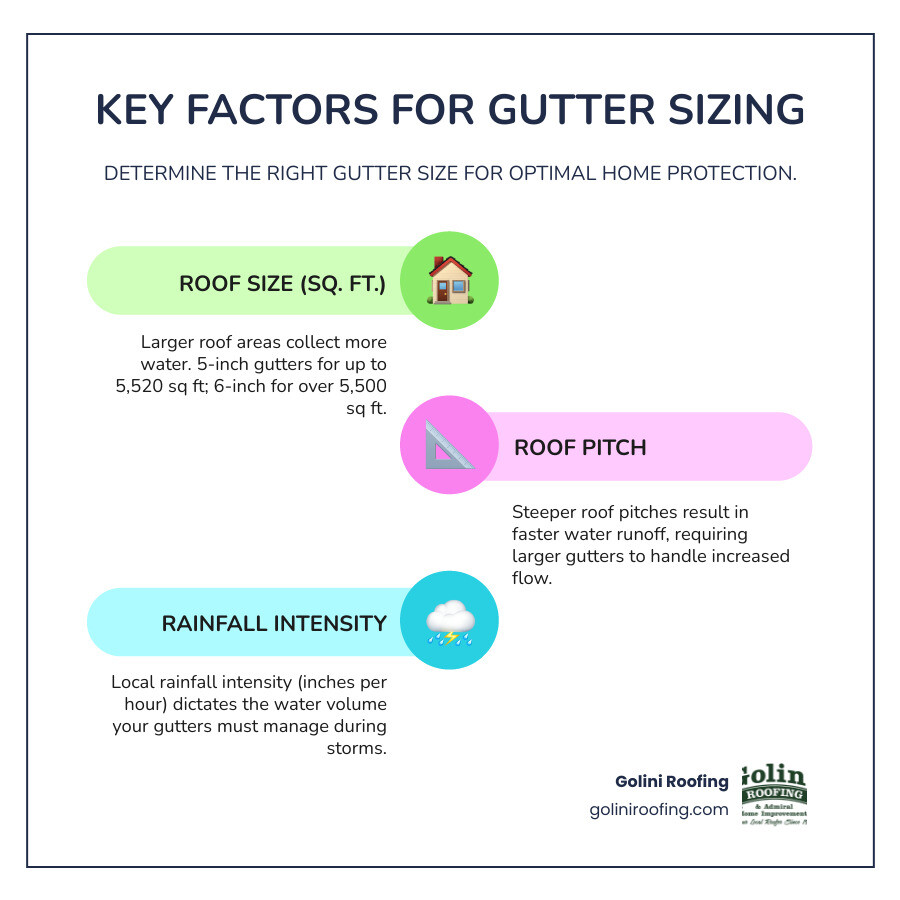
Your roof size, pitch, and local rainfall intensity all factor into choosing the right size. A small home with 600-1,000 square feet of roof area typically works well with 5-inch gutters. Larger homes over 1,500 square feet often need 6-inch gutters to handle the water volume.
Getting this wrong is expensive. Water damage from undersized gutters can cost thousands in foundation repairs, basement waterproofing, and structural fixes. The research shows that homeowners pay an average of $1,166 for gutter replacement – but that’s nothing compared to fixing water damage to your home’s foundation or interior.
I’m Jack Golini, and I’ve been helping homeowners protect their properties with proper gutter systems since 1982. Over my 35+ years in the roofing industry, I’ve seen how the right gutter sizes can make the difference between a dry basement and a costly disaster.
Quick gutter sizes definitions:
Understanding Standard Gutter Sizes and Styles
Most homeowners get overwhelmed when they start looking at gutter sizes and styles. The good news? There are really just a few key options you need to understand, and I’ll walk you through each one so you can make the right choice for your home.
Residential Gutter Sizes: 5-inch vs. 6-inch
When it comes to residential gutter sizes, you’re mainly choosing between 5-inch and 6-inch gutters. Think of it like choosing between a regular coffee cup and a large one – both do the job, but one handles more volume.
5-inch gutters have been the go-to standard for decades. They’re 3.5 inches deep and work great for most homes with moderate rainfall. If your home has 600-1,000 square feet of roof area and you don’t live in a particularly rainy climate, 5-inch gutters will likely serve you well.
But here’s where it gets interesting. 6-inch gutters can handle about 50% more water than their 5-inch cousins. That’s a huge difference when you’re dealing with heavy downpours or melting snow. These gutters are slightly deeper at 3.75 inches and can manage much larger roof areas.
The size difference might seem small on paper, but I’ve seen too many homeowners regret going with undersized gutters when that first major storm hits. The extra inch of width and quarter-inch of depth creates significantly more water capacity.
What about how they look? Honestly, 6-inch gutters are more noticeable on your home’s exterior. If you have smaller fascia boards (like 1″x6″), the 5-inch might look more balanced. But if you’ve got larger fascia boards (1″x8″), the 6-inch gutters often complement the proportions better.
| Feature | 5-Inch Gutters | 6-Inch Gutters |
|---|---|---|
| Width | 5 inches | 6 inches |
| Depth | 3.5 inches | 3.75 inches |
| Water Capacity | Standard capacity | Approximately 50% more water capacity |
| Ideal Use Case | Smaller homes (600-1000 sq ft), moderate rainfall | Larger homes (1500+ sq ft), heavy rainfall, steep roofs |
| Aesthetics | Less prominent, can suit smaller fascia boards | More prominent, often complements larger fascia boards |
My advice? When in doubt, go bigger. The cost difference is minimal, but the protection difference is substantial. You can learn more about your options in our guide to types of rain gutters.
Common Gutter Styles and Their Sizing Implications
Beyond width, the shape of your gutter affects both how much water it can handle and how it looks on your home. You’ve got two main players here: K-style and half-round gutters.
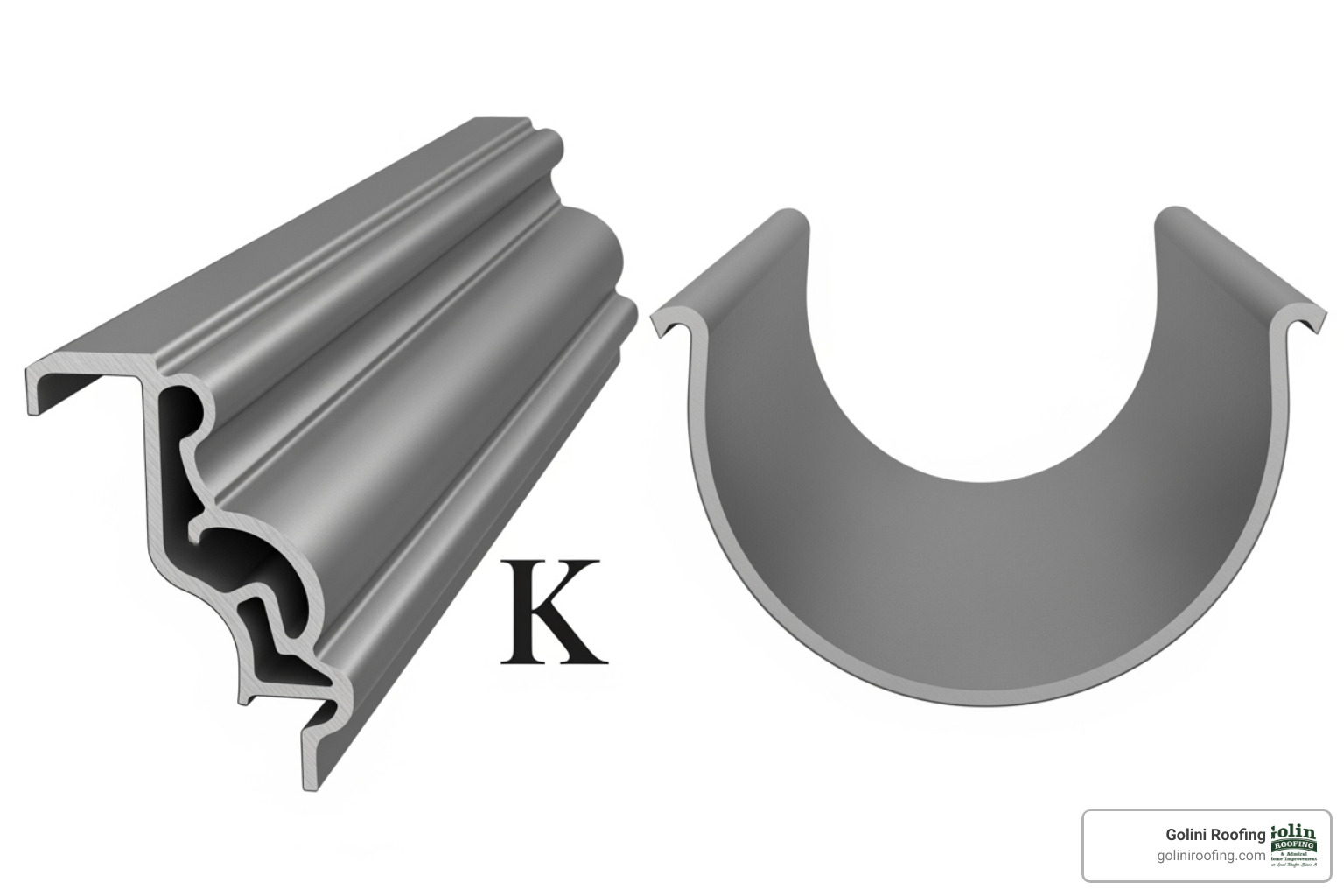
K-style gutters dominate the residential market, and for good reason. When you look at them from the side, they look like the letter ‘K’ – hence the name. They sit flat against your fascia board and have a decorative front edge that many homeowners find appealing.
Here’s the real kicker: K-style gutters are water-handling champions. A 5-inch K-style can manage up to 5,520 square feet of roof drainage area, while a 6-inch K-style handles up to 7,960 square feet. They’re also incredibly strong and durable, which means less worry about sagging or damage over time.
Half-round gutters offer a completely different aesthetic. Picture a pipe cut in half lengthwise – that’s your half-round gutter. They’re gorgeous, especially in copper, and they give homes a classic, traditional look that many homeowners love.
The trade-off? Half-round gutters hold less water than K-style gutters of the same width. A 5-inch half-round can handle up to 2,500 square feet of roof area, while a 6-inch half-round manages up to 3,840 square feet. If you’re choosing half-round for the aesthetics, just make sure you size up appropriately for your roof area.
When Are Larger Gutters (7-inch and Up) Necessary?
Most homeowners never need to think about gutter sizes beyond 6 inches, but there are exceptions. Commercial buildings and industrial properties often require 7-inch, 8-inch, or even larger gutters to handle their massive roof areas.
Extremely large homes – think custom estates with sprawling rooflines – might also push beyond standard residential sizing. And if you live in an area with exceptional rainfall intensity, even a large home might benefit from oversized gutters to prevent constant overflow issues.
In my 35+ years in this business, I’ve installed plenty of these larger systems on commercial properties. The principles are the same as residential work, just scaled up significantly. If you’re dealing with commercial drainage needs, our commercial downspout repair services can help ensure your entire system works properly.
The bottom line? Most homeowners will find their perfect solution in the 5-inch or 6-inch range, but it’s good to know larger options exist when standard sizes won’t cut it.
How to Calculate the Right Gutter Size for Your Home
Follow these steps to ensure your gutter system can handle the water from your roof, protecting your home from potential damage.
Choosing the right gutter sizes isn’t guesswork – it’s math. After 35+ years in the roofing business, I’ve seen too many homeowners pick gutters based on what “looks right” instead of what actually works. Let me walk you through the three essential calculations that will save you from costly water damage.
Step 1: Calculate Your Roof’s Drainage Area
Think of your roof as a giant funnel that collects every drop of rain and sends it straight to your gutters. The bigger the funnel, the more water you’re dealing with. That’s why we need to measure your roof’s drainage area – the total square footage of roof surface that sheds water into each gutter section.

Here’s how to get accurate measurements without risking a trip to the emergency room. Start by measuring each roof plane separately – your roof isn’t one flat surface, but multiple sections that each drain water in different directions.
For each roof section, you’ll need two measurements: the length along the gutter line (from one end to the other) and the width from gutter to ridge (how far the roof extends up toward the peak). Multiply these numbers together to get the square footage for that section.
Let’s say you have a roof section that’s 30 feet long and 15 feet wide. That gives you 450 square feet of drainage area for that section alone. Add up all the sections that drain into the same gutter run, and you’ve got your total drainage area.
If you’re not comfortable getting on a ladder, you can often make these measurements from the ground using the footprint of your house and adding a bit for roof overhang. Just remember – accuracy here determines whether your gutters work or overflow.
Step 2: Determine Your Roof’s Pitch
Your roof’s pitch – how steep it is – dramatically affects how fast water races toward your gutters. A steeper roof means faster water flow, which means you need larger gutter sizes to handle the increased volume and velocity.
Roof pitch is expressed as “rise over run” – how many inches your roof rises vertically for every 12 inches it extends horizontally. A 6/12 pitch means the roof goes up 6 inches for every foot it goes out.
Here’s the simple measurement method: Grab a 12-inch level and a tape measure. Place the level flat against your roof surface, making sure it’s perfectly horizontal using the bubble. Measure 12 inches along the level, then measure straight down from that point to the roof surface. That vertical measurement is your “rise.”
If you measure 5 inches down, you’ve got a 5/12 pitch. If it’s 8 inches, that’s an 8/12 pitch – and so on.
Now comes the important part – adjusting your drainage area calculation based on that pitch. Water moves much faster on steep roofs, creating what we call “water velocity on steep roofs.” This means your gutters need to handle not just more water, but water moving at higher speeds.
Use these roof pitch factors to adjust your drainage area: Low slopes (0-3 inches of rise) get multiplied by 1.0 – no change needed. Moderate slopes (4-5 inches) multiply by 1.05, while steeper roofs (6-8 inches) need a 1.1 multiplier. Very steep roofs (9-11 inches) get 1.2, and extremely steep roofs (12+ inches) require a 1.3 multiplier.
So if your roof drainage area is 2,000 square feet and your pitch is 7/12, you’d multiply 2,000 by 1.1 to get an effective drainage area of 2,200 square feet. This adjusted number is what you’ll use to determine your gutter sizes.
Step 3: Factor in Local Rainfall Intensity
Even perfect calculations won’t help if your gutters can’t handle a Massachusetts downpour. Rainfall intensity – how many inches of rain fall per hour during heavy storms – is the final piece of the puzzle.
Here in Massachusetts, we get everything from gentle spring rains to summer thunderstorms that dump inches of water in minutes. Those intense downpours are what size your gutters, not the average rainfall amounts you see in weather reports.
I’ve seen perfectly sized gutters (based on roof area alone) overflow spectacularly during a heavy storm because the homeowner didn’t account for rainfall intensity. The goal is preventing overflow during the worst weather your area typically sees, not just handling average conditions.
You can check your local rainfall intensity data through the National Weather Service, which provides detailed information about maximum rainfall rates for different regions. For Massachusetts climate considerations, we typically see rainfall intensities that can overwhelm undersized gutter systems, especially during summer storms and spring snowmelt periods.
This is why I often recommend 6-inch gutters for homes that might technically work with 5-inch systems based on roof area alone. That extra capacity provides insurance against the unexpected storm that dumps more water than your calculations anticipated.
When you combine your roof’s drainage area, pitch adjustment, and local rainfall intensity, you get a complete picture of what your gutters need to handle. It’s this thorough approach that keeps basements dry and foundations protected.
The Complete System: Matching Downspouts to Your Gutter Sizes
Here’s something most homeowners don’t realize: a gutter is only as good as its downspout. I’ve seen perfectly sized 6-inch gutters fail miserably because they were paired with tiny downspouts that couldn’t handle the water flow. It’s like trying to empty a bathtub through a drinking straw – it just doesn’t work.
An undersized downspout creates a bottleneck that makes your entire gutter system fail, no matter how carefully you’ve calculated your gutter sizes. When water can’t flow down fast enough, it backs up and overflows, defeating the whole purpose of having gutters in the first place.
Why Downspout Sizing is as Important as Gutter Sizes
Your downspouts are the workhorses of your gutter system. These vertical pipes carry all that collected rainwater from your gutters down to the ground, directing it safely away from your foundation. When they’re too small or you don’t have enough of them, you’re asking for trouble.
What happens when downspouts can’t keep up? Water backs up in your gutters, creating a cascade of problems. You’ll see water spilling over the edges, which completely defeats the purpose of having gutters. That backed-up water also traps leaves and debris, leading to clogs that make the problem even worse.
But the real damage happens to your home. Persistent overflow causes erosion around your foundation, damages your landscaping, and can lead to basement leaks. I’ve also seen it cause fascia boards to rot and contribute to ice dam formation during our harsh Massachusetts winters.
The frustrating part is that even the largest gutter sizes become useless when paired with inadequate downspouts. Over the years, we’ve helped countless homeowners resolve downspout drainage issues that could have been prevented with proper sizing from the start.
Standard Downspout Sizes and Capacities
Downspouts come in two main shapes – rectangular and round – and their capacity is measured by how many square feet of roof area they can effectively drain. As a rule of thumb, you should have one downspout for every 25 to 35 linear feet of guttering.
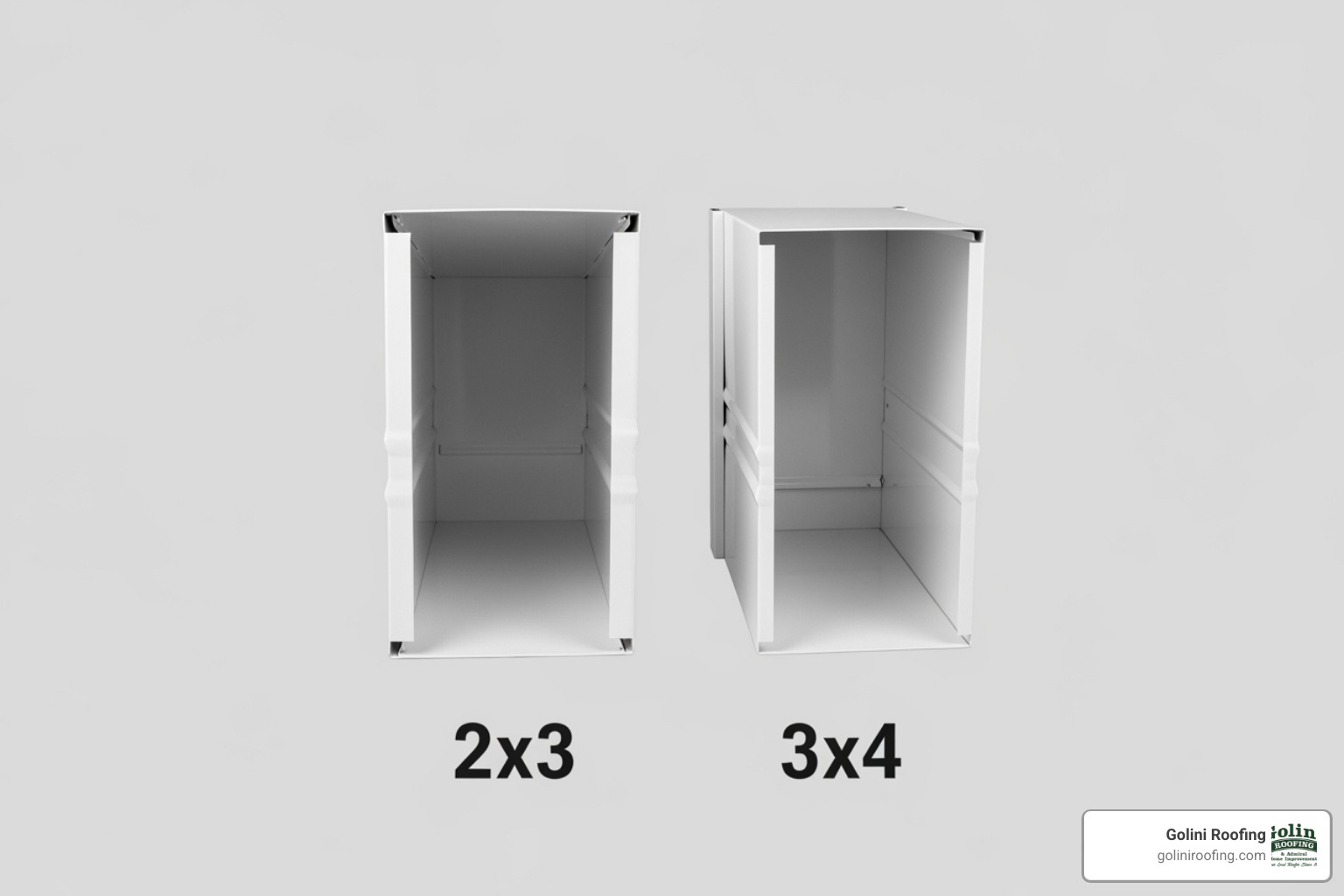
Rectangular downspouts are the most common choice for homes with K-style gutters. A 2×3-inch rectangular downspout can handle about 600 square feet of roof drainage area, making it perfect for 5-inch gutters on smaller homes. Step up to a 3×4-inch rectangular downspout, and you can manage up to 1,200 square feet – ideal for pairing with 6-inch gutters on larger homes.
Round downspouts offer a more traditional look, especially when paired with half-round gutters. A 3-inch round downspout handles approximately 706 square feet of drainage area, while a 4-inch round downspout can manage up to 1,255 square feet.
The key is matching your downspout capacity to both your gutter sizes and your roof’s water volume. For example, if you have a 5-inch K-style gutter system handling 3,000 square feet of roof area, you’d need at least five strategically placed 2×3-inch downspouts to prevent bottlenecking. A 6-inch gutter system on a larger home would require multiple 3×4-inch downspouts positioned every 25-30 feet along the gutter run.
Getting this pairing right is crucial. I’ve seen too many homeowners invest in quality gutters only to skimp on downspout sizing, creating an expensive system that doesn’t work properly. If you’re dealing with existing issues or need new downspouts installed, we can help with professional downspout repair near me services.
The goal is creating a complete system where water flows smoothly from your roof into the gutters and down through properly sized downspouts, keeping it far away from your foundation where it belongs.
Common Mistakes and Professional Guidance
After helping homeowners in the Wakefield area for over 35 years, I’ve seen just about every gutter sizes mistake you can imagine. Some are minor inconveniences, but others have cost families thousands in water damage repairs. The good news? Most of these mistakes are completely preventable once you know what to look for.
Mistakes to Avoid When Sizing Your Gutters
The biggest mistake I see is underestimating roof area. Homeowners often look at their house’s footprint and think that’s their roof size. But your roof has multiple planes – some steep, some shallow – and each one collects water differently. I’ve seen people choose 5-inch gutters for what they thought was a 1,200 square foot roof, only to find their actual drainage area was closer to 2,000 square feet.
Ignoring roof pitch is another costly error. A steep 10/12 pitch roof sends water racing down like a waterslide, while a gentle 4/12 pitch lets water flow more leisurely. That velocity difference means the steep roof needs bigger gutters even if the square footage is the same. Water will literally shoot right over undersized gutters on steep roofs – I’ve seen it happen during the first heavy rainstorm after installation.
Forgetting about local rainfall intensity is particularly common here in Massachusetts. We might get the same annual rainfall as other areas, but when we get hit with those intense summer thunderstorms, the rain can dump inches in just minutes. Your gutters need to handle that peak intensity, not just the average.
Too few downspouts create bottlenecks even when your gutter sizes are perfect. Think of it like having a six-lane highway that suddenly narrows to one lane – traffic backs up quickly. The same thing happens with water in your gutters. We recommend one downspout every 25 to 35 feet of guttering, but many homeowners try to get by with fewer to save money.
Mismatched component sizes defeat the entire system. I’ve seen beautiful 6-inch gutters paired with tiny 2×3-inch downspouts that couldn’t handle the water volume. It’s like trying to empty a bathtub through a drinking straw. Every part of your drainage system needs to work together.
Improper gutter slope is the mistake that drives me crazy because it’s so easily avoided. Gutters need about 1/4 inch of drop for every 10 feet of length to move water toward the downspouts. Too flat, and water sits there breeding mosquitoes and ice dams. Too steep, and it looks terrible and can cause water to rush past the downspout outlets.
These mistakes often lead to expensive gutter repair service calls that could have been avoided with proper initial sizing and installation.
When to Call a Gutter Installation Professional
Complex rooflines with valleys and dormers make accurate calculations nearly impossible for most homeowners. These architectural features create unique drainage patterns that require professional assessment. I’ve measured roofs where the actual drainage area was 40% larger than the homeowner calculated because they missed how water flows from multiple roof planes into single gutter sections.
Safety concerns should always trump DIY ambitions. Working at heights requires proper equipment, experience, and knowledge of safety protocols. Every year, we hear about homeowners getting seriously injured trying to install their own gutters. Your family needs you more than you need to save a few dollars on installation costs.
Ensuring a seamless system requires specialized equipment we bring to every job site. Our seamless gutters are custom-rolled to fit your exact measurements, eliminating the weak points and potential leaks that come with sectional gutters. This isn’t something you can replicate with store-bought materials.
Professional assessment goes beyond just measurements. We consider your home’s unique characteristics – the way wind patterns affect your roof, how your landscaping impacts drainage, and how your existing roofing system integrates with new gutters. Our meticulous approach to hand-nailing each shingle extends to every aspect of your roofing system, including proper gutter integration.
When you’re ready for professional gutter installation, we’re here to ensure your entire roofing system works together to protect your home for decades to come. Sometimes the best investment is getting it right the first time.
Protect Your Investment with Perfectly Sized Gutters
Choosing the right gutter sizes isn’t about picking what looks good or going with the cheapest option. It’s about making a calculated decision that protects your most valuable asset – your home. After 35+ years in the roofing business, I’ve seen too many homeowners learn this lesson the hard way.
The math matters. By taking the time to calculate your roof’s drainage area, factoring in the pitch, and considering our local Massachusetts weather patterns, you’re setting up a defense system that works. A properly sized gutter system isn’t just moving water – it’s preventing thousands of dollars in potential damage to your foundation, basement, and landscaping.
Your home deserves the best protection. Here in the Wakefield area, we know what New England weather can throw at us. From sudden summer downpours to heavy spring snowmelt, your gutters need to handle it all. That’s why we don’t cut corners – every gutter installation gets the same meticulous attention to detail as our hand-nailed roofing work.
When you invest in properly sized and professionally installed gutters, you’re not just buying peace of mind. You’re ensuring that your entire roofing system works as one cohesive unit. The roof we hand-nail with precision deserves gutters that are equally well-planned and expertly installed.
Don’t wait until the next big storm to find out if your gutters are up to the task. Whether you’re building new or replacing an aging system, getting the sizing right from the start saves money, prevents headaches, and keeps your home dry for decades to come.
Ready to protect your investment? Learn more about our rain gutter services and let’s make sure your home is ready for whatever Mother Nature has in store.
