
Flat Roof Replacement Cost Calculator: Top 5 Powerful Benefits 2024
Understanding Flat Roof Replacement Costs: No More Guesswork
A flat roof replacement cost calculator typically estimates between $3-$11 per square foot or $4,000-$16,800 total for an average-sized roof. Most calculators factor in:
- Roof size (square footage)
- Material type (EPDM, TPO, PVC, modified bitumen)
- Labor costs (40-50% of total)
- Tear-off and disposal ($1-$2 per square foot)
- Penetrations (skylights, vents, chimneys)
- Regional labor rates
Planning a flat roof replacement can feel overwhelming, especially when trying to budget accurately. The flat roof replacement cost calculator has become an essential tool for homeowners facing this significant investment. Instead of relying on rough estimates or waiting days for contractor quotes, these calculators provide immediate estimates based on your specific project parameters.
Whether you’re replacing an aging EPDM membrane or upgrading to a more durable PVC system, knowing your potential costs upfront helps you make informed decisions and avoid budget surprises. Modern calculators use regional pricing data and material-specific algorithms to deliver remarkably accurate projections.
I’m Jack Golini, owner of Golini Roofing, and with over 40 years of roofing experience since 1982, I’ve helped countless homeowners steer the complexities of flat roof replacement cost calculators to plan their projects effectively and avoid costly mistakes.

Relevant articles related to flat roof replacement cost calculator:
How a Flat Roof Replacement Cost Calculator Works
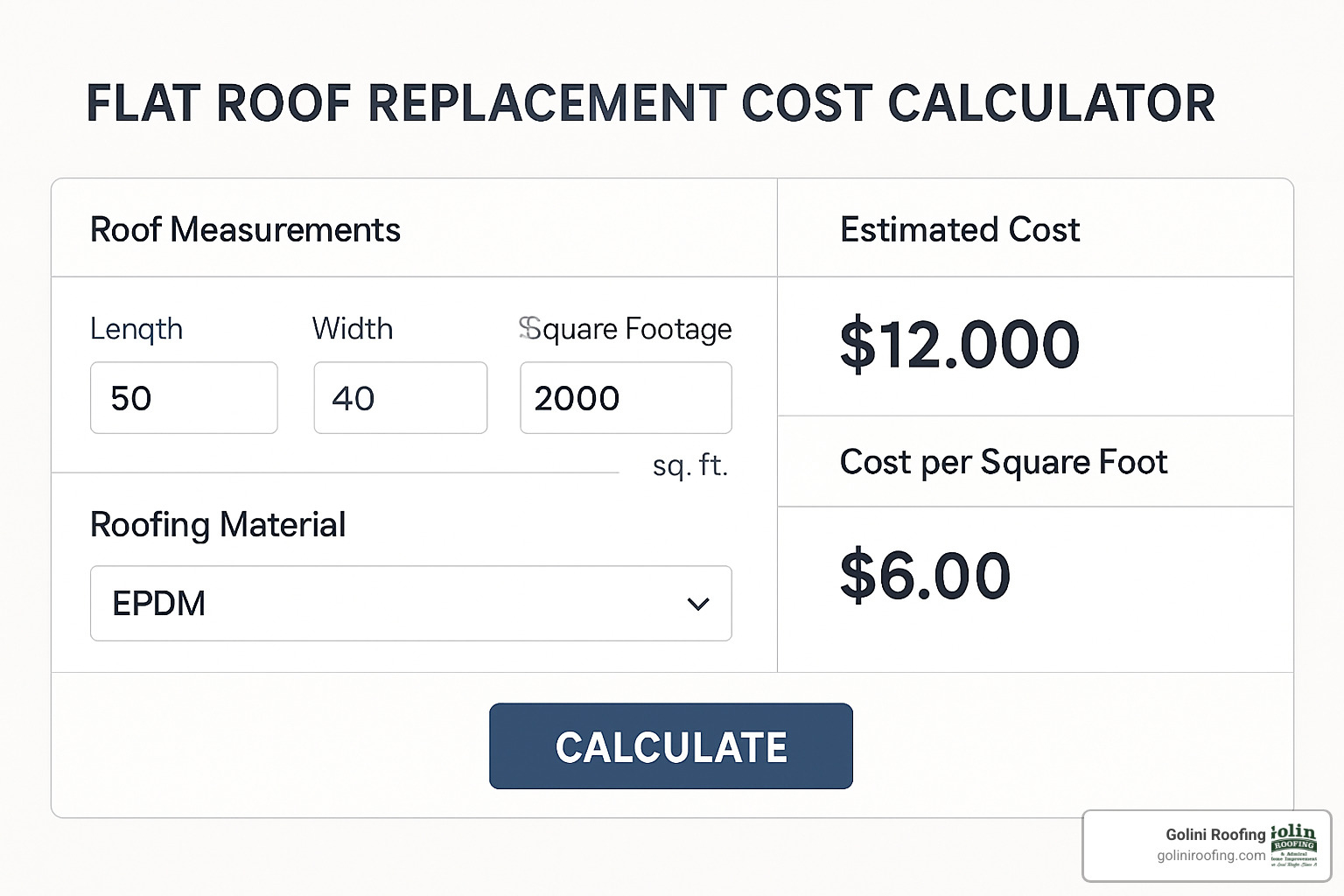
Ever wonder what is happening behind the scenes when you punch numbers into a flat roof replacement cost calculator? It is actually quite fascinating! These digital tools have revolutionized how homeowners plan for roofing projects, taking the guesswork out of budgeting.
Think of these calculators as smart assistants that combine your specific roof details with current market data. The magic happens when the calculator’s algorithm processes everything from your ZIP code to your material preferences, delivering a personalized estimate in seconds. Many of today’s advanced calculators even incorporate aerial imagery analysis – yes, they can actually “see” your roof from satellite images to help measure dimensions!
Here at Golini Roofing, we have spent decades perfecting our estimation process for Massachusetts homeowners. While online calculators provide a great starting point, our experience in communities like Wakefield, Burlington, and Winchester allows us to catch those local nuances that generic calculators sometimes miss.
What data the flat roof replacement cost calculator needs
To get the most accurate estimate from a flat roof replacement cost calculator, you will need to have some key information ready. The basics include your roof’s square footage and your ZIP code, but the more details you provide, the better.
Your roof’s area is obviously crucial – after all, we need to know how much material to order! Our Roof Square Footage Calculator can help if you are unsure about measurements. Do not forget that even “flat” roofs actually have a slight pitch (typically between 1/4″ to 1/2″ per foot).
The calculator will also want to know about penetrations (skylights, vents, chimneys), existing layers that need removal, your preferred materials (EPDM? TPO? PVC?), building height, roof complexity, parapet walls, and insulation needs. Each of these factors significantly impacts your final cost, so be as thorough as possible when inputting this information.
Behind the scenes: accuracy of a flat roof replacement cost calculator
The real power of a flat roof replacement cost calculator comes from its data sources. These tools tap into regularly updated cost libraries for materials, regional labor databases, and even account for typical waste factors (usually 10-15% of materials).
Most quality calculators achieve accuracy within about 10-15% of actual contractor quotes – pretty impressive for an automated tool! This accuracy comes from sophisticated programming that considers inflation adjustments and regional variables like local permit costs and disposal fees.
According to the Bureau of Labor Statistics, roofing labor rates can vary by up to 30% between different regions of the country. That is why location-specific calculators generally outperform generic ones – they understand that installing a flat roof in Lynnfield has different cost implications than the same project in another state.
After 35+ years of installing roofs throughout Massachusetts, we have developed an intuitive understanding of local pricing factors that even the best calculators sometimes miss. While these digital tools provide excellent ballpark figures, they cannot fully account for unique circumstances like difficult access points or structural issues that might only be apparent during an in-person inspection.
Think of the calculator as your first step in the budgeting process – an incredibly useful one that gets you 85-90% of the way there, with the final precision coming from an experienced contractor’s evaluation.
2024 Flat Roof Replacement Costs & Key Price Drivers

Let us talk real numbers. When homeowners ask me about budgeting for their flat roof project, I always point them to a flat roof replacement cost calculator first. In 2024, you are looking at about $3 to $11 per square foot for a complete replacement. For an average-sized flat roof, that translates to roughly $4,000 on the low end and up to $16,800 for premium materials and complex installations.
What is eating up your budget? Labor typically accounts for the biggest chunk – about 40-50% of your total cost. Materials follow close behind at 30-40%. Do not forget about tear-off and disposal, which can add another $1-$2 per square foot to your bill. Those old roofing materials have to go somewhere, and proper disposal is not free!
Here is how the costs typically break down:
| Cost Component | Percentage of Total | Typical Range |
|---|---|---|
| Materials | 30-40% | $1.50-$4.50 per sq ft |
| Labor | 40-50% | $2.00-$4.50 per sq ft |
| Tear-off & Disposal | 10-20% | $1.00-$2.00 per sq ft |
| Permits & Inspections | 2-5% | $100-$500 total |
| Contingency | 5-10% | Varies by project size |
Your specific circumstances can shift these numbers significantly. Roof size matters, of course, but larger roofs often benefit from volume pricing. Material choice creates the widest swing in costs – premium PVC might cost more upfront but could save you thousands in repairs over its lifetime compared to basic modified bitumen.
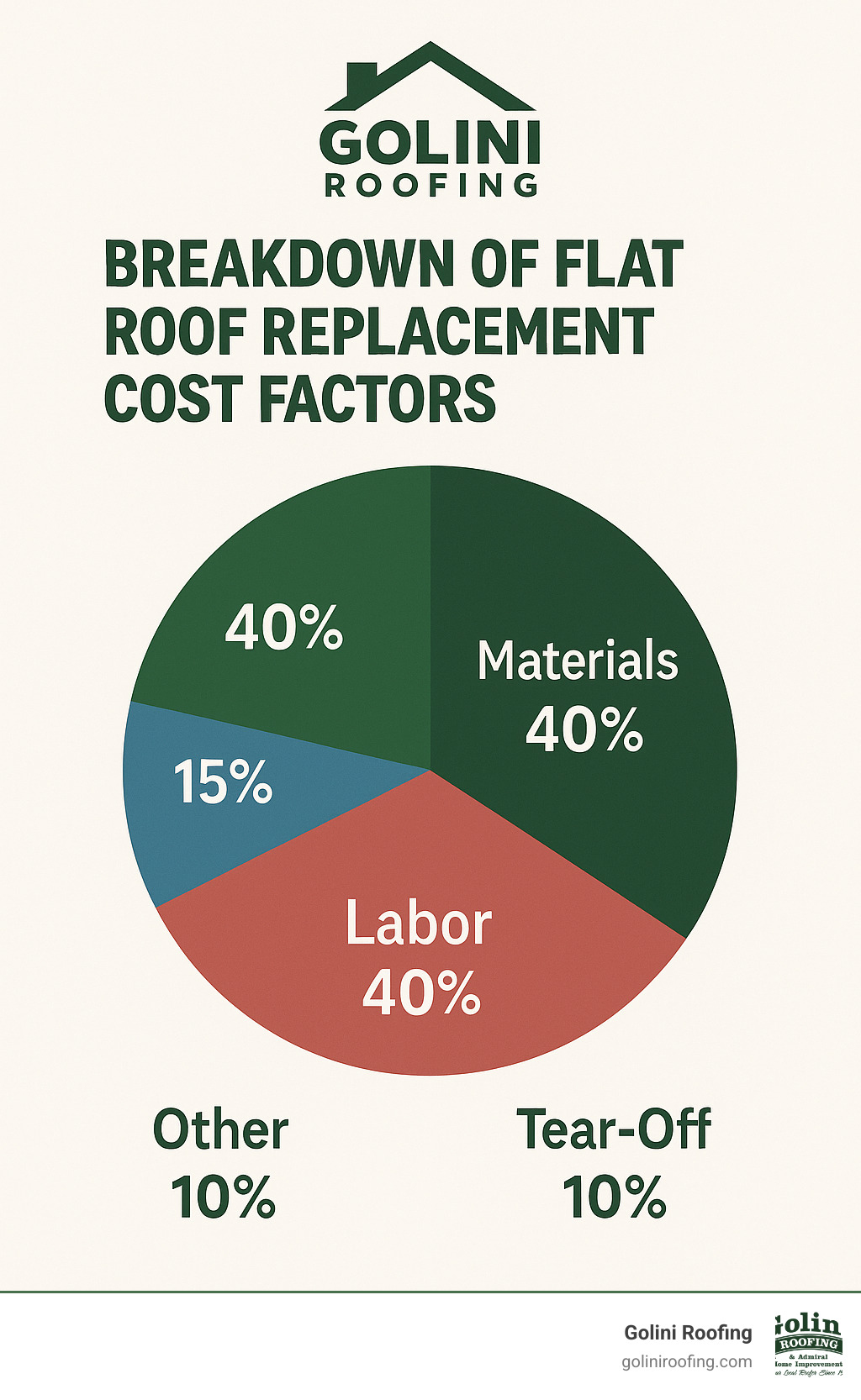
Living in Massachusetts brings its own considerations. Here in Wakefield and surrounding towns, we face stricter building codes and higher labor rates than the national average. Our winters also demand better insulation, which can add $1-$3 per square foot to your project. When we run your numbers through our flat roof replacement cost calculator, we account for these regional factors.
Multi-story buildings typically cost 20-30% more due to safety equipment and labor complexity. Those existing layers matter too – multiple layers needing removal will bump up your costs. And if your roof has numerous penetrations (think skylights, vents, HVAC units), each one requires special attention and flashing.
According to Nerdwallet’s research on roof replacement factors, climate considerations can add 5-15% to roofing costs in regions with extreme weather patterns. That is particularly relevant for us New Englanders, where snow loads and temperature swings put extra demands on roofing systems.
These figures represent average costs based on internet data, not actual Golini Roofing prices. Every roof has its own story, and we have seen enough in our 35+ years to know that a personal assessment is always best. But a good flat roof replacement cost calculator will get you in the right ballpark to start your planning process.
Flat Roofing Materials Compared: Cost, Lifespan & ROI
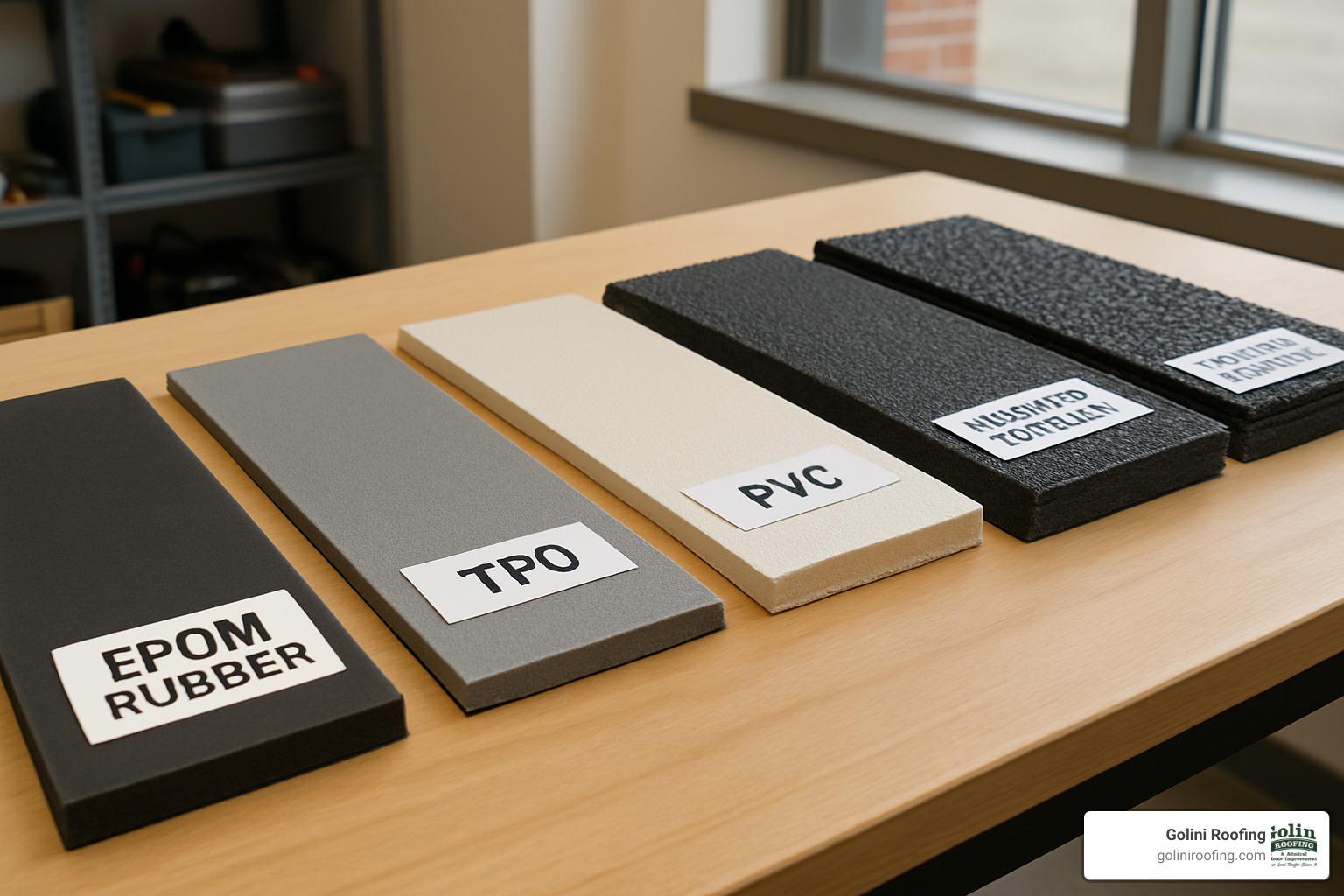
When you are plugging numbers into a flat roof replacement cost calculator, your material choice dramatically impacts the bottom line. It is not just about upfront costs – it is about what you will get in return over the years.
| Material | Cost per Sq Ft (Installed) | Lifespan | Energy Efficiency | Warranty |
|---|---|---|---|---|
| EPDM (Rubber) | $4-$8 | 15-25 years | Low-Medium | 10-30 years |
| TPO | $4-$10 | 10-25 years | High | 15-30 years |
| PVC | $5-$12 | 20-30 years | High | 20-30 years |
| Modified Bitumen | $3-$6 | 10-20 years | Low | 10-20 years |
| Built-up Felt (BUR) | $3-$5 | 15-30 years | Low | 10-20 years |
| Standing Seam Metal | $8-$12 | 30-80+ years | Medium-High | 30-50 years |
| Spray Foam | $4-$7 | 40-50 years | Very High | 10-20 years |
EPDM (that is rubber roofing) remains the workhorse of flat roofing. Think of it as the reliable sedan of roofing materials – not flashy, but it gets the job done at a reasonable price. Here in Massachusetts, though, its dark color can turn your top floor into a sauna during summer months, potentially bumping up your cooling bills.
TPO has been gaining serious traction among our Wakefield and Burlington customers. Its bright white surface reflects heat like a beach umbrella, helping keep cooling costs manageable during those increasingly hot New England summers. At a price point similar to EPDM but with better energy performance, it is no wonder we are installing more of it every year.
PVC is the premium option for those looking for the long haul. Yes, it will cost you more upfront – but it is like buying a quality pair of boots instead of replacing cheap ones every year. Its superior chemical resistance makes it ideal if your building has restaurant exhaust or other chemical exposures. I have seen 25-year-old PVC roofs still performing beautifully, which is why we often recommend it for “forever homes.”
Modified bitumen offers budget-friendly protection for smaller projects. It combines traditional asphalt with rubber or plastic polymers for added flexibility. While it will not last as long as the synthetic membranes, it is a solid choice when budget constraints are real – and we all know they often are!
Built-up roofing (BUR) is the old-school approach – layers of felt with hot tar and gravel. It has been around forever for a reason, but frankly, we are installing less of it these days due to its weight and installation complexity. That said, a well-installed BUR roof can serve faithfully for decades.
Standing seam metal might seem like an odd choice for a flat roof, but special low-slope profiles work beautifully. Yes, it is the priciest option upfront, but when you are looking at potentially 50+ years of service with minimal maintenance, the math starts making sense. Plus, it handles New England snow loads like a champ.
Spray foam delivers double-duty as both roofing and insulation. Its seamless application eliminates the possibility of seam failures, and the energy efficiency is off the charts. The catch? It requires expert application (this is not a DIY project!) and periodic recoating to maintain its protective qualities.
After 35+ years of installing these materials throughout Massachusetts, we have seen how material choice affects long-term performance. But here is the truth that calculators cannot tell you: even the best material poorly installed will fail prematurely. That is why at Golini Roofing, we focus just as much on installation quality as we do on material selection.
For a deeper dive into flat roof pricing specifics, check out our comprehensive Flat Roof Cost guide.
Step-By-Step Guide: Using a Flat Roof Replacement Cost Calculator to Plan Your Budget
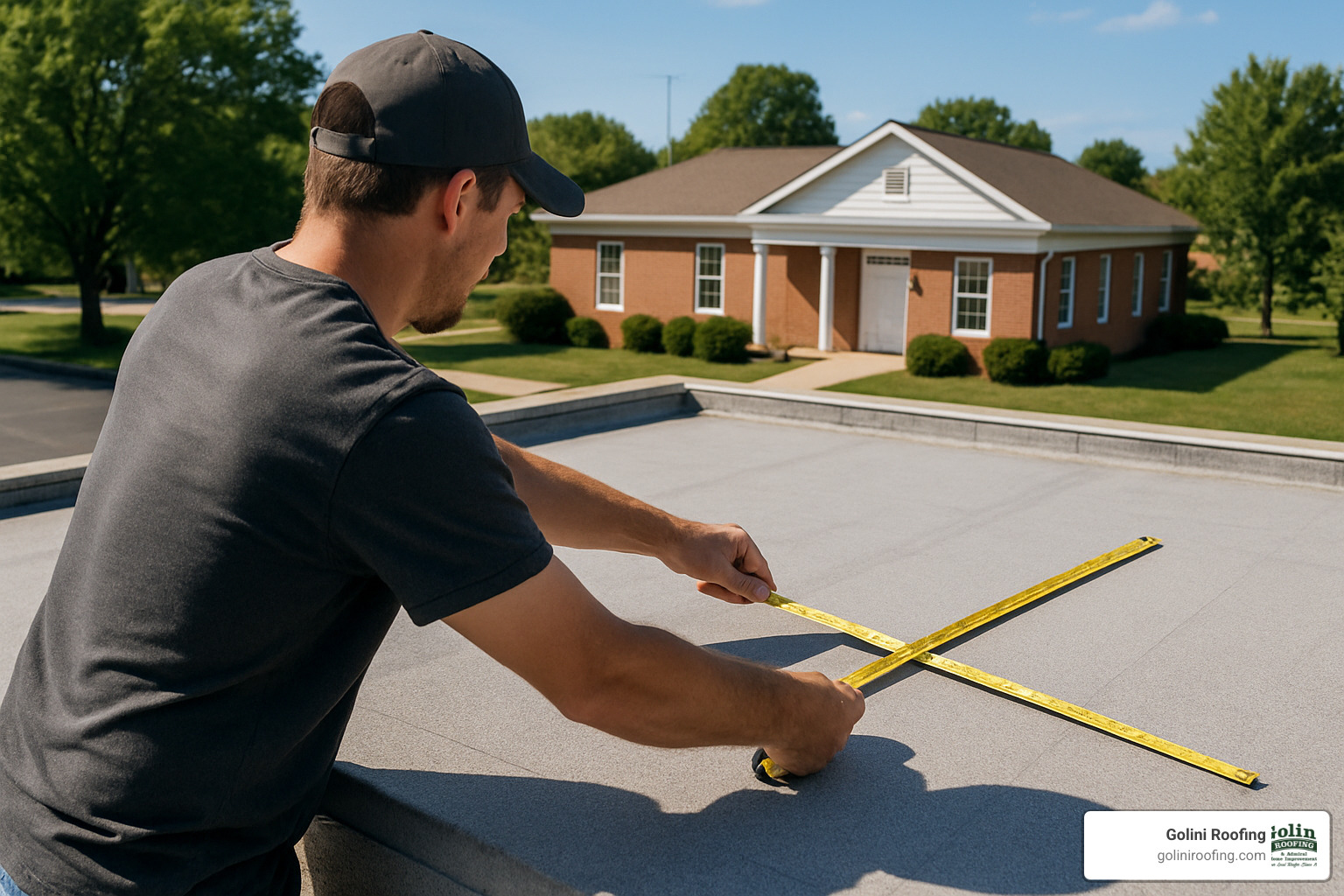
Getting started with a flat roof replacement cost calculator does not have to feel like deciphering ancient hieroglyphics. With a little preparation and the right information at your fingertips, you can get a remarkably accurate estimate of your project costs.
1. Gather Your Roof Measurements
The foundation of any good estimate begins with accurate measurements. Grab your tape measure and safely record the length and width of each roof section. Do not forget to account for those overhangs – typically adding 6-12 inches per side can make a big difference in your material calculations.
While you are up there (safely, please!), count all roof penetrations like skylights, vents, and chimneys, and measure any parapet walls. If climbing onto your roof feels like an Olympic sport you would rather not attempt, no worries – measuring your building’s footprint from ground level and adding for overhangs works too.
2. Determine Your Roof’s Pitch
Here is a little-known fact that surprises many homeowners: even “flat” roofs are not completely flat! They typically have a slight slope of about 1/4″ to 1/2″ per foot (or 1-2 degrees) to ensure proper drainage. Knowing this pitch helps the flat roof replacement cost calculator determine precisely how much material you will need.
3. Assess Current Roofing Conditions
Take a moment to count how many existing roofing layers you currently have. This is not just about curiosity – most building codes limit total layers to two, so if you are already at that limit, you will need a complete tear-off (which affects your budget). Those old layers are not just sitting there looking pretty; they are potential additional costs waiting to be calculated.
4. Select Your Preferred Roofing Material
Now for the fun part – choosing your new roof’s “outfit.” Your material choice dramatically impacts both immediate costs and long-term value:
EPDM makes sense if you are watching your wallet but still want reliability. TPO offers great energy efficiency for those hot Massachusetts summers. PVC provides maximum durability if you are planning to stay put for decades. And modified bitumen works well for smaller projects where budget is a primary concern.
5. Enter Your Location
Your ZIP code is not just a mailing necessity – it is a crucial factor in your roofing estimate. Labor and material costs in Wakefield, Burlington, and surrounding Massachusetts communities often differ from national averages. The flat roof replacement cost calculator uses this information to provide regionally accurate pricing custom to your specific location.
6. Input Additional Features
Do not forget to include the extras that make your roof uniquely yours. Better insulation might cost more upfront but save you money every month on energy bills. Drains, scuppers, edge metals, and flashings all play important roles in your roof’s performance. And those access difficulties like towering trees or limited parking? They affect labor costs too.
7. Review and Adjust Your Estimate
Once your calculator has worked its magic, take time to review the results. Adding a 10-15% contingency is always smart roofing wisdom – it is like bringing an umbrella when the forecast is sunny. Compare different material options, consider potential energy savings from reflective materials, and think about timing – scheduling during the roofing off-season might save you some cash.
For a truly comprehensive estimate custom to your specific situation, visit our New Flat Roof Cost Estimate page.
Example: 1,000 sq ft flat roof calculated with a flat roof replacement cost calculator
Let us walk through a real-world example using a flat roof replacement cost calculator for a typical 1,000 square foot flat roof in Wakefield, MA:
Imagine you have a 1,000 square foot roof with a gentle 1/4″ per foot slope, two vent pipes poking through, and one existing layer that needs removal. You are considering an EPDM 60-mil membrane for its reliability and value.
After plugging these details into the calculator, you might see results like:
Material costs: $2,000-$3,000
Labor: $2,000-$3,500
Tear-off and disposal: $1,000-$2,000
Permits and miscellaneous: $500-$1,000
This brings your total estimate range to $5,500-$9,500.
Curious about other materials? Switching to TPO might adjust your range to $6,000-$10,000, while premium PVC could push it to $7,000-$11,000. And do not forget insulation – adding R-30 insulation might add $1,500-$3,000 to your project, but could qualify for energy rebates and lower your heating and cooling costs for years to come.
Turning the estimate into action
Your flat roof replacement cost calculator estimate is not just a number – it is the first step in your roofing journey. Here is how to transform that estimate into reality:
Create a budget file that documents your estimate and includes that wise 10-15% contingency buffer. Massachusetts weather can be unpredictable, so develop a timeline that targets the prime roofing season from late spring through early fall.
Prepare a permits checklist – most Massachusetts towns require permits for roof replacements, with fees typically ranging from $100-$500 depending on your location. Use your calculator estimate as a baseline when gathering contractor quotes, and be wary of any that seem suspiciously high or low.
Do not forget project logistics – where will materials be stored? How will your landscaping be protected? Planning these details in advance makes for a smoother project experience.
At Golini Roofing, we have been helping Massachusetts homeowners steer this process for over 35 years. We understand that a new roof is not just a construction project – it is an investment in your home’s future. From estimate to completion, our team is dedicated to clear communication and detailed planning that turns calculator numbers into a beautiful, durable roof over your head.
Beyond the Calculator: Quotes, Contractors & Repair-vs-Replace Decisions

While a flat roof replacement cost calculator gives you a helpful starting point, there is more to the story when planning your roofing project. Let us explore what happens after you get that initial estimate.
In Massachusetts, particularly in communities like Wakefield and surrounding towns, labor rates tend to run higher than the national average. This is not surprising given our skilled workforce, stricter building codes, and higher cost of living. The good news? Local contractors with strong supplier relationships (like us at Golini Roofing) can sometimes offer more competitive pricing than online calculators might suggest.
Before jumping straight to replacement, take a moment to consider whether repairs might be sufficient. If your roof is relatively young (less than 10-15 years old), has only isolated leaks, and the membrane remains in generally good condition, repairs could be your most economical option – especially if you are working with budget constraints.
However, replacement typically makes more sense when your roof has passed the 20-year mark, shows widespread or recurring leaks, has already undergone multiple repairs, or when improving energy efficiency is a priority. As Bob Vila points out, once a flat roof surpasses 20 years of service, replacement usually proves more cost-effective than continuing with patch-up jobs.
For a deeper dive into repair options and their costs, our Flat Roof Repair Cost page offers valuable insights.
One thing no calculator can provide is a professional assessment of your roof’s underlying condition. While online tools estimate based on measurements and material selections, they cannot spot hidden structural issues or evaluate moisture infiltration. A thorough inspection from experienced professionals can identify concerns beneath the surface, assess insulation condition, evaluate drainage patterns, and recommend the most appropriate materials for your specific situation.
Do not overlook warranty considerations, either. Calculator estimates typically do not factor in the value of different warranty options. When comparing quotes, pay attention to manufacturer material warranties (typically 10-30 years), workmanship guarantees (which vary by contractor), extended warranty options, and whether warranties are transferable if you sell your property.
For complete information about replacement options, visit our Flat Roof Replacement page.
Questions to ask before hiring
Finding the right contractor makes all the difference in your roofing project’s success. Before signing on the dotted line, have a conversation covering these essential points:
- Credentials and expertise – Verify that your contractor is properly licensed and carries both liability insurance and workers’ compensation coverage. Ask about their specific experience with your chosen roofing material, as different systems require different skills.
- Installation methods – At Golini Roofing, we believe in the superior quality of hand-nailing for appropriate applications. Ask potential contractors about their installation techniques and why they prefer their methods.
- Project management – Who will oversee your project daily? Having an experienced foreman or project manager on-site ensures quality control and provides you with a point person for questions.
- Warranty protection – Get clear details on both manufacturer and workmanship warranties. A quality contractor stands behind their work with meaningful guarantees.
- Payment structure – Be cautious of contractors requesting large upfront payments. A reasonable deposit is standard, but the payment schedule should align with project milestones.
- Property protection – Your contractor should have a clear plan for protecting landscaping, windows, and exterior features during the installation process.
- Problem resolution – Discuss how unexpected issues will be handled. What happens if they find hidden damage or structural concerns once work begins?
- Timeline expectations – Understand the projected duration and what factors might cause delays. Weather is always a variable in roofing projects, but a good contractor builds reasonable contingencies into their schedule.
- Local references – Request contacts from recent flat roof installations in your area. Speaking with previous customers provides valuable insights into what to expect.
At Golini Roofing, we welcome these questions and more. With over 35 years serving Massachusetts communities like Wakefield, Burlington, and surrounding areas, we believe in transparent communication from estimate to completion. Our goal is not just to install your roof – it is to make the entire process as smooth and stress-free as possible.
Frequently Asked Questions about Flat Roof Replacement Costs
How much does removing an old flat roof cost?
Tearing off your existing flat roof is often the first step in the replacement process – and it is a cost many homeowners do not initially consider. Flat roof replacement cost calculators typically include removal expenses, which generally range from $1 to $2 per square foot.
What drives this cost? Several factors come into play. If you have multiple layers of old roofing material (which is common on older buildings), expect to pay toward the higher end of that range. Built-up roofs with tar and gravel are particularly labor-intensive to remove, requiring more time and effort from the crew.
For perspective, removing an old flat roof on a typical 1,500 square foot home might cost between $1,500 and $3,000. Here in Massachusetts, we often see costs trending slightly higher than national averages due to our stricter environmental regulations and limited disposal facilities.
At Golini Roofing, we handle all the permitting and proper disposal as part of our service package. We have been navigating these local regulations for over 35 years, so you do not have to worry about the complexities of construction waste management.
Are online flat roof replacement cost calculators as accurate as contractor quotes?
A good flat roof replacement cost calculator will typically get you within 10-15% of actual contractor quotes – close enough for initial budgeting, but with some important limitations.
These calculators shine when estimating standard rectangular roofs with minimal complications. Enter precise measurements and average material costs, and you will likely receive a reasonably accurate estimate for typical conditions.
However, the real world is rarely so straightforward. Complex roof configurations with multiple sections, unusual access conditions (like limited driveway space or overhanging trees), and underlying structural issues can significantly impact your final cost. Most online calculators simply cannot account for these variables.
Additionally, different Massachusetts municipalities have varying code requirements that might affect your project. A calculator based on national averages might not reflect these local nuances.
That is why we at Golini Roofing always recommend following up your online estimate with a professional assessment. Our in-person quotes include a thorough physical inspection of your roof’s condition and structure – something no algorithm can replace. We have been climbing on Massachusetts roofs since 1982, and that experience helps us spot potential issues that might affect your project cost.
How long does a typical flat roof replacement take?
When planning your flat roof replacement, timing matters – especially here in New England where weather windows can be unpredictable.
For a typical 1,500 square foot residential flat roof, you are generally looking at a 3-8 working day timeline from start to finish. This usually breaks down to 1-3 days for tear-off (depending on those existing layers we mentioned earlier), 1-2 days for deck inspection and any necessary repairs, and 1-3 days for the actual installation of your new roofing system.
Several factors can extend this timeline. Weather delays are perhaps the most significant in Massachusetts – we cannot safely install most flat roofing materials in rain or extreme temperatures. Extensive deck repairs, complex roof features like numerous penetrations, material availability challenges, and permit inspection schedules can all add days to your project.
At Golini Roofing, we have refined our process over thousands of installations across Wakefield, Burlington, Winchester, and surrounding communities. We provide detailed timelines during the quoting process and keep you informed of any schedule changes throughout your project. Our crews work efficiently while never compromising our standards for quality installation – after all, we are putting our 35-year reputation behind every roof we install.
Conclusion
The flat roof replacement cost calculator has truly transformed how we approach roofing projects. Remember when planning a roof replacement meant waiting days for estimates and crossing your fingers that you were budgeting enough? Those days are thankfully behind us.
These digital tools provide immediate, personalized estimates based on your specific roof dimensions, material choices, and location – giving you a solid financial starting point before you ever pick up the phone to call a contractor.
But here is the thing – a calculator is just the first step in your roofing journey. The real magic happens when you combine these initial estimates with hands-on expertise from experienced professionals. At Golini Roofing, we have spent over 35 years serving Massachusetts communities like Wakefield, Burlington, and Lynnfield, changing calculator estimates into durable, weather-tight roofing systems built specifically for New England’s challenging climate.
While national averages give you useful benchmarks, your actual costs will be influenced by local factors that might not be fully captured in generic calculators. Massachusetts homeowners often face unique considerations – from higher material and labor costs to stricter building codes and seasonal weather constraints that can impact installation timelines.
For the most accurate assessment of your specific flat roof replacement needs, I encourage you to use our New Roof Estimate Calculator as your starting point. Then, reach out for a detailed, no-obligation consultation where we can address the nuances of your particular project. Our team is ready to guide you from that initial estimate to a completed roof with the craftsmanship and attention to detail that has defined Golini Roofing since 1982.
By blending the convenience of digital estimation with our decades of hands-on experience, you can approach your flat roof replacement with confidence, clarity, and a realistic budget custom to your specific home. No surprises, no guesswork – just a solid plan and a partner who has been keeping Massachusetts homes dry and protected for generations.
