Why Choosing the Best Insulation for a Pitched Roof Can Cut Your Energy Bills in Half
Quick Answer: Best Insulation for Pitched Roofs
| Insulation Type | Best For | Thermal Performance |
|---|---|---|
| Rigid PIR/Phenolic Boards | Between & over rafters | Excellent |
| Stone Wool (Mineral Wool) | Between rafters, loft floor | Very Good |
| Fiberglass Batts | Loft floor, cold roofs | Good |
| Multifoil Insulation | Limited headroom, retrofit | Good |
| Blown-In Cellulose | Loft floor, attic top-up | Good |
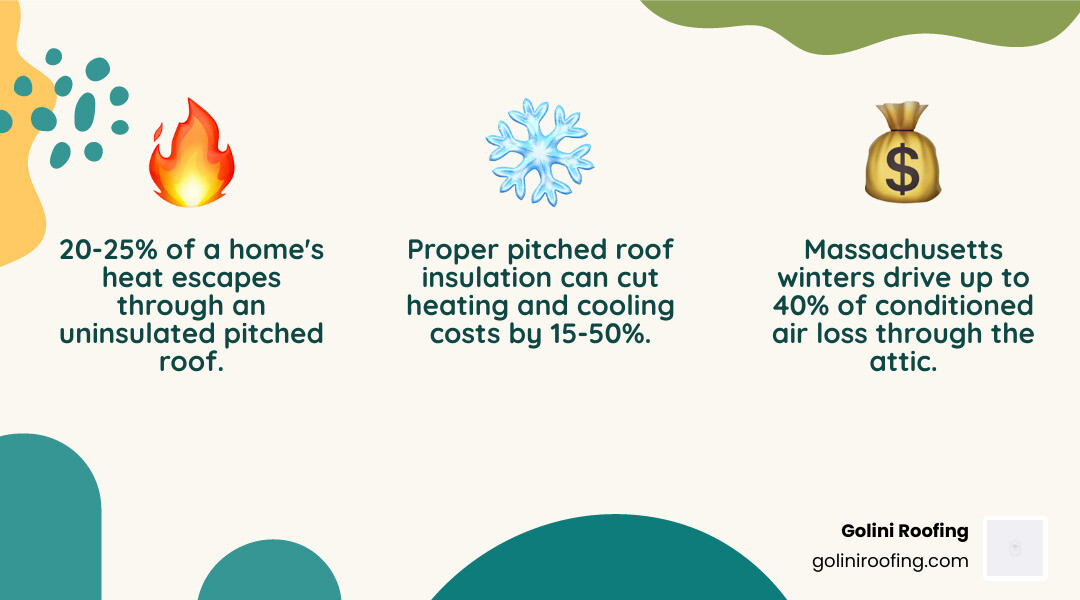
Finding the best insulation for a pitched roof is one of the highest-impact upgrades a Massachusetts homeowner can make. Without it, you can lose 20–25% of your home’s heat straight through the roof — and up to 40% of all conditioned air through the attic. That translates directly into higher heating bills every single winter.
This is especially relevant for homes across the North Shore — from Wakefield and Reading to Stoneham and Lynnfield — where cold winters put real pressure on a home’s thermal envelope.
The good news? A well-insulated pitched roof can cut heating and cooling costs by 15–50%, according to industry data. The challenge is knowing which insulation method and material is right for your specific roof, space, and budget.
This guide walks you through every key decision — clearly and without jargon.
I’m Jack Golini, owner of Golini Roofing, and I’ve been working on roofs in Massachusetts since 1982 — giving me over four decades of hands-on experience helping homeowners choose the best insulation for pitched roof installations that hold up through our toughest New England winters. That experience shapes every recommendation in this guide, and I’ll make sure you leave with a clear path forward.
Pitched Roof Insulation Methods: Cold vs. Warm Roofs
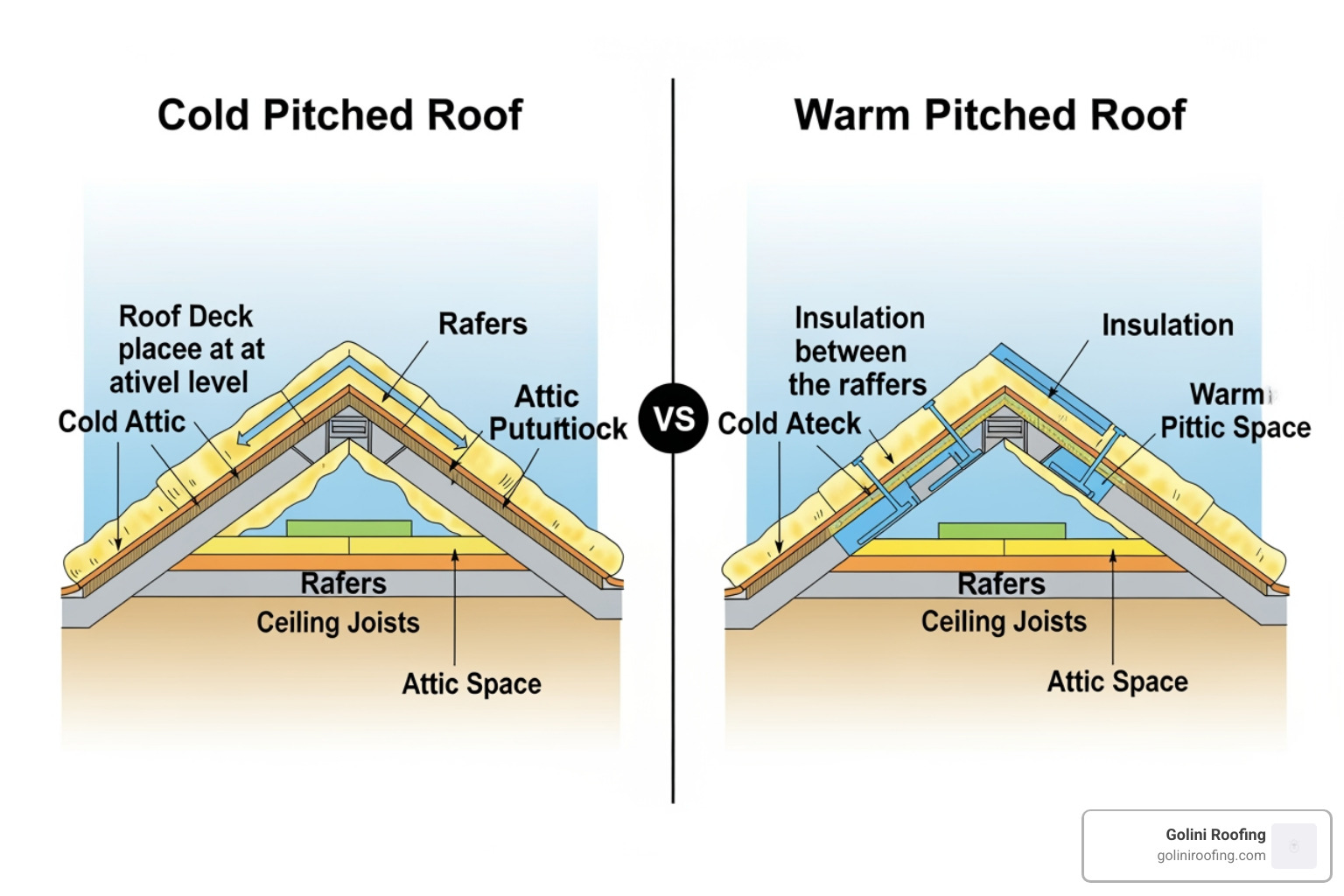
When insulating a pitched roof, the first major decision is where to place the thermal barrier. This choice fundamentally dictates whether you are creating a “cold roof” or a “warm roof.” Both methods have distinct advantages depending on how you plan to use your attic space.
The Cold Roof Method (Insulation at Ceiling Level)
In a cold roof setup, the insulation is laid flat along the loft floor (between and over the ceiling joists). This keeps the heat down in your living areas, while the attic space above remains unheated and “cold.”
- How it works: Mineral wool or fiberglass rolls are laid between the ceiling joists, with a second layer running perpendicular over the top to eliminate thermal bridging.
- Pros: It is the most cost-effective and straightforward method. It is highly efficient because you are only heating the actual living spaces below.
- Cons: The attic space itself becomes unusable for temperature-sensitive storage or future living space conversions. It also requires excellent ventilation to prevent condensation.
For detailed design specifications on ceiling-level layouts, you can review the Pitched Roof – Ceiling Level – Technical Detail documentation.
The Warm Roof Method (Insulation at Rafter Level)
A warm roof shifts the insulation barrier up to the rafters (the sloped beams of the roof structure). This brings the attic space inside the heated envelope of your home.
There are two primary ways to design a warm roof:
- Ventilated Warm Roof: The insulation is installed between the rafters, but a continuous 50mm (2-inch) air gap is maintained directly beneath the roof sheathing. This gap allows outdoor air to flow from the eave vents up to the ridge vent, carrying away moisture.
- Unventilated Warm Roof: The insulation completely fills the rafter depth. This setup typically requires a highly specialized vapor-permeable breather membrane on the exterior side of the rafters, coupled with counter battens to allow air circulation directly under the roof tiles or shingles.
By keeping the attic space warm, you eliminate the risk of freezing pipes and make the space ready for a future master suite, home office, or playroom. If you are dealing with unique slopes, you may also want to read our guide on Insulating Low Slope Residential Roofs to see how slope angles change your insulation strategy.
To explore how high-performance stone wool options adapt to these setups, check out the resources provided by the Pitched Roof Insulation | ROCKWOOL Group.
Selecting the Best Insulation for Pitched Roof Systems
Choosing the best insulation for pitched roof applications requires balancing thermal performance, fire safety, moisture management, and available space. Here is a breakdown of the most common materials used by professionals in 2026.
1. Stone Wool (Mineral Wool)
Stone wool is manufactured by spinning molten volcanic rock into dense fibers. It is widely regarded as one of the most durable and high-performing insulation materials available.
- Thermal Efficiency: Excellent thermal resistance that does not degrade over time.
- Fire Resistance: Outstanding. It is non-combustible and can withstand temperatures exceeding 1,000°C, providing a vital safety barrier in loft conversions.
- Moisture Control: Highly breathable and naturally water-repellent, meaning it won’t sag, settle, or lose its insulating properties if exposed to minor moisture.
- Best For: Rafter-level insulation in warm roofs and soundproofing between floors.
2. Rigid PIR and Phenolic Boards
Polyisocyanurate (PIR) and phenolic foam boards are highly compressed, foil-faced insulation panels.
- Thermal Efficiency: Exceptionally high. These boards offer the highest R-value per inch of thickness, making them the ultimate space-savers.
- Fire Resistance: Good, though they require a protective drywall barrier in habitable spaces.
- Moisture Control: The foil facings act as an integrated vapor barrier when the joints are properly taped.
- Best For: Tight rafter spaces in Reading and Stoneham homes where maximizing head height is crucial.
3. Multifoil Insulation
Multifoil consists of multiple reflective layers of foil separated by thin layers of wadding.
- Thermal Efficiency: It works primarily by reflecting radiant heat back into the home during winter and reflecting solar heat away in the summer.
- Space Saving: Extremely thin, making it ideal for historic homes with shallow rafters.
- Best For: Retrofit projects where preserving original architectural features is a priority. For a deeper look at these thin-profile systems, see the Multifoil Insulation for Pitched Roofs | SOPREMA UK product specifications.
4. Fiberglass Batts
The traditional choice for millions of American homes, fiberglass is made from spun glass fibers.
- Thermal Efficiency: Standard performance, though it must be installed perfectly without gaps or compression to achieve its rated R-value.
- Cost: Highly economical.
- Best For: Budget-friendly cold roof installations on flat loft floors.
When selecting your materials, it is also helpful to consider how your insulation choice pairs with your overall roofing material. You can read more about this in our comprehensive Residential Roofing Types Guide.
Building Regulations, U-Values, and Condensation Control in Massachusetts
In Massachusetts, our weather demands strict adherence to energy codes. Under the current energy conservation codes, residential roofs in Climate Zone 5 (which covers all of our service areas, including Wakefield, Lynnfield, and Melrose) must meet high thermal resistance standards.
Understanding U-Values and R-Values
- R-Value measures a material’s resistance to heat flow. The higher the R-value, the better the insulation. For a standard flat attic floor (cold roof), current guidelines recommend targeting an R-49 to R-60 rating.
- U-Value measures the rate of heat transfer through a structure. It is the mathematical inverse of the R-value ($U = 1/R$). A lower U-value means less heat escapes.
When insulating at the rafter level (warm roof), achieving these high R-values within a standard 2×6 or 2×8 rafter space can be challenging. This is why we often combine rigid PIR boards between the rafters with a continuous layer of insulation running across the underside of the rafters to eliminate thermal bridging through the wood.
Local municipalities enforce these guidelines closely. For example, you can review the specific local amendments and structural rules in the [PDF] ROOF DECK INSULATION 07 22 00-1 – Stoneham-MA.gov document to see how regional codes dictate insulation thickness and vapor barrier placement.
Managing Condensation and Ventilation
Proper insulation is only half the battle; the other half is ventilation. When warm, humid air from your kitchen and bathroom rises into a cold attic, it hits the cold roof sheathing and condenses into liquid water. This leads to wood rot, compromised insulation, and hazardous mold growth.
To prevent this:
- Install a Vapor Control Layer (VCL): A VCL should always be installed on the warm, interior side of the insulation to prevent indoor moisture from entering the roof structure.
- Maintain Balanced Ventilation: In a cold roof or ventilated warm roof, you must ensure a continuous flow of cool outdoor air. This is achieved by combining soffit vents (intake) at the lower edge of the roof with a ridge vent (exhaust) at the very top. This natural convection keeps the roof deck cool, which also prevents the formation of destructive ice dams during freezing winter storms.
Frequently Asked Questions About Pitched Roof Insulation
What is the best insulation for pitched roof projects with limited headroom?
If you are converting an attic with low ceilings, rigid phenolic boards or multifoil insulation are the premier choices. Because they offer high thermal resistance per inch, you can achieve the required R-value without deeply lowering your ceiling. Taping and sealing multifoil also allows it to serve as a high-performing vapor barrier, saving you even more space.
How does roof pitch affect the choice of the best insulation for pitched roof installations?
The steepness of your roof directly impacts how air moves through your ventilation channels. Steep-slope roofs naturally facilitate excellent air movement via convection from the soffit to the ridge. Low-slope roofs, however, require careful planning to prevent air stagnation. If you are dealing with a shallow slope, we recommend reading our Low Slope Residential Roofing Guide to learn how to adapt your insulation and waterproofing strategies.
Should I insulate at the ceiling level or between the rafters?
If you only use your attic for basic storage and have no plans to convert it into a bedroom or living space, insulating at the ceiling level (cold loft) is the most efficient and cost-effective choice. However, if you want to turn that attic into a comfortable, conditioned living space, you must insulate between and over the rafters (warm loft).
Should I choose DIY or professional installation?
While laying fiberglass batts on an open attic floor is a common DIY project, insulating a sloped pitched roof at the rafter level is a highly complex task. Improperly installed vapor barriers or blocked ventilation paths will trap moisture, leading to structural rot that can ruin your roof deck.
Additionally, working overhead in tight rafter spaces carries safety risks. We highly recommend hiring a certified professional to ensure your insulation meets local Massachusetts building codes and preserves the lifespan of your roof.
What are the average industry costs for pitched roof insulation?
Based on publicly available internet data, the average cost for a standard attic insulation project is approximately $2,500. However, actual costs vary widely depending on the size of your home, the insulation materials selected, and whether structural ventilation modifications are required.
To account for industry variability, realistic professional installation costs typically range from $5,000 on the lower end for straightforward top-ups, up to $12,500 or more on the high end for premium, high-performance rafter-level systems. (Note: These are average industry ranges sourced from online data and do not represent actual pricing for Golini Roofing.)
Conclusion
Investing in the best insulation for pitched roof systems is one of the smartest decisions you can make to protect your home and lower your energy bills. Whether you opt for a highly efficient cold roof or transform your attic into a beautiful warm living space, proper material selection and flawless ventilation are the keys to long-term success.
At Golini Roofing, we have been serving homeowners in Wakefield, MA, and surrounding North Shore communities for over 35 years. We specialize in both residential and commercial roofing services, bringing unparalleled craftsmanship to every project. What sets us apart is our dedication to quality — including our signature hand-nailing of every single shingle to ensure a roof that stands the test of time.
If you are ready to upgrade your roof’s insulation, replace aging shingles, or ensure your attic is properly ventilated for the seasons ahead, we are here to help. Explore our Residential Roofing Service to see how we can protect your home.
Contact Golini Roofing today at +781-246-0141 or click below to request your professional estimate!