
What Is the Complete Roof Replacement Cost in 2026?
The complete roof replacement cost in the US varies widely — here’s a quick snapshot based on industry averages from publicly available internet data (not Golini Roofing’s actual pricing):
| Home Size | Typical Cost Range |
|---|---|
| 1,000 sq ft | $5,800 – $22,000 |
| 1,500 sq ft | $7,500 – $30,000 |
| 2,000 sq ft | $9,000 – $45,000 |
| 2,500 sq ft | $12,500 – $60,000 |
| 3,000 sq ft | $15,000 – $75,000 |
Material matters most. Asphalt shingles sit at the lower end. Slate and standing-seam metal push costs significantly higher. Labor, roof pitch, tear-off, and local building codes all add to the final number.
In Massachusetts, expect costs to run above national averages — driven by stricter code requirements, New England weather demands, and higher regional labor rates.
For most homeowners across Massachusetts communities like Wakefield, Reading, and Woburn, a full roof replacement is one of the largest single home investments they’ll ever make. The numbers can feel overwhelming — especially when contractor quotes vary by thousands of dollars for what looks like the same job on the surface.
The truth is, no two roofs cost the same. Size, pitch, material, hidden decking damage, and local labor markets all compound together. Understanding exactly what drives the price is the only way to budget accurately and avoid being caught off guard mid-project.
I’m Jack Golini, owner of Golini Roofing — I’ve been replacing and repairing roofs across Massachusetts since 1982, and in that time I’ve seen every factor that can drive up a complete roof replacement cost unexpectedly. In this guide, I’ll walk you through a realistic, no-fluff breakdown of what you should actually expect to pay — and why.
Basic complete roof replacement cost glossary:
- average cost to reroof a house
- how much does a roof cost to replace
- price of a new roof
Understanding the Complete Roof Replacement Cost in 2026
When planning for a major home improvement project, understanding the baseline figures is the first step toward building an accurate budget.

According to online databases and industry-wide reports, the average cost for a standard residential roof replacement is approximately $13,500. However, because the roofing industry is subject to massive variability in material grades, structural differences, and regional overhead, actual market rates cover a very wide spectrum. For a truly comprehensive look at what a full replacement might entail, online data shows a realistic wide range starting at a low-end of $27,000 (representing standard homes with premium additions) up to a high-end of $67,500 (for larger, highly complex properties utilizing high-performance materials).
Please note that all prices mentioned throughout this guide are average costs sourced from publicly available internet data and are not the actual prices of Golini Roofing. We present these industry averages to help you understand general market forces rather than to quote our specific services.
When calculating your potential expenses, it is critical to look beyond the basic square footage of your home’s floor plan. Many homeowners ask How Much Does It Cost to Replace a Roof? only to realize that their roof surface area is actually 10% to 25% larger than their home’s interior living space due to slopes, eaves, and overhangs. To get a realistic sense of the scope of your project, you must account for the actual surface area of the roof deck, which is the primary metric contractors use when determining your overall Roof Replacement Cost.
Regional Pricing and the Complete Roof Replacement Cost in Massachusetts
Geography plays a massive role in shaping your final roofing estimate. In Massachusetts, local building codes and regional climate requirements mean that standard national averages rarely tell the whole story.
For instance, the Massachusetts State Building Code has strict guidelines designed to protect homes from harsh New England winters. One of the most important regional requirements is the installation of a self-adhering polymer-modified bitumen sheet—commonly known as an ice and water barrier. State code dictates that this protective barrier must extend from the lowest eave edge to a point at least 24 inches inside the exterior wall line of the building. In areas prone to heavy snow and ice dams, such as Wakefield, Stoneham, and Winchester, we often recommend extending this protection even further up the roof planes.
These local safety standards, combined with regional labor rates and municipal permit fees, mean that Calculating Roof Replacement Cost in Greater Boston requires a localized approach. Permit fees alone in towns like Woburn or Reading can range from $150 to $400, and regional labor standards ensure that crews are fully licensed, insured, and workers’ compensation compliant, which protects you as a property owner but naturally increases the baseline project cost.
How Material Selection Impacts Your Complete Roof Replacement Cost
The material you choose to protect your home is the single largest variable under your control. The primary options range from highly economical to lifetime architectural investments:
- Asphalt Shingles: This remains the most popular option across Massachusetts. Standard three-tab shingles are the most budget-friendly upfront, but architectural (dimensional) shingles offer far superior wind resistance and a longer lifespan for only a slight increase in price.
- Metal Roofing: Standing-seam metal roofs are highly durable and offer incredible wind and snow-shedding capabilities. While the initial investment is higher, they can easily last 50 years or more.
- Natural Slate: Often found on historic homes in communities like Ipswich and Beverly, slate is the ultimate lifetime roofing material. It can last well over a century, though its extreme weight requires a structurally reinforced roof deck.
To understand how these options compare on a per-square basis, it helps to review the New Roof Cost per Square Foot. For an interactive look at how these material selections translate to your specific home size, tools like the Roof Replacement Cost Calculator 2026 — By Sq Ft, Material & State | CostPrism can help you visualize the cost differences between entry-level and premium materials.
Key Factors That Drive Your Total Roofing Estimate
To avoid surprises when you receive a professional quote, it is helpful to understand the structural and physical challenges that estimators look for when they step onto your property.

Every professional Roof Cost Estimate is built on a combination of material volume, physical accessibility, and labor hours. When we evaluate a home to Estimate the Cost of a New Roof, we look closely at how the roof’s geometry will affect our crew’s safety and installation speed.
Roof Size and Pitch Complexity
In the roofing industry, measurements are calculated in “squares.” One roofing square is equal to 100 square feet of roof surface. For example, a home with 2,400 square feet of roof surface requires 24 squares of materials.
However, size is only half the equation. The pitch—or steepness—of your roof has a dramatic impact on labor dynamics. Any roof with a pitch greater than 7/12 (meaning it rises more than 7 inches vertically for every 12 inches of horizontal run) is generally considered “non-walkable.” Non-walkable roofs require specialized safety harnesses, scaffolding, and staging equipment.
If your home in North Reading or Wilmington features steep gables, multiple dormers, intersecting valleys, or unique architectural turrets, the installation process slows down significantly. This complexity increases both the time required on-site and the volume of material waste, which directly impacts the Average Cost to Replace a 2000 Sq Ft Roof.
Labor and Local Market Dynamics
Labor typically accounts for 50% to 60% of the total cost of a roof tear-off and replacement. In the highly competitive Greater Boston market, labor rates reflect the high cost of living and the rigorous safety standards required by the state.
When you receive a New Roof Estimate in towns like Woburn, Stoneham, or Burlington, you are paying for the expertise of the crew. At Golini Roofing, we do not believe in cutting corners. While many modern crews rely on pneumatic nail guns to speed through installations, we pride ourselves on our meticulous hand-nailing process. Hand-nailing each individual shingle ensures that every nail is driven straight, to the exact correct depth, and directly into the common bond of the shingle. This old-school craftsmanship prevents the common wind-uplift issues associated with rushed gun-nailing and guarantees a roof that can withstand the worst New England nor’easters.
Comparing Roofing Materials: Lifespan vs. Upfront Investment
When deciding on a material, it is vital to weigh the upfront cost against the expected lifespan of the roof. A cheaper roof that needs to be replaced in 15 years often costs far more in the long run than a premium roof that lasts for 40 or 50 years.
Below is a comparison table based on general online market data to show how different materials compare:
| Material Type | Average Lifespan | Pros | Cons |
|---|---|---|---|
| 3-Tab Asphalt | 15 – 20 Years | Lowest upfront cost | Lower wind resistance, shorter life |
| Architectural Asphalt | 25 – 30 Years | Excellent cost-to-durability ratio | Vulnerable to extreme hail |
| Standing Seam Metal | 40 – 70 Years | Sheds snow easily, highly durable | Higher upfront investment |
| Natural Slate | 75 – 150+ Years | Unmatched beauty, virtually fireproof | Extremely heavy, highest cost |
Investing in high-quality materials means you won’t have to worry about another replacement for decades. To dig deeper into how these materials perform over time, check out our guide on the Average Cost of New Roof. For a step-by-step breakdown of how shingle grades affect your long-term budget, take a look at The Shingle Truth: Estimating Roof Replacement Expenses.
Additional Line Items in a Professional Tear-Off and Replacement
A complete roof replacement is rarely as simple as putting new shingles over old ones. A professional, long-lasting job requires preparing the structural foundation of your roof from the deck up.
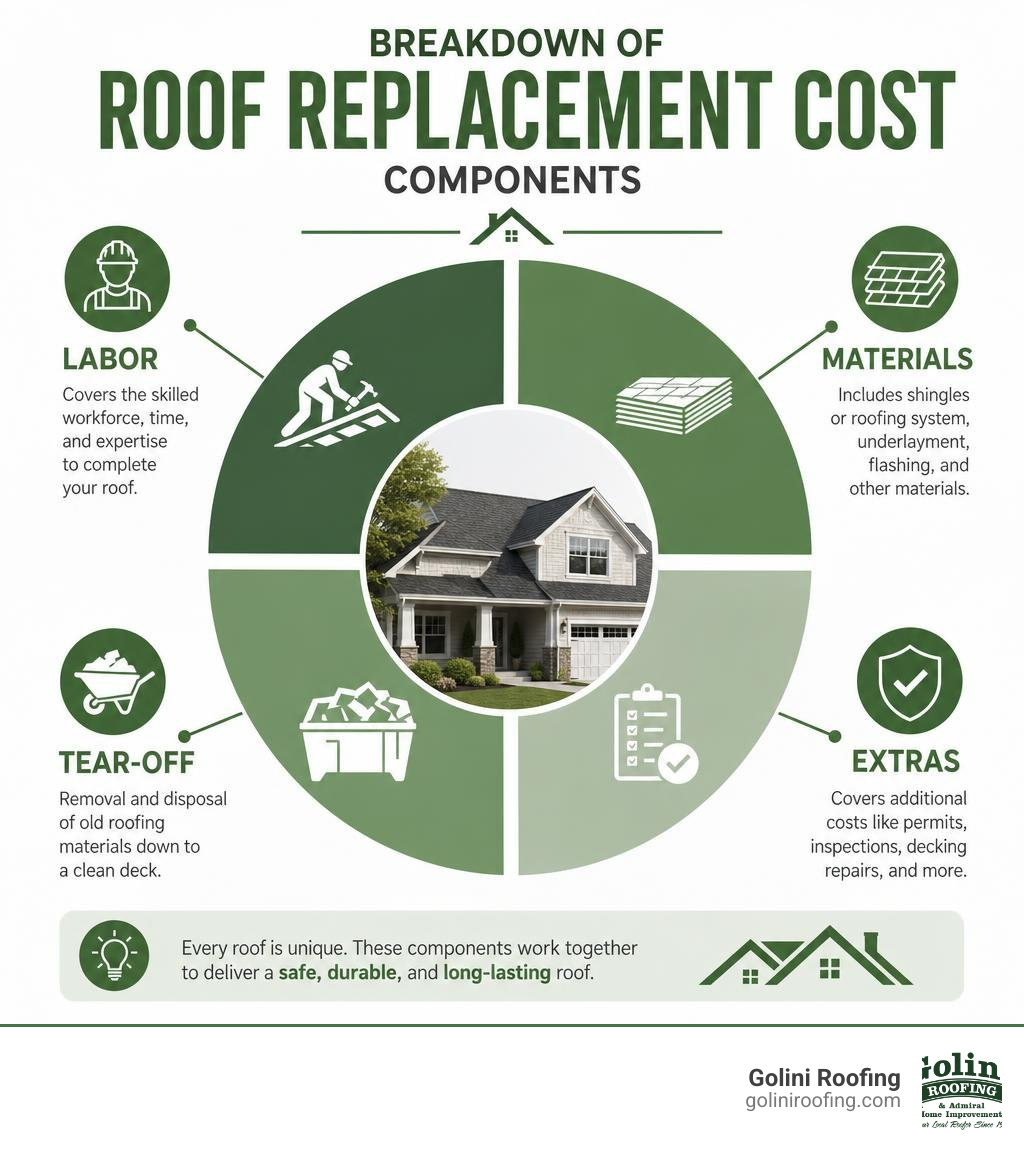
When we tear off an old roof, we often discover hidden issues that must be addressed before the new shingles can be hand-nailed. To budget effectively, you should understand the costs associated with a full Roof Tear Off Cost and what goes into the Average Cost to Tear Off and Replace Roof.
Tear-Off and Disposal Fees
The process of removing and disposing of your existing roof layers requires significant labor and heavy equipment. If your home has multiple layers of old shingles from past reroofing projects, the tear-off process takes longer and generates more waste.
Disposal fees are calculated by weight, which means a multi-layer tear-off in Woburn or Wakefield will require larger dumpsters and higher landfill fees. A legitimate contractor will always include these waste disposal and cleanup costs directly in their initial quote so you aren’t left with an unexpected bill for dumpster rentals. You can learn more about this step in our Roof Replacement Complete Guide.
Decking Repairs and Underlayment Upgrades
Once the old shingles are removed, the raw wood decking (or sheathing) is fully exposed. This is the only time a contractor can inspect your roof’s structural integrity.
Approximately 15% to 20% of tear-off projects reveal some level of wood rot or water damage, often caused by slow, long-term leaks or poor attic ventilation. Replacing damaged plywood or older tongue-and-groove boards is essential; hand-nailing new shingles into rotten wood will cause the nails to back out, voiding your warranty and leading to premature roof failure.
Additionally, upgrading from standard 15-pound organic felt to a high-performance synthetic underlayment offers vastly superior tear strength and moisture protection. When planning your project, it is highly recommended to allocate a small buffer in your Roof Replacement Budget to cover potential decking repairs and quality underlayment upgrades.
Frequently Asked Questions About Roof Replacement Costs
How long does a complete roof replacement take?
For most standard single-family homes in Massachusetts, the physical installation of an asphalt shingle roof takes between 1 and 3 days. However, the total timeline can be affected by weather conditions—such as heavy rain or winter snow—and the structural complexity of the roof. If significant decking repairs are discovered during the tear-off phase, this can add an extra day to the project. You can find a detailed breakdown of what to expect during the process in our guide: How Long Does Roof Replacement Take?.
Does homeowners insurance cover a full roof replacement?
Homeowners insurance is designed to cover sudden, accidental damage caused by covered perils—such as severe windstorms, hail, fallen trees, or lightning. It does not cover normal wear and tear, gradual deterioration, or neglect.
When filing a claim, the payout depends on whether you have a Replacement Cost Value (RCV) policy or an Actual Cash Value (ACV) policy. RCV policies cover the actual cost of replacing the roof at today’s market rates (minus your deductible), while ACV policies only pay out the depreciated value of the roof based on its age. Always review your policy’s deductible structure and consult with your insurance agent before initiating a claim.
Can I install new shingles over an existing roof layer?
While some local building codes allow for a “reroof” or overlay (installing a second layer of shingles over the first), we strongly advise against it.
Overlaying may save you some money upfront on tear-off and disposal costs, but it comes with severe long-term drawbacks. It prevents the contractor from inspecting the wood decking for hidden rot, adds massive physical weight to your home’s structure, and traps heat, which can shorten the lifespan of the new shingles. Furthermore, many premium manufacturers will limit or entirely void their material warranties if the shingles are not installed directly over a clean, approved deck.
Conclusion
A complete roof replacement is a significant investment, but it is also the single most important line of defense protecting your home, your family, and your belongings from the unpredictable New England weather.
At Golini Roofing, we bring over 35 years of dedicated local experience to every project. We don’t believe in rushed jobs or shortcuts; our signature hand-nailing craftsmanship ensures that your new roof is built to last for decades. Whether you need residential or commercial roofing services, our team is proud to serve homeowners across Wakefield, Reading, Stoneham, and the surrounding Massachusetts communities with honesty, transparency, and unmatched quality.
Ready to get a clear, honest assessment of your roof? Visit our Contact Us page to request a professional estimate. You can also explore our full range of professional solutions on our Golini Roofing Services page.
