Downspout Placement: Questions to Ask Before Gutter Installation
Before you sign off on a gutter installation, ask the installer to show you where every downspout will go, where the water will end up after it leaves the downspout, and what that spot will be like in January. Downspout placement is easy to change on paper and a nuisance to change after the gutters are up. The best time to raise it is during the estimate walk-around, while you can point at the actual corners of your house.
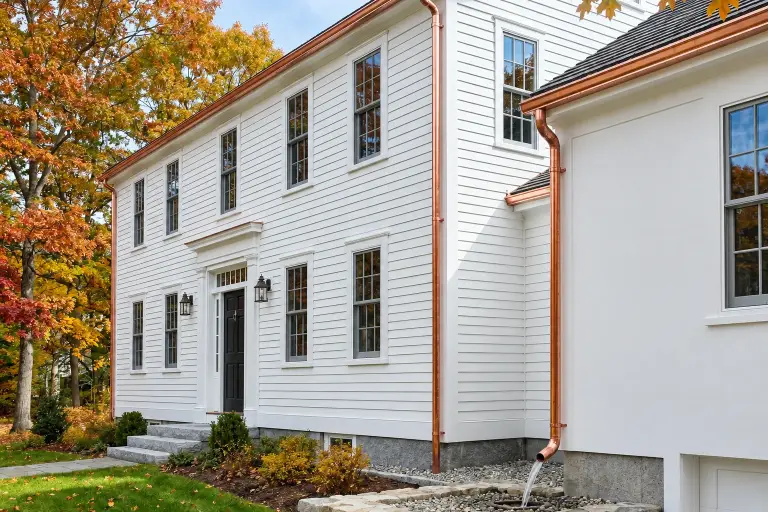
This checklist covers the downspout placement questions worth asking, and why each one matters on a Massachusetts house. It comes from Golini Roofing, in Wakefield since 1982, which installs, replaces and repairs gutters across the North Shore. When we quote gutters, we walk the whole water path, from the roof edge to every downspout outlet, and we place downspouts to send water away from the house.
Where will each downspout go, and why there?
Ask the installer to mark each proposed downspout on a sketch or a photo of the house, so you are both talking about the same corners. Then ask:
- How many downspouts, and why that number? The US Department of Energy's Building America Solution Center recommends a downspout every 20 to 50 feet along the gutter. This Old House's Tom Silva says runs of 60 feet or more should have at least two outlets, per its sizing guide.
- Is there a downspout near each valley? A valley pours the water of two roof slopes into one short stretch of gutter. If the nearest downspout is far away, that stretch is where overflow starts.
- Which way does the gutter slope toward each one? The DOE guide calls for gutters sloped at least 1/16 inch per foot toward the outlets. On a long run with a downspout at each end, the gutter can slope both ways from the middle.
- What size downspout? That is a sizing question, covered in our gutter sizing guide.
Where does the water go after it leaves the downspout?
A downspout in the right spot still causes trouble if it empties at the foundation. The DOE guide recommends carrying roof water at least 5 feet from the building, with the ground sloping away from the foundation for at least 5 feet. Ask:
- Will each downspout get an extension or splash block, and is that in the price?
- Does the ground at each outlet slope away from the house, or toward it?
- Will the water run toward a neighbor's yard, a window well or a bulkhead?
- If the yard is tight, what are the options for that corner?
Grading and drainage work in the yard is usually separate from gutter installation, so ask who would handle it if it is needed.
What will happen at this spot in winter?
This is the question most homeowners skip, and it matters more in Wakefield than in most of the country. On a sunny winter day, snow on the roof melts and runs down the downspouts, then freezes again after sunset. Wherever that water lands, it can turn to ice.
- Walkways, steps and the front door. A downspout that empties across a path becomes a sheet of ice on a cold night. Ask for outlets that drain away from the routes you walk.
- The driveway. Water across the driveway freezes where you park and walk. An extension that crosses the driveway edge also gets hit by plows and buried by snowbanks.
- Where the snow piles go. If the outlet ends where you or your plow driver push the snow, meltwater has nowhere to go and the extension freezes solid. Our driveway snow plowing access checklist covers marking things the plow should avoid.
- North-facing corners. Shaded sides of the house stay frozen longer, so ice there lasts.
Upper roofs, porches and additions
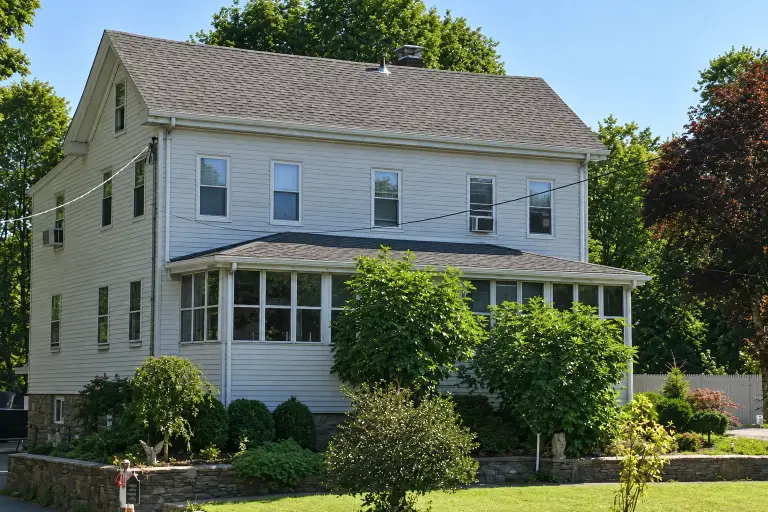
If your house has a second-story roof above a porch, a sunroom or an ell, ask:
- Will the upper gutter's downspout empty onto the lower roof, or be carried down to the lower gutter or the ground?
- If it empties onto the lower roof, can the lower gutter handle both roofs' water?
- Will a downspout run across the face of the house or past a window? Ask how it will be routed and fastened.
What happens to existing downspout connections?
If an old downspout disappears into a pipe in the ground, ask two things before you agree to the layout: will the new downspout connect to that pipe, and has anyone checked where the pipe goes and whether it still drains? Buried lines are often outside a gutter contract, so get the answer in writing either way. Our downspout extension repair guide covers the rules on where a buried line may connect and the Dig Safe call required before any digging.
An outlet-by-outlet worksheet
Fill in one row for each downspout on the estimate. Leave anything unanswered visibly open until it is settled.
| Downspout (location) | Why here | Where water ends up | Winter concern | Extension or connection | In the price? |
|---|---|---|---|---|---|
| Front left corner | |||||
| Front right corner | |||||
| Back left corner | |||||
| Back right corner | |||||
| Porch or addition |
Compare it with the written estimate before you agree. If an outlet location or a responsibility is unclear, ask for an updated layout first. Already have gutters and just need to fix a downspout that is leaking or crushed? That repair guide covers it.
How we handle downspout placement
When Golini Roofing quotes gutters, we look at the roof edge, the fascia boards the gutters hang on, the gutters and where each downspout empties. Gutters are hung to slope toward the downspouts, and downspouts are placed to send water away from the house. Your free written estimate says what we recommend and why, and if your roof is being done too, we set the gutters to the new roof edge. Our own crew does the work. Read more on our gutter installation page.
Common questions about downspout placement
How far apart should downspouts be?
The US Department of Energy's Building America guidance recommends a downspout every 20 to 50 feet along the gutter. Runs of 60 feet or more should have at least two outlets.
Where should downspouts not drain?
Not at the foundation, not across walkways or the driveway where water will freeze, not into the foundation drain, and not into the sewer. Aim for ground at least 5 feet out that slopes away from the house.
Can a downspout drain onto a lower roof?
It can, but the lower gutter then carries both roofs' water. Ask the installer whether that gutter is big enough, or whether the downspout should be carried down to the lower gutter or the ground.
Can I move a downspout after the gutters are installed?
Yes, but it means new holes in the gutter, new pipe and sometimes re-pitching the run. It is cheaper and neater to settle placement before installation.
Planning new gutters? Request a free estimate or call us at (781) 246-0141. We will walk around the house and tell you where we would put each downspout, and why.