What Is a Roofing Square Calculator — and Why It Matters for Your Project
A Roofing Square Calculator is the fastest way to estimate how much material your roof needs before you spend a dollar.
Here’s the quick answer if that’s all you need:
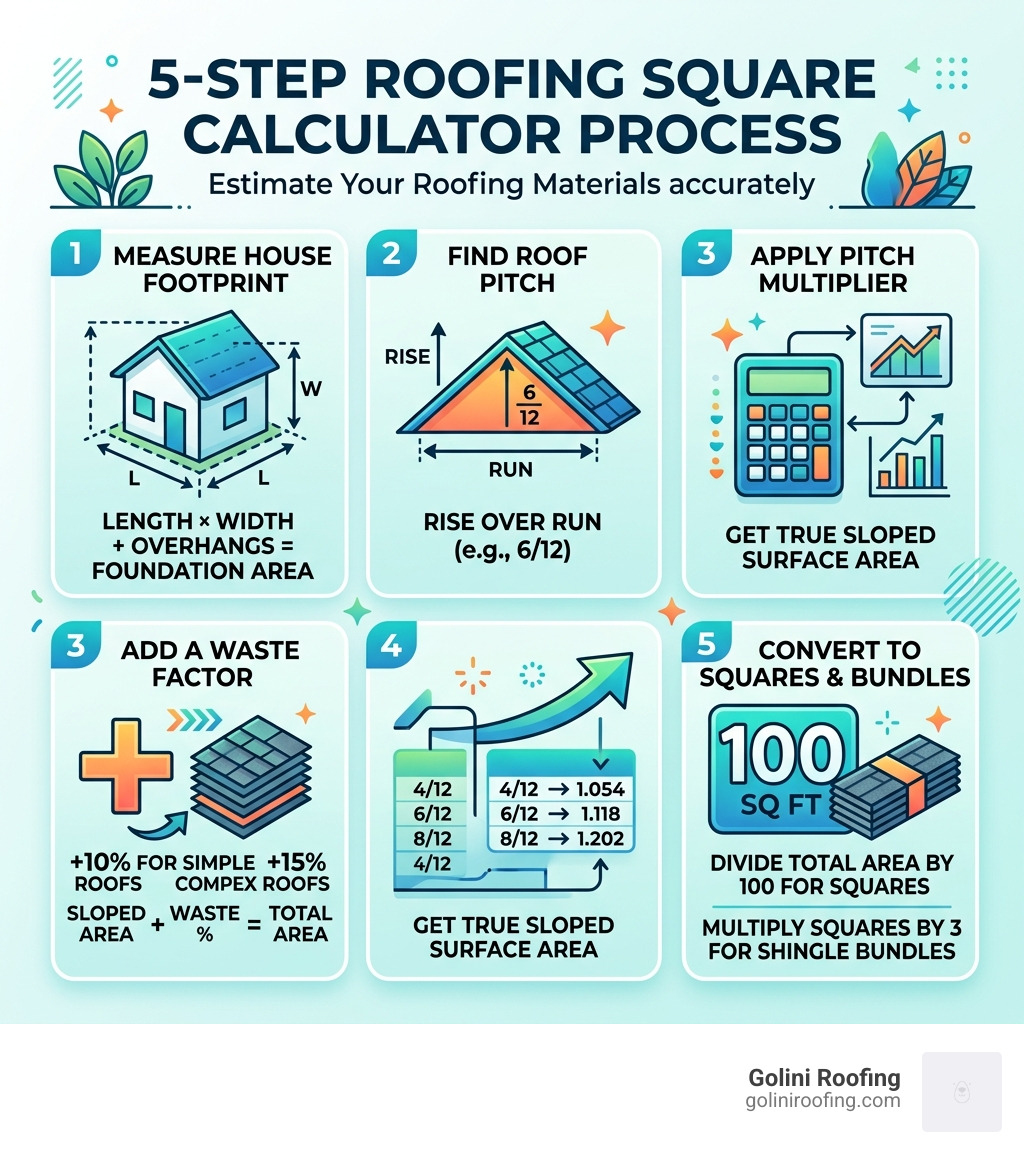
How to use a roofing square calculator in 5 steps:
- Measure your house footprint — length × width, plus overhangs
- Find your roof pitch — expressed as rise over run (e.g., 6/12)
- Apply the pitch multiplier — to get true sloped surface area
- Add a waste factor — 10% for simple roofs, 15% for complex
- Convert to squares and bundles — divide total area by 100 for squares; multiply by 3 for shingle bundles
One roofing square = 100 square feet of roof surface. It’s the standard unit every roofing professional uses to price and order materials.
Getting this number right matters more than most homeowners realize. Order too little and your project stalls mid-installation. Order too much and you’ve wasted money. A simple miscalculation — like forgetting to account for roof pitch — can throw your estimate off by hundreds of square feet on an average home.
The good news? With the right steps and a reliable calculator, even a first-timer can get an accurate figure before calling a single contractor.
I’m Jack Golini, owner of Golini Roofing, and after more than 35 years installing and replacing residential roofs across Wakefield, MA and the North Shore, I’ve seen every kind of measurement error a homeowner can make before picking up the phone. In this guide, I’ll walk you through exactly how to use a Roofing Square Calculator so you go into your project with confidence.
Explore more about Roofing Square Calculator:
- Unpacking Shingle Coverage: Everything You Need to Know About Bundles and Squares
- What is a Roofing Square in Measurement
- How Do You Measure the Square Footage of a Roof
Step 1: Measure the House Footprint and Overhangs
The foundation of any accurate roofing estimate is the house footprint. This is the horizontal “shadow” the house casts on the ground. To get started, you need the exterior length and width of the building.
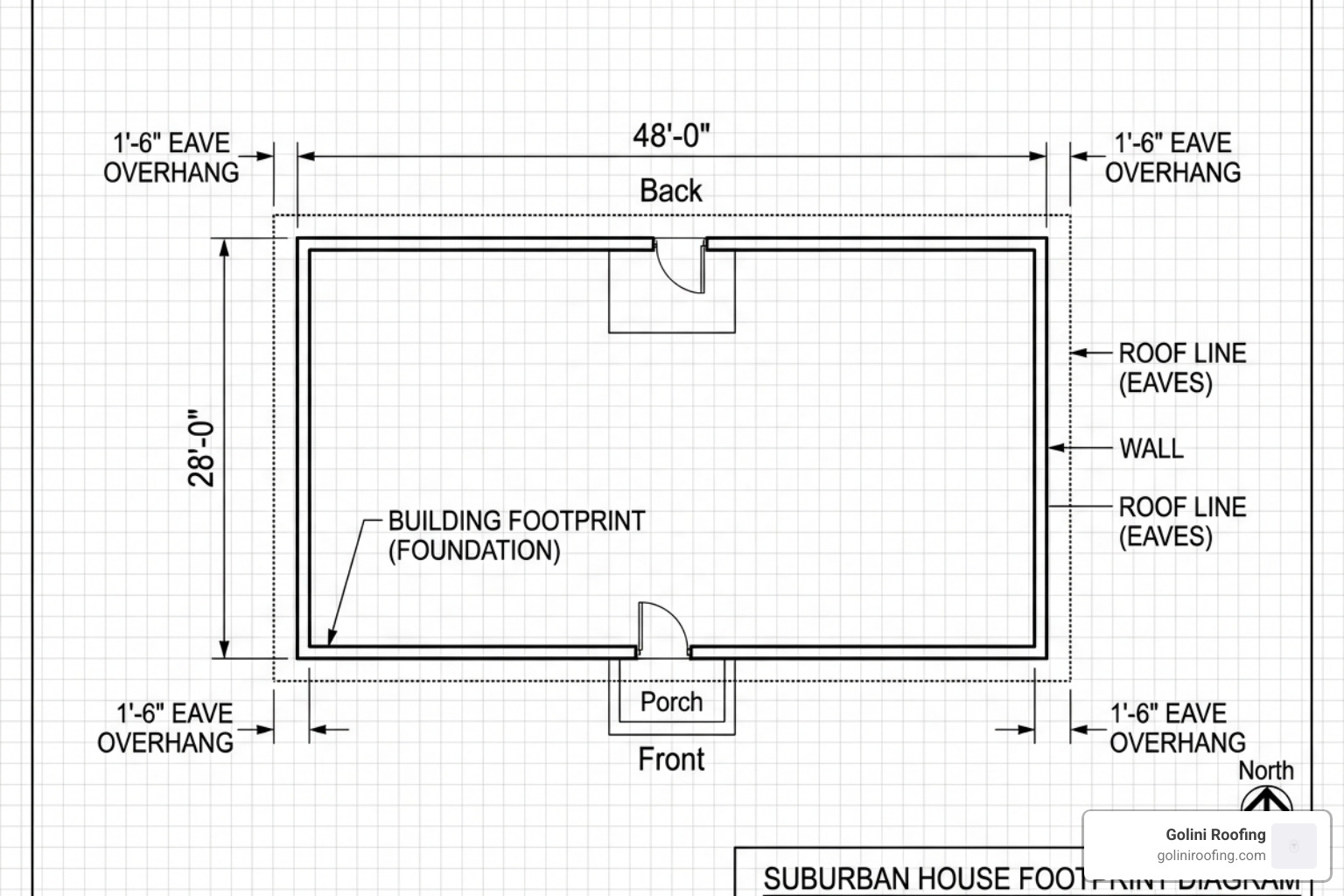
While it might be tempting to use your interior living space square footage from a real estate listing, that number is almost always wrong for roofing. It doesn’t account for the thickness of exterior walls, nor does it include the most important part of your roof’s perimeter: the overhangs.
Measuring Length and Width
Using a long tape measure, record the distance from one exterior wall to the other. If your home is a simple rectangle, this is easy. If you have an L-shaped or T-shaped house, break the footprint into smaller rectangles, calculate the area of each, and add them together.
Don’t Forget the Overhangs
Most homes in areas like Reading or Stoneham have eaves (the edges that hang over the side walls) and rakes (the edges that hang over the gable ends). These typically stick out 8 to 16 inches.
- Eave overhangs: Add these to your width.
- Rake edges: Add these to your length.
If your house is 40 feet long with a 1-foot overhang on each end, your “roof length” for the calculator is actually 42 feet. For a more detailed walkthrough, check out our guide on How Do You Measure the Square Footage of a Roof?.
Safety First
We always recommend taking these measurements from the ground whenever possible. You can use a rolling measuring wheel or even high-resolution satellite tools. If you must use a ladder, ensure it is on level ground and have a spotter present. For a quick digital start, you can use our Roof Square Footage Calculator to input your base dimensions.
Step 2: Determine Your Roof Pitch and Multiplier
If roofs were flat, our jobs would be much simpler. But because residential roofs slope to shed the heavy snow we get in Massachusetts, the actual surface area is always larger than the footprint. This is where “pitch” comes in.
What is Roof Pitch?
Roof pitch is the steepness of your roof, expressed as a ratio of “rise” over “run.” The “run” is always 12 inches. If a roof rises 6 inches for every 12 inches it moves horizontally, it has a 6/12 pitch.
- 4/12 Pitch: A shallow slope, common on ranch-style homes.
- 6/12 to 9/12 Pitch: The standard range for most residential homes.
- 12/12 Pitch: A steep 45-degree angle.
The Slope Factor (Pitch Multiplier)
To find the true surface area, a Roofing Square Calculator uses a mathematical “multiplier” derived from the Pythagorean theorem. This multiplier accounts for the extra distance shingles must travel up the slope.
| Roof Pitch | Angle (Degrees) | Pitch Multiplier | Area Increase |
|---|---|---|---|
| 3/12 | 14.0° | 1.031 | 3.1% |
| 4/12 | 18.4° | 1.054 | 5.4% |
| 6/12 | 26.6° | 1.118 | 11.8% |
| 8/12 | 33.7° | 1.202 | 20.2% |
| 12/12 | 45.0° | 1.414 | 41.4% |
As you can see, a 12/12 pitch roof requires over 41% more material than a flat roof of the same size! You can find a precise tool for these conversions at Roofing Calculator — Estimate Shingles, Squares & Materials.
Step 3: Calculating Total Area with a Roofing Square Calculator
Now that you have your footprint area (planar area) and your pitch multiplier, it’s time to find the “True Surface Area.”
The Formula: Base Area (including overhangs) × Pitch Multiplier = True Roof Surface Area
For example, if your adjusted footprint is 2,000 square feet and you have a 6/12 pitch (1.118 multiplier), your actual roof area is 2,236 square feet. To see how this translates into industry units, read Your Roof’s Square Count: The Easy Way to Figure It Out.
Gable vs. Hip Styles
- Gable Roofs: These have two sloping sides that meet at a ridge. They are the easiest to calculate because the pitch is usually uniform.
- Hip Roofs: These have four sloping sides. While the math is slightly more complex, a good Roofing Square Calculator handles this by treating the triangles and trapezoids as planes that all share the same pitch multiplier.
- Shed Roofs: A single sloping plane. Simple, effective, and very easy to measure.
Using a Roofing Square Calculator for Complex Roofs
Most homes in towns like Winchester or Lynnfield aren’t simple boxes. They feature intersecting planes, valleys where two roof sections meet, and architectural features like dormers.
When dealing with complex roofs:
- Measure each plane separately: Treat every section of the roof as its own rectangle or triangle.
- Account for Valleys: Valleys require extra flashing and underlayment, so precision here is key.
- Dormer Additions: A small dormer can add 50 to 100 square feet to your total. Don’t ignore them!
- Skylights: Don’t subtract the area of skylights from your shingle count. You’ll need those shingles for the cuts and waste around the window anyway.
For multi-plane projects, the Roof Square Footage Calculator (Squares & Bundles) – Pitch + Waste is an excellent resource for aggregating different sections.
Step 4: Account for the Roofing Waste Factor
No roofing project uses 100% of the material ordered. You have to cut shingles to fit valleys, rakes, and hips. You also need “starter courses” along the eaves and ridge caps along the peaks. This “extra” is known as the waste factor.
- Standard Waste (10%): Use this for simple gable roofs with few penetrations (chimneys, vents).
- Moderate Waste (12-15%): Use this for hip roofs or roofs with a few valleys.
- Complex Waste (15-20%): Use this for roofs with multiple dormers, turrets, or intersecting rooflines.
If your calculated area is 2,236 square feet, a 10% waste factor brings your total to 2,460 square feet. In roofing, we round this up to 25 squares. For more on why we add this margin, see How Do You Measure the Square Footage of a Roof?.
Step 5: Convert Squares to Shingle Bundles and Materials
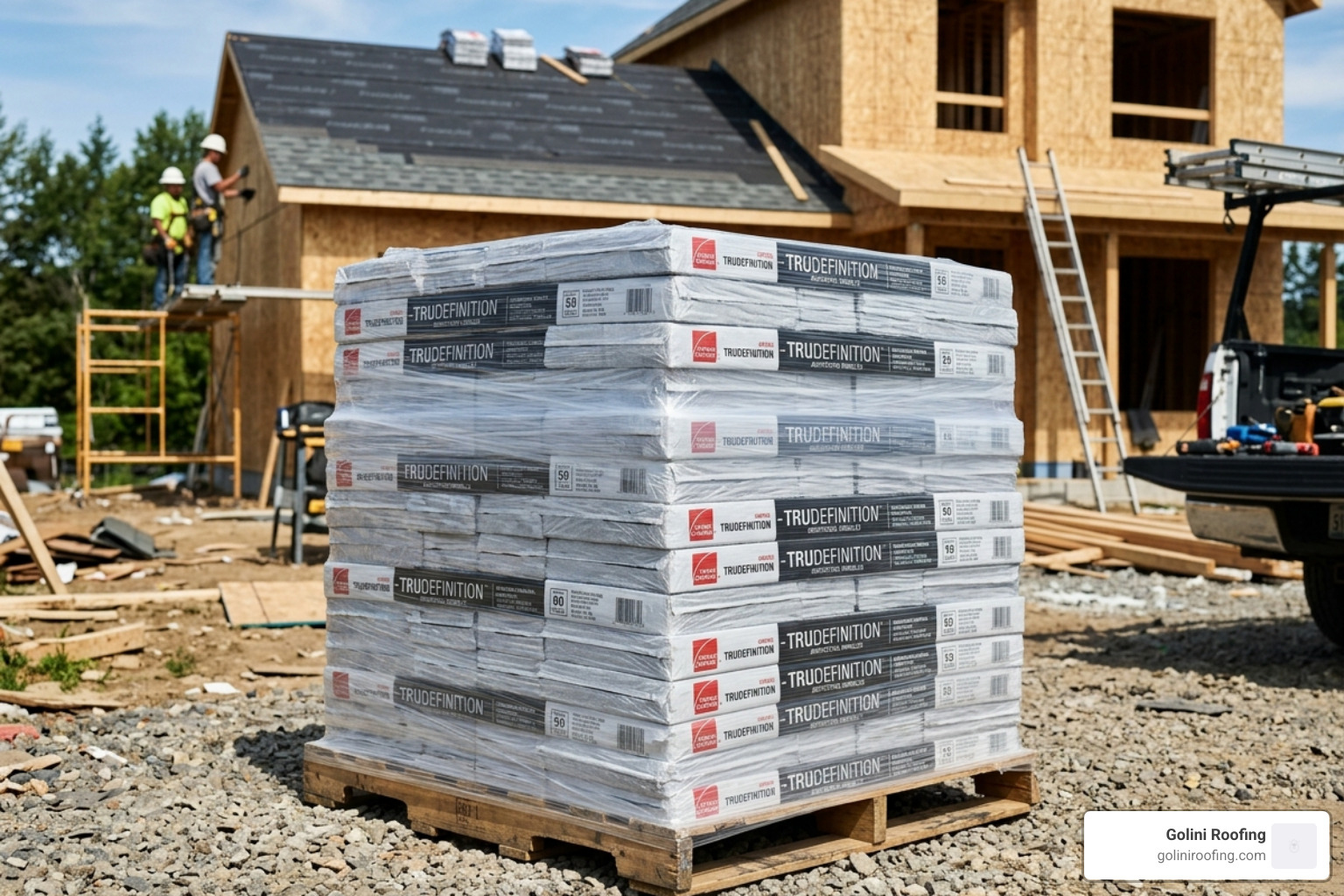
Once you have your total square footage (including waste), you need to translate that into a shopping list. In the United States, shingles are sold in “bundles.”
The Rule of Three
For standard asphalt shingles, the math is simple: 3 bundles = 1 roofing square (100 sq ft).
If your project requires 25 squares, you will need 75 bundles of shingles. However, keep in mind that some premium or heavy-duty shingles may require 4 bundles per square. Always check the manufacturer’s label.
Other Essential Materials
A Roofing Square Calculator isn’t just for shingles. You can use your total square footage to estimate:
- Underlayment: Usually sold in rolls. A roll of #15 felt covers about 432 sq ft, while synthetic rolls often cover 1,000 sq ft.
- Drip Edge: Measured in linear feet along the eaves and rakes.
- Ice and Water Shield: Critical for our Massachusetts winters; usually installed 3 to 6 feet up from the eave.
- Nails: Expect to use about 320 to 480 nails per square.
For a deeper dive into material lists, check out our Calculate Your Roof Shingles: A Simple Guide to Estimating Materials.
Estimating Materials with a Roofing Square Calculator
When using a calculator, pay attention to the “coverage per bundle.” Standard 3-tab shingles cover approximately 33.3 square feet per bundle. If you are using architectural shingles, verify the coverage, as it can vary slightly. You can find more details on Coverage of a Bundle of Shingles to ensure you don’t run short.
Common Mistakes to Avoid with a Roofing Square Calculator
Even with a great tool, “garbage in, garbage out” applies. Here are the most common pitfalls we see:
- Using Interior Floor Space: As mentioned, your 2,000 sq ft home likely has a roof closer to 2,600 or 3,000 sq ft once you add the garage, porch, overhangs, and pitch.
- Ignoring the Pitch: Forgetting the slope multiplier is the #1 cause of material shortages.
- Forgetting Overhangs: Those 12-inch eaves add up quickly across the entire perimeter of a house.
- Rounding Down: Always round up to the nearest square or bundle. You can’t buy half a bundle of shingles at the supply house!
- Inaccurate Waste Factors: Being “cheap” with your waste factor usually results in a second trip to the store and a color-match headache.
To understand these units better, read What is a Roofing Square in Measurement?.
Accuracy Tips for Your Roofing Square Calculator
To ensure your numbers are solid:
- Satellite Imagery: Use tools like Google Earth to verify your footprint measurements.
- Double-Check: Measure twice, calculate once.
- Professional Consultation: If your roof is extremely steep or complex, it pays to have a pro take a look. You can use our New Roof Estimate Calculator for a baseline.
- Blueprint Review: If you have the original plans for your home, the roof pitch and dimensions are already there for you.
Frequently Asked Questions about Roofing Squares
How many bundles of shingles are in a roofing square?
For standard asphalt shingles, there are 3 bundles per square. Since one square is 100 square feet, each bundle covers roughly 33.3 square feet. If you are using specialized architectural shingles, always check the packaging, as some brands require 4 bundles to cover a square. For a rough idea of how this impacts your budget, try our Average Roof Cost Calculator.
Why is my roof area larger than my home’s square footage?
Your home’s square footage is a 2D measurement of the floor. Your roof is a 3D structure. The “extra” area comes from:
- The Pitch: The steeper the slope, the more surface area there is.
- Overhangs: The roof extends past the exterior walls.
- Vertical Rise: The distance from the eave to the ridge adds significant surface area that isn’t reflected in a floor plan.
What is the standard waste factor for a residential roof?
The industry standard is:
- 10% for Gable Roofs: Simple, two-sided roofs.
- 15% for Hip Roofs: Four-sided roofs with more cutting involved.
- 20% for Complex Geometry: Roofs with many valleys, dormers, and chimneys. This factor covers the starter strips, ridge caps, and shingles lost during the cutting process.
Conclusion
Calculating your roofing needs doesn’t have to be a mystery. By following these five steps and using a reliable Roofing Square Calculator, you can estimate your materials with professional-level accuracy. Whether you’re in Wakefield, Woburn, or Wilmington, knowing your “square count” is the first step toward a successful project.
At Golini Roofing, we’ve spent over 35 years perfecting the art of the residential roof. Based in Wakefield, MA, our team brings a level of craftsmanship you won’t find everywhere else—including our signature technique of hand-nailing every single shingle to ensure maximum durability and wind resistance. We believe that a roof is only as good as the measurements and the hands that install it.
Ready to take the next step? Whether you need a simple repair or a full replacement, we’re here to help. More info about our roofing services can be found on our website, where you can also request a detailed consultation.
Pricing Note: Please note that any pricing mentioned in this article is based on general internet data and market averages as of April 2026. These figures are intended for rough budgeting purposes and do not represent actual quotes from Golini Roofing. Average roofing costs for asphalt shingles can range from $3.50 to over $11.00 per square foot depending on complexity, materials, and local labor rates.