
Why Getting Your Shingle Count Right Matters Before You Buy
Figuring out how many squares of shingles do i need is the most important first step before ordering materials or hiring a contractor — and getting it wrong can cost you hundreds of dollars in wasted materials or frustrating project delays.
Here’s a quick answer to get you started:
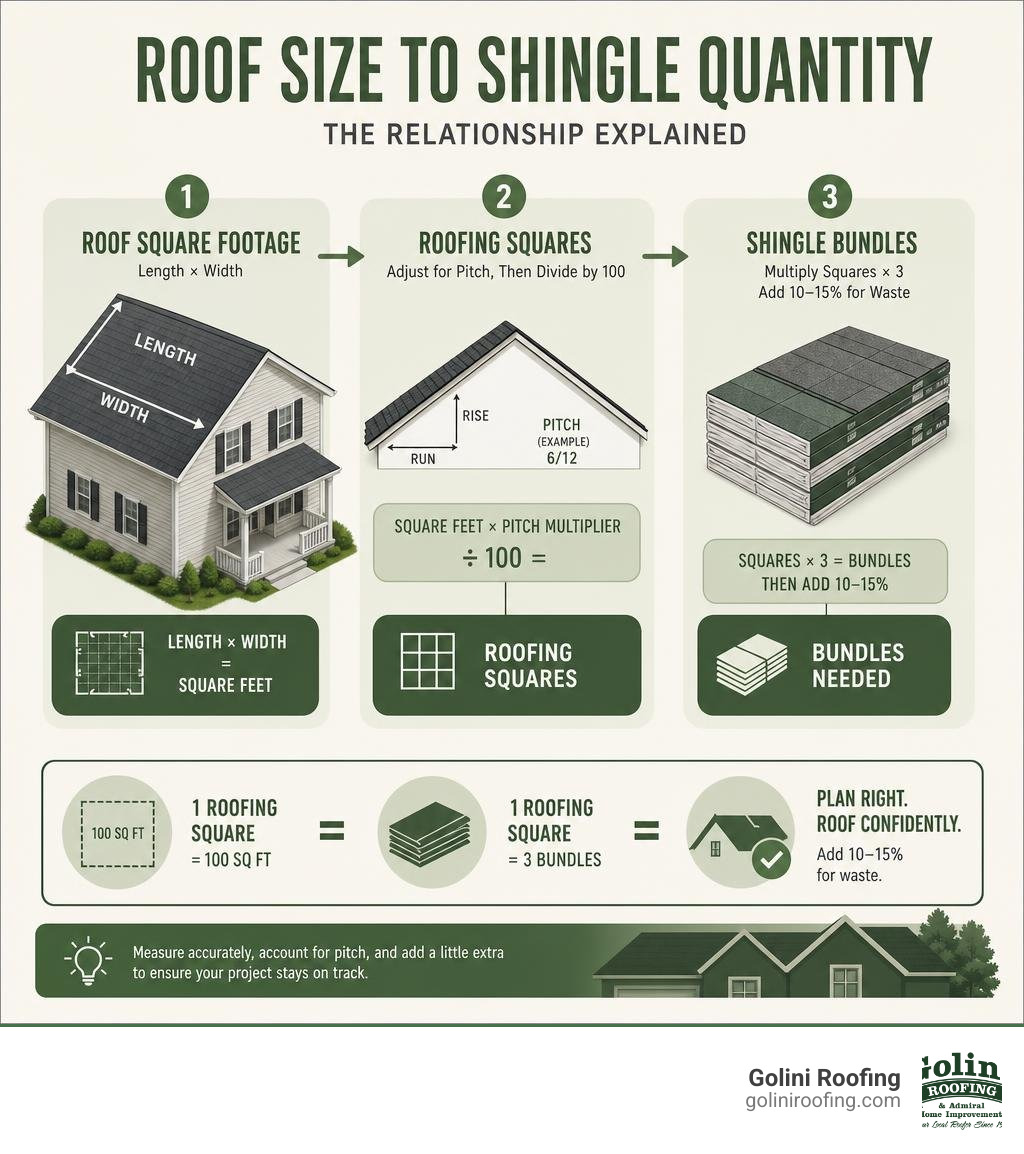
To calculate how many squares of shingles you need:
- Measure your roof’s length and width (or use your home’s footprint)
- Multiply length × width to get square footage
- Apply a pitch multiplier (e.g., 1.118 for a 6/12 pitch)
- Divide the result by 100 — that’s your number of roofing squares
- Multiply squares × 3 to get bundles (for standard architectural shingles)
- Add 10–15% for waste
Quick reference:
| Roof Area (sq ft) | Roofing Squares | Bundles Needed (+ 10% waste) |
|---|---|---|
| 1,000 | 10 | 33 |
| 1,200 | 12 | 40 |
| 1,500 | 15 | 50 |
| 2,000 | 20 | 66 |
| 2,500 | 25 | 83 |
One roofing square = 100 square feet. Most standard asphalt shingles require 3 bundles per square, with each bundle covering approximately 33.3 square feet.
Getting this right matters whether you’re replacing a roof in Wakefield, Wilmington, or anywhere else in Massachusetts. Order too little and your project stalls. Order too much and you’re paying for materials you don’t need.
I’m Jack Golini, owner of Golini Roofing, and I’ve been calculating shingle quantities and installing roofs across Massachusetts since 1982 — so I know exactly where homeowners go wrong when estimating how many squares of shingles they need. In this guide, I’ll walk you through everything step by step, so you can plan your project with confidence.
How many squares of shingles do i need word list:
- Calculate roof pitch
- how do you figure out square footage of a roof
- coverage of a bundle of shingles
Understanding Roofing Measurements: Squares vs. Square Footage
When we talk to homeowners in Wakefield or Wilmington about their roof replacements, the first hurdle is often translating standard square footage into industry terms. If you tell a supplier your home is 2,000 square feet, they won’t sell you 2,000 “units” of shingles. Instead, they talk in “squares.”

So, what exactly is a roofing square?
Simply put, one roofing square is equal to 100 square feet of roof surface area. This is the universal unit of measurement used by manufacturers, distributors, and contractors throughout North America. It helps simplify the math on large surfaces. For a deeper dive into this unit of measurement, you can read our detailed breakdown on What is a Roofing Square in Measurement?.
It is highly common to confuse your home’s interior footprint area with your actual roof surface area. A ranch-style home in Lynnfield might have a 1,500-square-foot ground floor, but because the roof is sloped and overhangs the sides of the house, the actual roof surface area could easily be 1,800 square feet or more.
To make sure your estimates are accurate, you can check out a leading manufacturer’s guide on measuring roofing squares, or read our own guide on Unpacking Shingle Coverage to understand how this translates directly to the materials delivered to your driveway.
The Math Behind Shingle Bundles and Squares
Shingles are heavy, dense, and awkward to transport. If manufacturers packaged an entire roofing square (100 square feet) into a single box, it would weigh well over 200 pounds! To make the materials manageable for human backs, shingles are divided into smaller packages called “bundles.”
For standard three-tab and architectural shingles, the math is incredibly consistent:
- 1 Bundle covers approximately 33.3 square feet of roof area.
- 3 Bundles are required to cover 1 roofing square (100 square feet).
This means if your roof is measured at 15 squares, you will need at least 45 bundles of shingles. However, keep in mind that this is the bare minimum coverage. As detailed in a leading manufacturer’s guide on shingle bundles, some premium or heavy designer shingles are thicker and cover less area per bundle. For these specialty products, you might need 4 or even 5 bundles to cover a single square because of the increased overlap and weight.
For standard installations in places like Winchester and Woburn, we almost always work with architectural shingles, which account for over 80% of residential shingle installations in the U.S. in 2026. These durable, multi-layered shingles provide excellent wind resistance and are packaged at the standard rate of three bundles per square.
Calculating Your Roof: How Many Squares of Shingles Do I Need?
Now that we understand the core units, let’s look at how we calculate the actual surface of your roof. This is where things get interesting because we have to account for the slope—or “pitch”—of your roof.

A flat roof has a pitch multiplier of 1.0. But as the slope of your roof increases, the surface area increases as well. A roof with a steep 12/12 pitch (a 45-degree angle) has over 41% more surface area than a flat roof covering the exact same footprint!
To make this calculation easier, we use a slope multiplier. If you want to skip the manual math, you can use our Roof Square Footage Calculator or learn the manual techniques in our guide on Measuring Your Roof Square Footage Without the Headache.
Step-by-Step: How Many Squares of Shingles Do I Need for My Roof Footprint?
If you are trying to estimate your materials from the ground, you can use your home’s footprint as a starting point. Let’s walk through a realistic example for a home in Boxford or Beverly:
- Find the Base Area: Measure the length and width of your home’s footprint, including any overhangs. Let’s say your home is 40 feet long by 30 feet wide.
40 ft × 30 ft = 1,200 sq ftof flat footprint area.
- Apply the Pitch Multiplier: Let’s assume your home has a moderate 6/12 pitch (for every 12 inches of horizontal run, the roof rises 6 inches). The multiplier for a 6/12 pitch is 1.118.
1,200 sq ft × 1.118 = 1,341.6 sq ftof actual sloped roof area.
- Convert to Squares: Divide your total sloped square footage by 100.
1,341.6 / 100 = 13.42 squares.
- Add the Waste Factor: We always round up to the next whole square and add a waste factor (typically 10% for a simple roof) to account for cuts, starters, and mistakes.
13.42 squares × 1.10 = 14.76 squares. Rounding up, you would order 15 squares of shingles.
- Convert to Bundles: Multiply your total squares by 3.
15 squares × 3 = 45 bundles.
For more hands-on assistance, you can read our step-by-step walkthrough on How to Use a Roofing Square Calculator or read Calculate Your Roof Shingles to see how different architectural styles impact these numbers.
Factors That Answer: How Many Squares of Shingles Do I Need for Complex Roofs?
The simple calculation above works beautifully for a standard gable roof (two flat sloping sides meeting at a center ridge). But very few homes in Ipswich or Beverly are perfectly simple.
If your roof features hips (where the roof slopes downward on all four sides), valleys (where two sloping roof planes meet to form a V-shape), dormers, chimneys, or skylights, your material calculations must change.
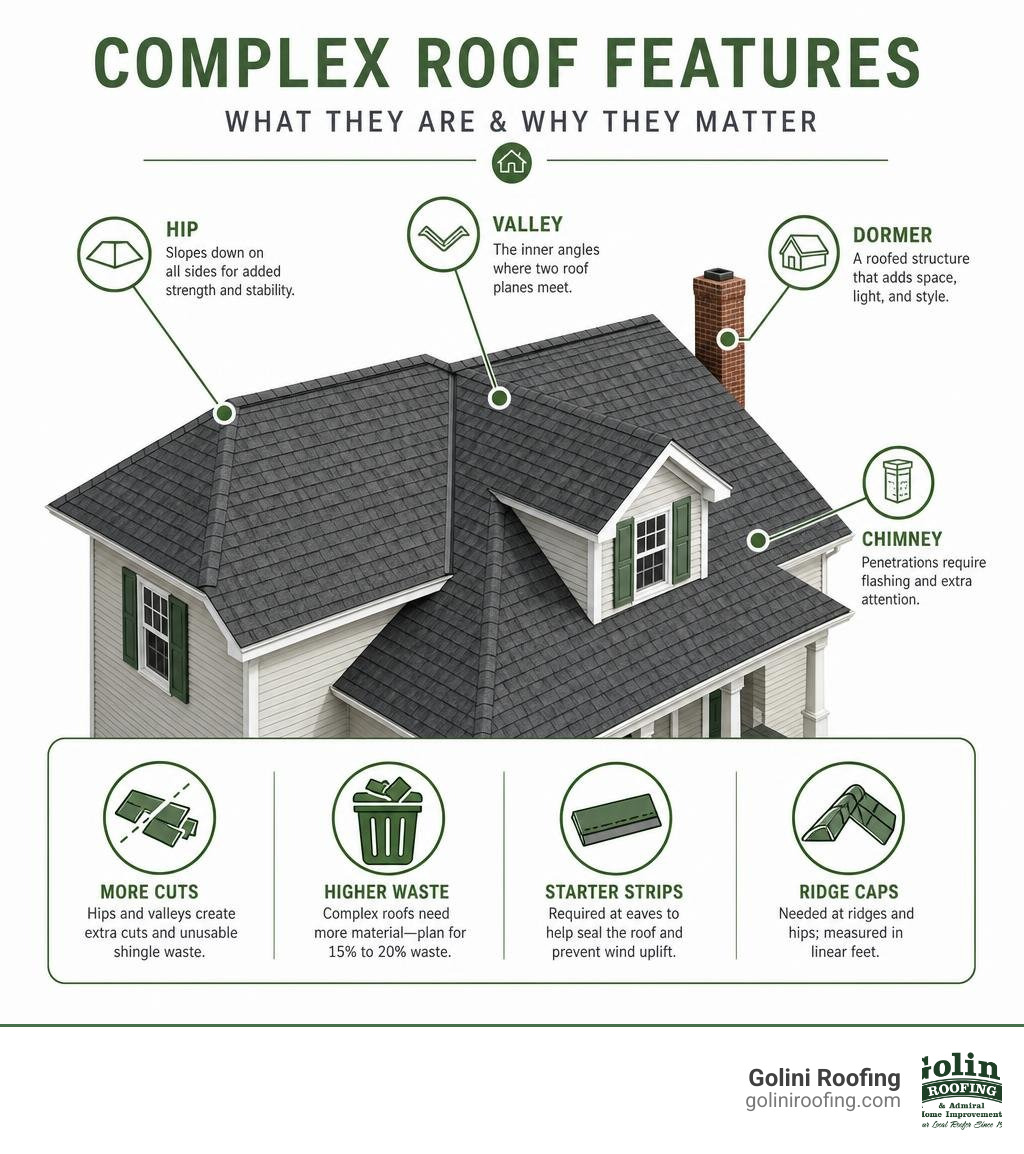
- Valleys and Hips: These require diagonal cuts. Every time a roofer cuts a shingle to fit a valley or a hip, the off-cut portion is often unusable waste. This dramatically increases the amount of material you need.
- Higher Waste Factors: While a simple gable roof only requires a 10% waste factor, a complex roof with multiple hips, valleys, and dormers requires a 15% to 20% waste factor.
- Starter Strips: You cannot simply start laying shingles at the bottom edge of your roof. You need a specialized “starter strip” to seal the first row against wind uplift.
- Ridge Caps: The peak of your roof (the ridge) and the sloped hips require specialized ridge cap shingles to seal the joints. These are calculated in linear feet, not square footage.
To see how these complex features change your material requirements, you can run your numbers through the ToolCalcs Roofing Calculator or the CalcSmart Roofing Calculator. Both tools allow you to adjust for complexity and pitch.
Essential Roofing Materials Beyond Shingles
When answering how many squares of shingles do i need, it is easy to forget that a roof is a complete system, not just a layer of shingles. To get a durable, code-compliant roof in Massachusetts, you must calculate several other essential materials alongside your shingles.
Our local building codes in towns like Woburn, Winchester, and Wakefield are strict, especially regarding winter weather protection. Here is a breakdown of the accessory materials you will need:
- Underlayment: This is the water-resistant barrier installed directly onto the wood roof deck. Traditional #15 or #30 felt is still used, but modern synthetic underlayment is far more popular because of its durability. Synthetic rolls typically cover 1,000 square feet (10 squares) per roll.
- Ice and Water Shield: In Massachusetts, building codes require a self-adhering polymer-modified bitumen sheet (Ice and Water Shield) at the eaves. It must extend from the lowest eave edge to a point at least 24 inches inside the exterior wall line to protect against ice dams. It is also highly recommended in valleys and around chimneys.
- Drip Edge: This metal flashing is installed along the eaves and rakes to direct water away from your fascia boards and into your gutters. It comes in 10-foot pieces.
- Starter Shingles: These run along the bottom eaves and side rakes. A standard bundle of starter strips covers about 105 linear feet.
- Ridge Vent and Ridge Caps: Ridge vents allow hot air to escape your attic, while ridge caps cover the vent and hips. Ridge cap bundles typically cover 35 linear feet.
Here is a quick reference table to help you estimate these essential accessory materials:
| Material Type | Standard Packaging | Coverage Area / Length | Purpose |
|---|---|---|---|
| Synthetic Underlayment | 1 Roll | 1,000 sq ft (10 Squares) | Primary water barrier over roof deck |
| Ice & Water Shield | 1 Roll | 200 sq ft (2 Squares) | Ice dam protection at eaves and valleys |
| Drip Edge | 1 Piece | 10 Linear Feet | Directs water into gutters, protects wood |
| Starter Strips | 1 Bundle | 105 Linear Feet | Wind-resistant base layer at eaves |
| Ridge Cap Shingles | 1 Bundle | 35 Linear Feet | Seals the peaks and hips of the roof |
| Roofing Nails | 1 Box (approx. 7,200 nails) | Covers ~15 to 18 Squares | Secures shingles (4-6 nails per shingle) |
For a complete breakdown of how these materials are bundled together for a full roof replacement, check out the Roof Shingle Calculator HQ or refer to our guide on Your Roof’s Square Count.
Professional Installation Costs and Considerations
While calculating your own roof materials can be a fun weekend math project, actually installing a roof—or even climbing onto a steep roof deck to take measurements—is a different story.
If you are looking at average industry costs based on national and statewide internet data, a professional asphalt shingle roof installation typically ranges from $800 to $2,800 per square.
Please note: These are average costs sourced from publicly available internet data to show industry variability. They are not the actual prices of Golini Roofing. Every roof is unique, and actual costs depend on pitch, height, accessibility, and the specific materials chosen.
Why is there such a massive range in pricing? It comes down to several factors:
- Pitch and Height: A steep roof (like a 10/12 or 12/12 pitch) requires specialized safety equipment, staging, and significantly more labor time. Roofers must work slower and more carefully, which increases labor costs.
- Tear-Off Layers: If your home in Wilmington or Beverly has multiple layers of old shingles, they must all be torn off and disposed of. Tearing off two or three layers of old shingles requires double the labor and increases disposal fees.
- Installation Method: Many modern roofing companies rely on nail guns set to high speed, which can sometimes lead to misplaced or under-driven nails. At Golini Roofing, we take pride in our unique signature process: meticulous hand-nailing of every single shingle. This takes a bit more time, but it guarantees that every nail is driven straight, flush, and exactly where the manufacturer intended. This level of craftsmanship prevents wind blow-offs and ensures your roof lasts for decades.
- Warranties: Hiring a professional, manufacturer-certified contractor ensures you receive a valid wind and material warranty. If you attempt a DIY installation and misplace your nails, the manufacturer can easily void your warranty if your shingles blow off during a New England nor’easter.
If you want to estimate your project budget further, you can play with the Shingles Calculator or the Roof Pitch Shingle Calculator. However, we always recommend having a professional assess your roof in person to avoid costly surprises.
Frequently Asked Questions about Shingle Calculations
How many bundles of shingles are in a square?
For standard three-tab and architectural shingles, there are exactly 3 bundles in a roofing square. Each bundle covers 33.3 square feet, meaning three bundles will cover 100 square feet of roof area.
If you are purchasing premium, heavy-weight designer shingles, the coverage per bundle is often lower because of the thickness and exposure of the shingles. For these specialty products, you may need 4 or 5 bundles per square. Always check the manufacturer’s label on the packaging to verify the coverage. For more details on this, see our guide on Don’t Get Bundled Up.
What waste factor should I add to my roof estimate?
For a simple gable roof with no valleys, dormers, or hips, a 10% waste factor is standard. This covers the starter row, ridge caps, and minor cuts at the edges.
If your roof has a hip design, valleys, or dormers, you should increase your waste factor to 15% or 20%. This accounts for the significant amount of material lost when cutting shingles diagonally to fit into valleys and along hip lines. If you want to see how these calculations are structured, you can watch this instructional video on estimating shingle materials.
Can I calculate my roof area from the ground?
Yes, you can estimate your roof area from the ground by measuring your home’s footprint and applying a pitch multiplier. For example, if you measure your home’s ground dimensions and find the footprint is 1,500 square feet, and you estimate your pitch is 6/12, you would multiply 1,500 by 1.118 to get an estimated roof area of 1,677 square feet (approx. 16.8 squares).
However, estimating from the ground is only an approximation. It does not account for vertical walls, complex chimney flashings, or hidden dormers. For a truly accurate estimate, a professional roofer should measure the roof directly or use advanced satellite imaging technology. Attempting to measure a steep roof yourself carries severe fall hazards, and we strongly discourage homeowners from climbing onto their roofs.
You can also use the CalcShed Shingle Calculator to help play with footprint dimensions and pitch multipliers safely from your computer.
Conclusion
Calculating how many squares of shingles do i need is a vital step in planning your home’s roof replacement. By understanding the relationship between square footage, roofing squares, and shingle bundles, you can approach your roofing project with clarity and confidence.
But remember, a roof is only as good as its installation. Even the most precise material order won’t protect your home if the shingles aren’t installed with care.
At Golini Roofing, based in Wakefield, MA, we bring over 35 years of dedicated experience to every project. We serve homeowners across the North Shore, including Wilmington, Winchester, Woburn, and Lynnfield. Our signature offering is our meticulous hand-nailing process—we do not cut corners with fast nail guns. We hand-nail every shingle to ensure maximum wind resistance, durability, and a beautiful finish that stands up to harsh New England winters.
If you are ready to get an incredibly accurate, professional estimate for your roof replacement, we are here to help. Explore our Golini Roofing Services to learn more about what we do, or take the next step today:
